 Back
BackChapter 1 Review of Key Economic Concepts – Principles of Macroeconomics
Study Guide - Smart Notes
 Tailored notes based on your materials, expanded with key definitions, examples, and context.
Key Economic Concepts
What is Economics?
Economics is the science that studies human behaviour as a relationship between unlimited wants and scarce resources which have alternative uses. It seeks to understand how individuals, families, businesses, and governments allocate limited resources to satisfy their needs and wants.
Definition: Economics examines the allocation of scarce resources to maximize satisfaction.
Example: Choosing between spending money on healthcare or education.
What are Economic Resources?
Economic resources are the inputs used to produce goods and services. They are classified into four main categories:
Land: Naturally occurring resources such as soil, forests, water, mineral deposits, and air. Economists call income from land rent.
Capital: Resources created for further production, including machinery, equipment, tools, infrastructure, and buildings. Income from capital is called interest.
Labour: Skills, talents, and abilities people possess and apply in producing goods and services. Income from labour is called wages.
Entrepreneurship: Special skills to identify market opportunities, take investment initiatives and risks, make policy decisions, and innovate. Income from entrepreneurship is called profit.
Scarcity, Choice, and Opportunity Cost
Resource Allocation and Opportunity Cost
Scarcity means resources are limited, so economic units must make choices about which wants to satisfy. Every choice involves an opportunity cost, which is the next best alternative forgone.
Scarcity: Limited resources relative to unlimited wants.
Choice: Selecting among alternatives due to scarcity.
Opportunity Cost: The value of the next best alternative that is forgone when a choice is made.
The Production Possibilities Curve (PPC)
The PPC illustrates resource allocation, choice, and opportunity cost. It shows the maximum output combinations a country can produce given its resources and technology.
PPC Definition: The curve represents the maximum possible production of two goods using all resources efficiently.
Assumptions: Fixed resources and technology; only two products produced.
Maximum Output Given Resources and Technology
Suppose a country produces only healthcare and education. The available resources and technology allow the country to produce a maximum amount of these two products in various combinations.
Product | A | B | C | D | E |
|---|---|---|---|---|---|
Healthcare (1000s) | 10 | 8 | 6 | 4 | 2 |
Education (1000s) | 2 | 4 | 6 | 8 | 10 |
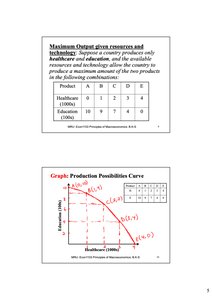
Graph: Production Possibilities Curve
The PPC is typically bowed outward, reflecting increasing opportunity costs. Moving along the curve from one point to another shows the trade-off between the two goods.
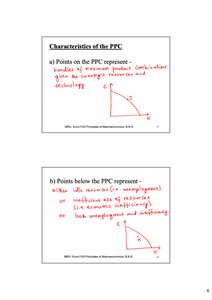
Characteristics of the PPC
Points on the PPC: Represent efficient production combinations using all resources and technology.
Points below the PPC: Indicate underutilization of resources (e.g., unemployment or inefficiency).
Points above the PPC: Are unattainable given current resources and technology.
Factors Shifting the PPC
Technological improvement
Increase in economic resources
Improvement in labour productivity (e.g., better education, infrastructure)
International trade and specialization
Economic growth
Fundamental Economic Problems Facing Every Economy
Every economy must address four fundamental questions:
What to produce? (resource allocation)
How to produce? (choice of technology)
How to keep resources fully employed?
How to keep productive capacity growing?
The economic system a country chooses determines how these questions are answered.
Economic Systems
Types of Economic Systems
Traditional Economics: Resource ownership and activity regulated by customs; little change or technology.
Command Economics: Centrally planned; state owns all resources and plans economic activity (e.g., North Korea).
Free-Market Economics: Resources privately owned; activity organized through market forces of demand and supply (Capitalism).
Main Characteristics of Traditional Economics
Resources owned collectively by community members
Activity regulated by customs
Economic activity is largely based on tradition and habit
Usually small rural communities, especially in developing countries
Main Characteristics of Planned Economics
State owns all economic resources
Economic activity is centrally planned
Coordination problems: Without price mechanism, difficult to gauge demand and supply
Lack of freedom reduces incentives for self-effort and productivity
Lack of competition results in poor quality goods and services
State ownership causes inefficiencies and stagnates standard of living
Main Characteristics of Market Economy (Capitalist Economy)
Economic resources are privately owned
Activity organized through market forces of demand and supply
Freedom of choice to pursue self-interest
Market incentives ensure efficient economic choices
Competition promotes business specialization and technological innovation
Efficient financial sector facilitates resource allocation
The Circular Flow of Income & Expenditures
Model Overview
The Circular Flow of Income and Expenditures model illustrates how financial markets improve resource allocation in market economies. The inner circle represents the flow of resources, goods, and services; the outer circle represents financial flows that drive the flow of goods and services.
Households own all resources
Businesses undertake all production
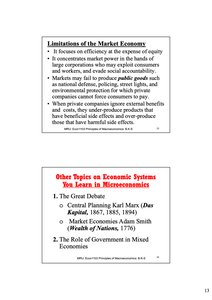
Limitations of the Market Economy
Focuses on efficiency at the expense of equity
Concentrates market power in the hands of large corporations
May fail to produce public goods (e.g., defense, policing, health, infrastructure)
Market economies often under-provide goods with social benefits and over-produce goods with harmful side effects
Other Topics on Economic Systems (Microeconomics)
The Great Debate: Central Planning (Karl Marx) vs. Market Economies (Adam Smith)
The Role of Government in Mixed Economies
Additional info: These notes cover Chapter 1: Economic Issues and Concepts, directly relevant to macroeconomics college courses.
