 Back
BackChapter 2: Measurement in Macroeconomics – GDP, Price Indices, and Labour Market
Study Guide - Smart Notes
 Tailored notes based on your materials, expanded with key definitions, examples, and context.
Measurement in Macroeconomics
Gross Domestic Product (GDP): National Income and Product Accounts (NIPA)
Gross Domestic Product (GDP) is a fundamental measure of economic activity, representing the total value of goods and services produced within a country during a specific period. The National Income and Product Accounts (NIPA) provide three main approaches to measuring GDP:
Product Approach: Calculates GDP by summing the value added at each stage of production across all industries.
Expenditure Approach: Measures GDP by summing all expenditures made on final goods and services.
Income Approach: Computes GDP by summing all incomes earned by factors of production, including wages, profits, and taxes less subsidies.
Example: In a fictional island economy, GDP can be measured by tracking the activities of a coconut producer, a restaurant, consumers, and the government, using each approach to ensure consistency.
National Income Accounting Example
National income accounting involves detailed tabulation of economic transactions. For instance, tables may show the output and income of a coconut producer, a restaurant, after-tax profits, government activities, and consumer expenditures. These tables help illustrate the calculation of GDP using the three approaches.
Product Approach: Sum of value added by each producer.
Expenditure Approach: Sum of consumption, investment, government spending, and net exports.
Income Approach: Sum of wages, rents, interest, and profits.
Problems in Measuring GDP
Several challenges arise when measuring GDP:
Underground Economy: Economic activity not reported to authorities, such as informal or illegal transactions, is difficult to measure directly. Indirect methods, like tracking currency usage, may be used.
Government Production: Many government services (e.g., defense) are not sold in markets, making their value hard to estimate.
Nominal and Real GDP and Price Indices
To distinguish between changes in output and changes in prices, economists use nominal and real GDP:
Nominal GDP: Measures the value of output using current prices.
Real GDP: Measures the value of output using constant prices from a base year, adjusting for inflation.
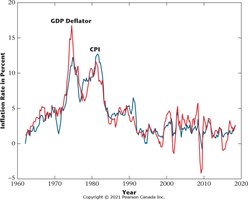
Price Index: A weighted average of prices used to measure the price level. Common indices include the Consumer Price Index (CPI) and the GDP deflator.
Inflation Rate: The rate of change in the price level, calculated using price indices.
Formula for Inflation Rate:
Price indices allow us to determine how much of GDP growth is due to increased production (real) versus increased prices (nominal).
Comparing Price Indices: CPI vs. GDP Deflator
The Consumer Price Index (CPI) and the GDP deflator are two major price indices used to measure inflation. While both track changes in the price level, they differ in coverage and calculation:
CPI: Measures the average change in prices paid by consumers for a fixed basket of goods and services.
GDP Deflator: Measures the change in prices of all domestically produced goods and services, reflecting the composition of GDP.
Example: The growth rate in real GDP is typically smaller than nominal GDP due to positive inflation. The two time series may cross when real GDP is measured in a new base year.
Table Purpose: Tables comparing CPI and GDP deflator illustrate differences in inflation measurement and highlight statistical discrepancies.
Problems in Measuring Real GDP and the Price Level
Several issues complicate the measurement of real GDP and the price level:
Changing Relative Prices: The prices of goods and services change at different rates, affecting index accuracy.
Quality Changes: Improvements or deteriorations in product quality are hard to quantify.
New and Obsolete Goods: Introduction of new products and removal of outdated ones challenge consistent measurement.
Savings, Wealth, and Capital
Savings and wealth are key concepts in macroeconomics, reflecting the accumulation of resources for future use:
Private Disposable Income: Income available to households after taxes and transfers.
Private Sector Saving: Portion of disposable income not spent on consumption.
Government Saving: Defined as negative government deficit; government saving = government revenue minus government expenditure.
National Saving: Sum of private and government saving.
National Savings Formula:
Investment and Current Account Surplus: National savings is reflected in investment (new capital stock) and the acquisition of claims on foreigners (current account surplus).
Labour Market Measurement
The labour market is measured using surveys that classify the working-age population into three groups:
Employed: Individuals currently working.
Unemployed: Individuals not working but actively seeking employment.
Not in the Labour Force: Individuals neither working nor seeking work.
Labour Force: The sum of employed and unemployed individuals.
Three Key Labour Market Measures: These measures provide insight into the health of the economy and the effectiveness of labour policies.
