 Back
BackChapter 5: The Measurement of National Income – Study Notes
Study Guide - Smart Notes
 Tailored notes based on your materials, expanded with key definitions, examples, and context.
Chapter 5: The Measurement of National Income
5.1 National Output and Value Added
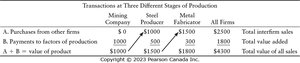
Understanding how national output is measured is fundamental to macroeconomics. Production occurs in stages, and to avoid errors in measurement, economists distinguish between intermediate and final goods.
Intermediate Goods: Goods used as inputs in the production of other goods.
Final Goods: Goods purchased by the end user, not used for further production.
Double Counting: The error that arises when the value of intermediate goods is counted multiple times in estimating national output.
Value Added: The increase in value that a firm contributes to a product, calculated as: Alternatively, value added equals payments owed to the firm’s factors of production.
The sum of all values added in an economy is a measure of the economy’s total output.
Example: The stages of production (mining, steel production, metal fabrication) each add value, and summing these values avoids double counting.
5.2 National Income Accounting: The Basics
National income accounting provides three main ways to measure the total output of an economy, all yielding the same value for Gross Domestic Product (GDP).
Value Added Method: Sum the value added at each stage of production.
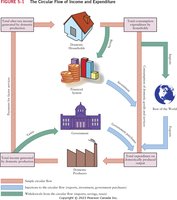
Expenditure Method: Sum the total flow of expenditure on final domestic output.
Income Method: Sum the total flow of income generated by domestic production.
All three methods yield GDP, the total value of goods and services produced in a given period.
Figure 5-1: The Circular Flow of Income and Expenditure
This diagram illustrates the flow of goods, services, and money between households, firms, government, and the rest of the world. It shows how income generated from production is spent on goods and services, and how these flows are interconnected.
GDP from the Expenditure Side
GDP can be calculated by summing expenditures on final goods and services produced within a country during a given year.
Consumption Expenditure (Ca): Household spending on goods and services.
Investment Expenditure (Ia): Spending on goods not for present consumption, including inventories, capital goods, and residential housing.
Net Investment:
Government Purchases (Ga): Expenditure on currently produced goods and services, excluding transfer payments.
Net Exports (NXa):
GDP Formula:
GDP from the Income Side
This method involves summing all incomes earned in the production of goods and services.
Factor Incomes: Wages and salaries, interest, and business profits.
Non-factor Payments: Indirect taxes (taxes on production and sale) and subsidies (payments from government to firms).
Depreciation: Portion of output used to replace worn-out capital.
Statistical Discrepancy: Adjustment to ensure income and expenditure measures of GDP match.
GDP (Income Side) Formula:
5.3 National Income Accounting: Some Further Issues
There are important distinctions and issues in national income accounting, including the difference between real and nominal GDP, the use of price indices, and the limitations of GDP as a measure of economic activity and living standards.
Real and Nominal GDP
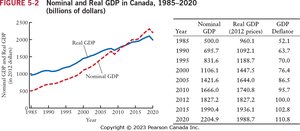
Nominal GDP: Total GDP valued at current prices.
Real GDP: GDP valued at base-period prices, reflecting the quantity of physical output.
GDP Deflator: An index number calculated as: Measures the average change in prices of all items in GDP.
Example: In 2012, nominal GDP equals real GDP (measured in 2012 prices), so the GDP deflator equals 100.
GDP Deflator versus the Consumer Price Index (CPI)
The GDP deflator and CPI measure different things.
CPI: Measures the change in the average price of consumer goods.
GDP Deflator: Measures the change in the average price of goods produced domestically.
Omissions from GDP
GDP does not capture all economic activity, such as illegal activities, the underground economy, home production, volunteering, leisure, free digital products, and economic "bads".
While GDP is a good measure of organized market activity, it omits significant non-market activities.
Do the Omissions Matter?
Correcting omissions is difficult and may distort policy-relevant figures.
Changes in GDP are a good indicator of changes in economic activity, even if the level is inaccurate.
Modified measures including non-market activities could lead to policy errors.
GDP and Living Standards
Changes in real per capita income are a good measure of average material living standards.
Material living standards are only part of overall well-being; GDP does not capture all aspects of quality of life.
Additional info: These notes expand on the brief points in the original slides, providing definitions, formulas, and context for each concept. The included images directly reinforce the explanations of value added, the circular flow, and the distinction between nominal and real GDP.
