Back
BackChapter 8: GDP – Measuring Total Production and Income
Study Guide - Smart Notes
 Tailored notes based on your materials, expanded with key definitions, examples, and context.
Gross Domestic Product: Measuring Total Production and Income
Introduction to Macroeconomics
Macroeconomics is the study of the economy as a whole, focusing on aggregate measures such as inflation, unemployment, and economic growth. Unlike microeconomics, which examines individual households and firms, macroeconomics analyzes the overall functioning and performance of an economy.
Key Macroeconomic Terms
Business cycle: Alternating periods of economic expansion and recession.
Expansion: A phase where total production and employment are increasing.
Recession: A phase where total production and employment are decreasing.
Economic growth: The ability of an economy to produce increasing quantities of goods and services over time.
Inflation rate: The percentage increase in the price level from one year to the next.
8.1 Gross Domestic Product Measures Total Production
Definition and Components of GDP
Gross Domestic Product (GDP) is the market value of all final goods and services produced within a country during a specific period, typically one year. GDP is the most widely used measure of overall economic activity.
Market Value: Goods and services are valued at their market prices to provide a common measurement unit.
Final Goods and Services: Only goods and services purchased by the final user are counted to avoid double counting. Intermediate goods are excluded.
Produced in a Country: Only production within a country's borders is included, regardless of the producer's nationality.
During a Period of Time: Only new goods and services produced within the specified period are counted. Used goods are excluded.
Production and Income Approaches
GDP can be measured by either the total value of production or the total income generated in the economy, as every dollar spent on goods and services becomes income for someone else.
The Circular Flow Model
The circular flow model illustrates the movement of money, goods, and services in an economy. It shows the interactions between households, firms, government, the rest of the world, and the financial system.
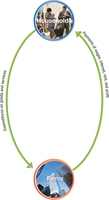
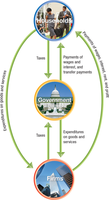
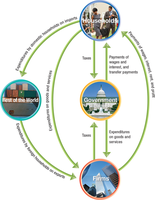
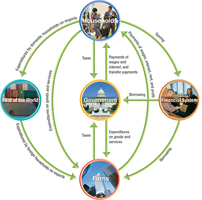
Expenditure Components of GDP
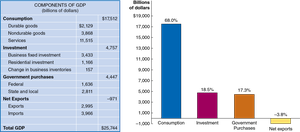
The Bureau of Economic Analysis (BEA) measures GDP using four major expenditure categories:
Consumption (C): Household spending on goods and services, excluding new housing.
Investment (I): Spending on new factories, buildings, machinery, inventories, and new housing.
Government Purchases (G): Government spending on goods and services, excluding transfer payments.
Net Exports (NX): Exports minus imports.
The GDP formula is:
Value Added Approach
GDP can also be measured by summing the value added at each stage of production. Value added is the market value a firm adds to a product, ensuring no double counting occurs.
8.2 Does GDP Measure What We Want It to Measure?
Shortcomings of GDP as a Measure of Total Production
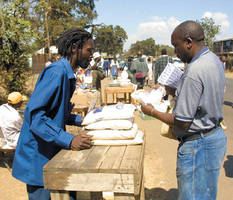
Household Production: Non-market activities such as childcare and cleaning are not included in GDP.
Underground Economy: Unreported or illegal economic activity is omitted. This is a small share in developed countries but can be over 50% in developing countries.
Shortcomings of GDP as a Measure of Well-Being
GDP per capita does not account for leisure, environmental quality, crime, social problems, or income distribution.
Improvements in well-being (e.g., lower crime) may reduce GDP but increase actual welfare.
8.3 Real GDP versus Nominal GDP
Distinguishing Real and Nominal GDP
Nominal GDP values output using current-year prices, while Real GDP values output using base-year prices. Real GDP allows for comparison of output across years by removing the effects of price changes.
Since 1996, the BEA uses chain-weighted prices to adjust for changing relative prices.
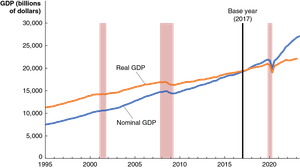
GDP Deflator
The GDP deflator is a measure of the price level, calculated as:
The GDP deflator is 100 in the base year. The percentage change in the GDP deflator measures the inflation rate.
Real GDP and Economic Shocks
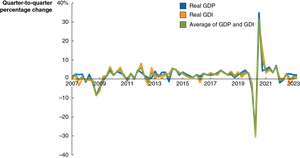
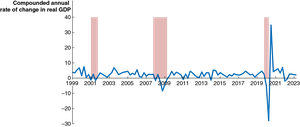
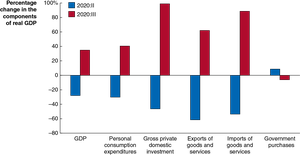
Large fluctuations in real GDP, such as those during the COVID-19 pandemic, can have significant impacts on employment and business activity.
8.4 Other Measures of Total Production and Total Income
Alternative National Income Measures
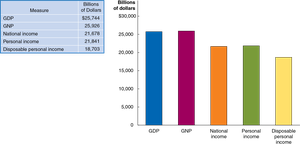
Gross National Product (GNP): Production by a nation's citizens, including overseas production.
National Income: GDP minus depreciation (consumption of fixed capital).
Personal Income: Income received by households, including transfer payments and excluding retained earnings.
Disposable Personal Income: Personal income minus personal taxes; the amount households can spend or save.
Division of Income
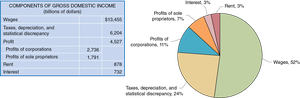
All production generates income, which is distributed as wages, profits, rent, and interest. In practice, statistical discrepancies arise due to data limitations.
GDP versus GDI
Gross Domestic Income (GDI) measures output from the income side. While GDP and GDI usually move together, they can diverge in the short run, providing different perspectives on economic conditions.