 Back
BackChapter 9: The Government and Fiscal Policy – Principles of Macroeconomics Study Notes
Study Guide - Smart Notes
 Tailored notes based on your materials, expanded with key definitions, examples, and context.
Government in the Economy
Fiscal and Monetary Policy
Macroeconomic policy is primarily conducted through two main instruments: fiscal policy and monetary policy. Fiscal policy refers to the government's decisions regarding spending and taxation, while monetary policy involves the management of the nation's money supply by the central bank (e.g., the Federal Reserve in the U.S.).
Fiscal policy: Government's use of spending and taxation to influence the economy.
Monetary policy: Central bank actions that determine the size and rate of growth of the money supply.
Discretionary fiscal policy: Deliberate changes in government spending or taxes to achieve macroeconomic goals.
Taxes and government spending often adjust in response to economic conditions, either automatically or through policy decisions.
Government in the Circular Flow
The government plays a crucial role in the circular flow of income, interacting with households and firms through taxation, spending, and transfer payments. The inclusion of government modifies the basic circular flow model by adding government purchases (G), net taxes (T), and disposable income (Yd).
Net taxes (T): Taxes paid by firms and households minus transfer payments received.
Disposable income (Yd): Total income minus net taxes:
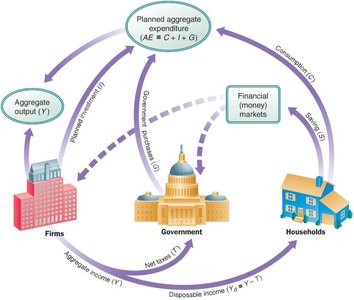
Government Purchases, Net Taxes, and Disposable Income
Key Relationships and Formulas
Disposable income:
Budget deficit: The difference between government spending and tax revenue:
If , the government runs a surplus.
The aggregate expenditure (AE) model with government is:
Equilibrium output:
Consumption Function with Taxes
When taxes are included, the consumption function depends on disposable income:
or
Here, a is autonomous consumption, and b is the marginal propensity to consume (MPC).
Planned Investment and Government Policy
The government can influence investment through tax policies, such as depreciation allowances. Planned investment also depends on the interest rate.
Equilibrium Output and Income Determination
Aggregate Expenditure and Equilibrium
Equilibrium in the goods market occurs when aggregate output (income) equals planned aggregate expenditure:
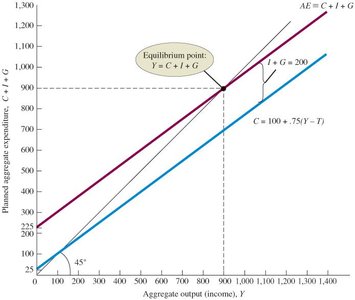
In the graphical model, the equilibrium point is where the AE line crosses the 45-degree line, indicating that planned spending equals actual output.
Saving/Investment Approach
Another way to view equilibrium is through the saving/investment approach:
This equation shows that the sum of private saving and net taxes must equal the sum of investment and government spending in equilibrium.
Fiscal Policy at Work: Multiplier Effects
Fiscal Multipliers
Fiscal policy affects the economy through multiplier effects. The three main multipliers are:
Government spending multiplier: or
Tax multiplier:
Balanced-budget multiplier: Always equals 1
Where MPC is the marginal propensity to consume and MPS is the marginal propensity to save ().
Government Spending Multiplier
An increase in government spending shifts the AE curve upward, leading to a multiplied increase in equilibrium output.
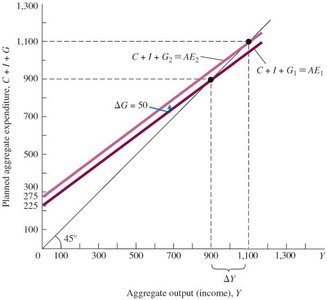
For example, if government spending increases by $50, and the MPC is 0.75, the equilibrium output increases by $200.
Tax Multiplier
The tax multiplier measures the effect of a change in taxes on equilibrium output:
A tax cut increases disposable income, leading to higher consumption and output, but the effect is smaller than an equivalent change in government spending.
Balanced-Budget Multiplier
If government spending and taxes increase by the same amount, the equilibrium output increases by exactly that amount. The balanced-budget multiplier is always 1.
The Federal Budget
Federal Budget Structure
The federal budget is a statement of the government's receipts and expenditures. Fiscal policy operates through changes in the budget.
Federal surplus (+) or deficit (−): Receipts minus expenditures.
Federal debt: The total amount owed by the federal government.
Privately held federal debt: Portion of the debt held by non-government entities.
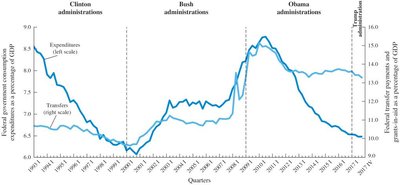
Recent Trends in U.S. Fiscal Policy
Federal tax and spending patterns have varied across different administrations, affecting the overall fiscal stance of the government.
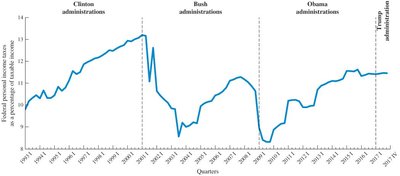
The Economy’s Influence on the Government Budget
Automatic Stabilizers and Destabilizers
Some budget items automatically change with the economy, helping to stabilize or destabilize GDP:
Automatic stabilizers: Items that reduce fluctuations in GDP (e.g., progressive taxes, unemployment benefits).
Automatic destabilizers: Items that amplify economic fluctuations.
Fiscal drag: The negative effect when rising incomes push taxpayers into higher brackets, increasing average tax rates.
Full-Employment Budget and Deficits
Full-employment budget: The hypothetical budget if the economy were at full employment.
Structural deficit: The deficit that remains even at full employment.
Cyclical deficit: The deficit caused by a downturn in the business cycle.
Appendix: Fiscal Policy Multipliers with Income-Dependent Taxes
Deriving the Multipliers
When taxes depend on income, the size of the multiplier is reduced. The general formula for equilibrium output becomes:
(for lump-sum taxes)
With income-dependent taxes: , where
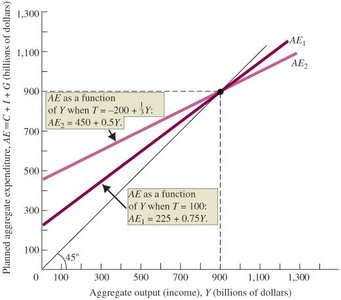
The multiplier is smaller when taxes rise with income, as some of the increase in income is offset by higher taxes.
Key Terms and Concepts
Automatic stabilizers
Balanced-budget multiplier
Budget deficit
Cyclical deficit
Discretionary fiscal policy
Disposable income (Yd)
Federal budget
Federal debt
Fiscal drag
Fiscal policy
Full-employment budget
Government spending multiplier
Monetary policy
Net taxes (T)
Privately held federal debt
Structural deficit
Tax multiplier
Summary Table: Fiscal Policy Multipliers
Policy Stimulus | Multiplier | Final Impact on Equilibrium Y |
|---|---|---|
Government spending multiplier (ΔG) | 1 ÷ MPS | ΔG × (1 ÷ MPS) |
Tax multiplier (ΔT) | −MPC ÷ MPS | ΔT × (−MPC ÷ MPS) |
Balanced-budget multiplier (ΔG = ΔT) | 1 | ΔG |
