 Back
BackComparative Advantage and the Gains from International Trade
Study Guide - Smart Notes
 Tailored notes based on your materials, expanded with key definitions, examples, and context.
Comparative Advantage and the Gains from International Trade
9.1 The United States in the International Economy
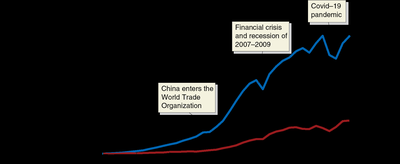
International trade has become increasingly important to the U.S. and global economies over the past 50 years. Advances in shipping, transportation, and communication, along with policy changes, have facilitated the growth of trade. Traditionally, countries imposed high tariffs on imports, but this often led to reciprocal taxes on exports, reducing overall gains from trade.
Tariff: A tax imposed by a government on imports.
Imports: Goods and services bought domestically but produced in other countries.
Exports: Goods and services produced domestically but sold in other countries.
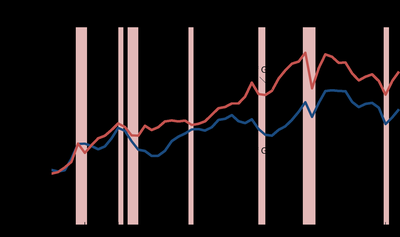
Key Point: The share of imports and exports in U.S. GDP has grown, especially since the 1970s, though it declined during the Great Recession and has stabilized since.
9.2 Comparative Advantage in International Trade
Comparative advantage is central to understanding why countries trade. It refers to the ability of an individual, firm, or country to produce a good or service at a lower opportunity cost than competitors. This is distinct from absolute advantage, which is the ability to produce more of a good or service with the same resources.
Comparative Advantage: Ability to produce at a lower opportunity cost.
Absolute Advantage: Ability to produce more output with the same resources.
Opportunity Cost: The highest-valued alternative that must be given up to engage in an activity.
Example: The United States has an absolute advantage in producing both smartphones and wheat compared to China, but each country has a comparative advantage in one good due to differing opportunity costs.
Output per Hour (Smartphones) | Output per Hour (Wheat, bushels) | |
|---|---|---|
China | 4 | 2 |
United States | 6 | 12 |
Opportunity costs:
Opportunity Cost (Smartphones) | Opportunity Cost (Wheat) | |
|---|---|---|
China | 0.5 bushel of wheat | 2 smartphones |
United States | 2 bushels of wheat | 0.5 smartphone |
9.3 How Countries Gain from International Trade
Countries gain from trade by specializing in the production of goods for which they have a comparative advantage and trading for goods in which they do not. This specialization increases total world production and allows both countries to consume more than they could in isolation (autarky).
Autarky: A situation in which a country does not trade with other countries.
Terms of Trade: The ratio at which a country can trade its exports for imports from other countries.
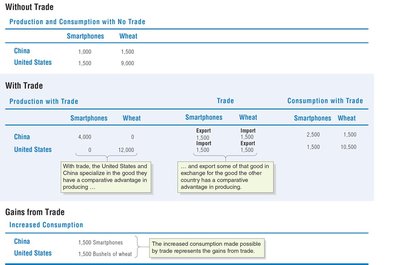
Key Point: With trade, both countries can consume more of both goods than they could without trade, representing the gains from trade.
Why Not Complete Specialization? In reality, not all goods can be traded, increasing opportunity costs limit specialization, and consumer preferences differ across countries.
Winners and Losers: While trade increases national welfare, some groups (e.g., workers in industries facing import competition) may lose and seek protectionist policies.
9.4 Government Policies That Restrict International Trade
Governments often restrict trade to protect domestic industries through tariffs, quotas, and voluntary export restraints (VERs). These policies benefit domestic producers but reduce overall economic welfare by raising prices for consumers and creating deadweight losses.
Tariff: Tax on imports.
Quota: Numerical limit on imports.
Voluntary Export Restraint (VER): Negotiated limit on exports from one country to another.
Deadweight Loss: The reduction in economic surplus resulting from a market distortion such as a tariff or quota.
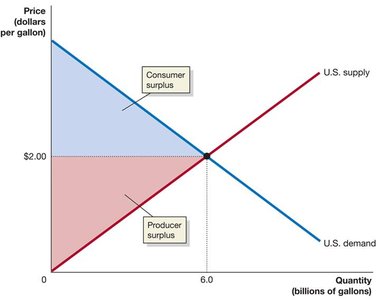
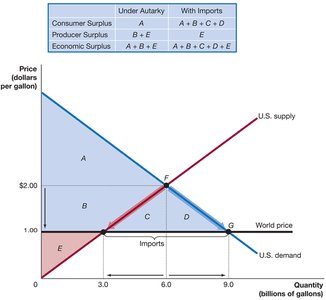
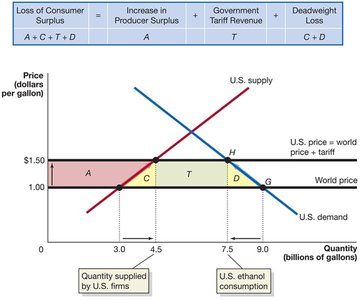
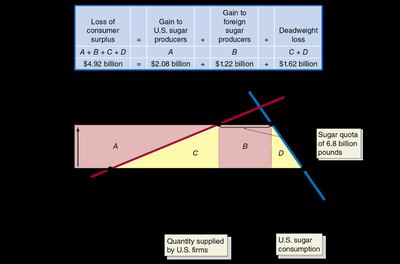
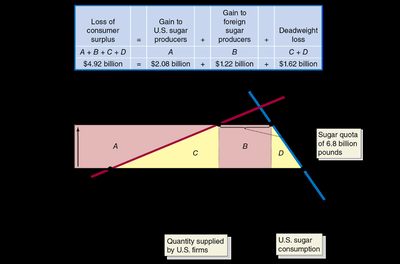
Example: The U.S. sugar quota raises the price of sugar, benefiting domestic producers but costing consumers billions of dollars and creating deadweight loss.
9.5 The Debate over Trade Policies and Globalization
Trade policies and globalization are subjects of ongoing debate. Economists generally support free trade due to its overall benefits, but concerns remain about job losses, wage impacts, and cultural changes. Trade agreements like GATT and the WTO have aimed to reduce barriers and resolve disputes.
World Trade Organization (WTO): International organization overseeing trade agreements and dispute resolution.
Globalization: The process of countries becoming more open to foreign trade and investment.
Protectionism: Use of trade barriers to shield domestic firms from foreign competition.
Arguments for Protectionism:
Saving jobs and protecting high wages
Protecting infant industries
National security concerns
Modern Issues: Recent debates include the use of tariffs for environmental reasons (e.g., carbon border adjustment mechanisms) and the challenge of "dumping" (selling goods below cost).

Political Economy: The costs of trade restrictions are spread across many consumers, while the benefits are concentrated among a few producers, making it politically difficult to remove such restrictions.
Policy Recommendation: Economists suggest that the winners from trade should compensate the losers, for example, through retraining programs and tax credits for skill development.
Summary Table: Effects of Trade Policies
Policy | Winners | Losers | Economic Effect |
|---|---|---|---|
Free Trade | Consumers, efficient producers | Inefficient domestic producers | Increases total surplus |
Tariffs | Protected domestic producers, government (tariff revenue) | Consumers | Creates deadweight loss |
Quotas/VERs | Protected domestic producers, foreign producers with quota rights | Consumers | Creates deadweight loss |
Key Formulas
Opportunity Cost (of Good X):
Economic Surplus:
Deadweight Loss (from Tariff/Quota):
