 Back
BackComprehensive Study Notes: Money, Banking, and Monetary Policy in Macroeconomics
Study Guide - Smart Notes
 Tailored notes based on your materials, expanded with key definitions, examples, and context.
Money, Banking, and the Federal Reserve System
Definition and Functions of Money
Money is any asset that people are willing to accept in exchange for goods and services or for payment of debts. It plays a crucial role in facilitating economic transactions and supporting the functioning of the economy.
Medium of Exchange: Money is widely accepted in exchange for goods and services.
Unit of Account: Money provides a common measure for valuing goods and services.
Store of Value: Money allows individuals to transfer purchasing power from the present to the future.
Standard of Deferred Payment: Money is used to settle debts payable in the future.
Commodity Money: Has value independent of its use as money (e.g., gold, silver).
Fiat Money: Has value because the government declares it as legal tender (e.g., U.S. dollar).
Measuring Money: M1 and M2
The money supply is measured using two main aggregates:
M1: Currency in circulation, checking account deposits, and traveler’s checks.
M2: Includes M1 plus savings deposits, small-denomination time deposits, and non-institutional money market fund shares.
The Banking System
Types of Banks and Their Roles
Commercial Banks: Accept deposits and make loans to individuals and businesses.
Central Bank (Federal Reserve): Regulates the banking system and controls the money supply.
Bank Balance Sheets and Money Creation
Banks use a balance sheet to show their assets (reserves, loans, securities) and liabilities (deposits, borrowings, equity). The process of money creation involves banks making loans from excess reserves, which increases the money supply.
Required Reserves: The minimum fraction of deposits banks must hold as reserves, set by the Federal Reserve.
Excess Reserves: Reserves held by banks above the required minimum.
Simple Deposit Multiplier: The maximum amount the money supply can increase based on an increase in reserves. The formula is:
$ \text{Simple Deposit Multiplier} = \frac{1}{\text{Required Reserve Ratio}} $
The Federal Reserve System
Structure and Functions
The Federal Reserve (the Fed) is the central bank of the United States. It was established in 1913 to provide the nation with a safer, more flexible, and more stable monetary and financial system.
Board of Governors: Seven members appointed by the President, confirmed by the Senate.
Federal Open Market Committee (FOMC): Main policy-making body, sets target for the federal funds rate.
12 Regional Federal Reserve Banks: Serve as the operating arms of the central bank.
Tools of Monetary Policy
The Fed uses several tools to influence the money supply and interest rates:
Open Market Operations: Buying and selling government securities to influence reserves and the federal funds rate.
Discount Policy: Changing the interest rate charged to banks for borrowing from the Fed.
Reserve Requirements: Changing the required reserve ratio for banks.
Monetary Policy and Aggregate Demand
The Money Market and Interest Rates
The money market shows the relationship between the quantity of money demanded and the interest rate. The equilibrium interest rate is determined where money demand equals money supply.
Money Demand: Downward sloping; as interest rates fall, the quantity of money demanded increases.
Money Supply: Set by the Fed; represented as a vertical line.
Transmission Mechanism of Monetary Policy
Monetary policy affects the economy primarily through its impact on interest rates, which in turn influence aggregate demand (AD).
Lower interest rates increase investment and consumption, shifting AD to the right.
Higher interest rates decrease investment and consumption, shifting AD to the left.
Aggregate Demand and Aggregate Supply Analysis
Short-Run and Long-Run Aggregate Supply
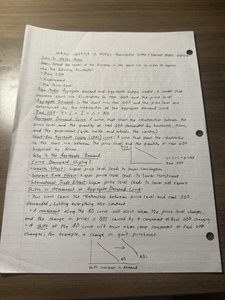
The aggregate demand (AD) curve shows the relationship between the price level and the quantity of real GDP demanded. The short-run aggregate supply (SRAS) curve shows the relationship between the price level and the quantity of real GDP supplied in the short run.
AD Curve: Downward sloping due to wealth effect, interest rate effect, and international trade effect.
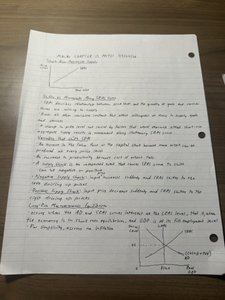
SRAS Curve: Upward sloping because some input prices are sticky in the short run.
LRAS Curve: Vertical at the potential level of output (full employment GDP).
Monetary Policy in the AD-AS Model
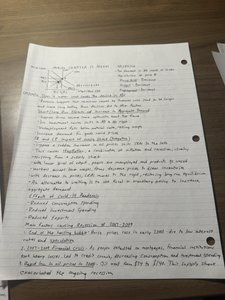
Expansionary monetary policy shifts the AD curve to the right, increasing output and price level in the short run. Contractionary monetary policy shifts the AD curve to the left, decreasing output and price level.
Recent Economic Events and Policy Responses
The Great Recession (2007-2009)
The financial crisis of 2007-2009 was triggered by a collapse in the housing market, leading to a severe recession. The Federal Reserve responded with aggressive monetary policy, including lowering the federal funds rate and engaging in unconventional policies such as quantitative easing.
Quantitative Easing: Large-scale purchases of financial assets to inject liquidity into the economy.
Zero Lower Bound: Situation where the federal funds rate is at or near zero, limiting the effectiveness of traditional monetary policy.
Summary Table: Tools of Monetary Policy
Tool | Description | Effect on Money Supply |
|---|---|---|
Open Market Operations | Buying/selling government securities | Increase (buying), Decrease (selling) |
Discount Policy | Changing discount rate for banks | Lower rate increases, higher rate decreases |
Reserve Requirements | Changing required reserve ratio | Lower ratio increases, higher ratio decreases |
Key Equations
Simple Deposit Multiplier:
$ \text{Simple Deposit Multiplier} = \frac{1}{\text{Required Reserve Ratio}} $
Money Supply (M1):
$ M1 = \text{Currency in Circulation} + \text{Checking Account Deposits} + \text{Traveler's Checks} $
Money Supply (M2):
$ M2 = M1 + \text{Savings Deposits} + \text{Small Time Deposits} + \text{Money Market Funds} $
Conclusion
Understanding money, banking, and monetary policy is essential for analyzing macroeconomic fluctuations and the role of government intervention in stabilizing the economy. The Federal Reserve’s actions influence interest rates, aggregate demand, and ultimately, economic growth and stability.
