 Back
BackCore Macroeconomic Concepts: GDP, Unemployment, Inflation, Goods and Money Markets
Study Guide - Smart Notes
 Tailored notes based on your materials, expanded with key definitions, examples, and context.
Measuring National Output and Income
Gross Domestic Product (GDP)
Gross Domestic Product (GDP) is the total market value of all final goods and services produced within a country in a given period. It is a central measure of economic activity and can be calculated using three main approaches:
Value-Added Approach: Sums the value added at each stage of production across all productive units. Value added is the difference between a firm's sales and the value of its intermediate inputs.
Expenditure Approach: Calculates GDP as the total spending on final goods and services. The formula is , where C is consumption, I is investment, G is government spending, and NX is net exports.
Income Approach: Sums all incomes earned by factors of production, including wages, profits, interest, and taxes less subsidies. The formula is .
Note: Government services not sold at market prices are valued at their cost of production.
Nominal vs. Real GDP
Nominal GDP: Measures output using current prices. It can increase due to higher production or higher prices (inflation).
Real GDP: Measures output using constant prices from a base year, isolating changes in production from changes in prices.
Base Year Effects: The choice of base year affects real GDP calculations if relative prices change over time.
Chain-Weighted GDP: Uses a geometric average of growth rates calculated with different base years, providing a more accurate measure of real GDP growth over time.
Unemployment and Inflation
Unemployment Rate and Participation Rate
The labor market is characterized by employment (N), unemployment (U), and the labor force (L = N + U).
Unemployment Rate: , where U is the number of unemployed and L is the labor force.
Participation Rate:
Discouraged Workers: Individuals not working and not looking for work are not counted in the labor force.
Inflation Rate and Price Indices
Inflation: A sustained rise in the general price level. The inflation rate is the percentage change in the price level over time.
Deflation: A sustained decline in the price level (negative inflation rate).
Price Index: A weighted average of prices used to measure the price level and calculate inflation.
Common Indices:
GDP Deflator: Measures prices of all goods produced domestically. Set to 100 in the base year.
Consumer Price Index (CPI): Measures prices of goods consumed by households.
Personal Consumption Expenditures Price Index (PCEPI): Another measure of consumer prices.
Differences: CPI can rise faster than the GDP deflator if import prices (e.g., oil) increase.
Goods Market
Aggregate Expenditure and Equilibrium
The goods market focuses on the relationship between aggregate expenditure and output. In the U.S., consumption is the largest component of GDP.
Expenditure Approach: (in a closed economy, )
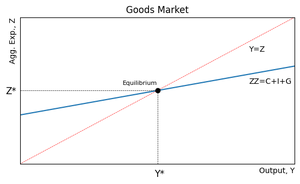
Aggregate Expenditure (Z):
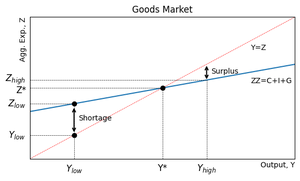
Equilibrium Condition: (output equals aggregate expenditure)
Disequilibrium:
If , there is excess supply (inventories accumulate, firms reduce output).
If , there is excess expenditure (inventories deplete, firms increase output).
Consumption Function
Aggregate consumption depends on disposable income:
Consumption Function:
= income, = net tax revenue, = marginal propensity to consume (MPC), = autonomous consumption
MPC (): Fraction of additional disposable income that is consumed.
Autonomous Consumption (): Consumption independent of current income (e.g., financed by savings or borrowing).
The Multiplier Effect
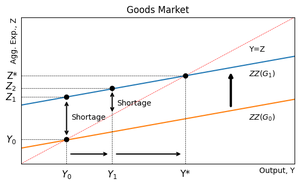
An exogenous increase in expenditure (e.g., government spending) leads to a multiplied increase in equilibrium output:
Multiplier Formula:
Each round of increased income leads to further consumption, but by a smaller amount each time (geometric series).
Example: If c_1 = 0.25\Delta Y = \frac{1}{0.75} \times 1 = 1.33T$
Other Multipliers
Investment Multiplier:
Tax Multiplier:
Goods Market Graphs and Shifts
Changes in exogenous variables (e.g., government spending) shift the aggregate expenditure curve (ZZ), leading to new equilibrium output levels.
Savings and Investment
Private Saving:
Public Saving:
National Saving:
Equilibrium: (in a closed economy)
The Money Market
Functions and Types of Money
Money serves as a medium of exchange, store of value, and unit of account. Households allocate their portfolios between money (liquid, no return) and bonds (less liquid, positive return).
Bond Pricing and Interest Rates
Bond Price Formula: or
Bond prices and yields are inversely related: higher bond prices mean lower yields, and vice versa.
Money Demand
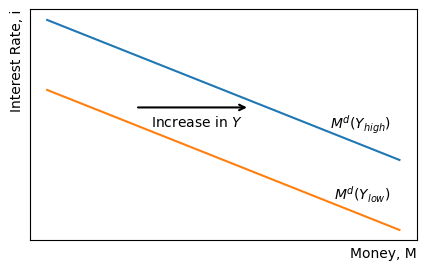
Money demand () is negatively related to the interest rate (opportunity cost of holding money) and positively related to income.
When income rises, the money demand curve shifts right.
Money Supply and Central Banking
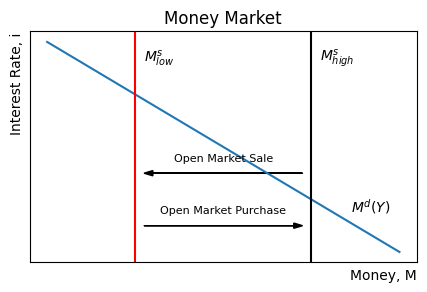
The central bank controls the money supply, primarily through open market operations (buying or selling government bonds).
Expansionary Policy: Buying bonds increases the money supply.
Contractionary Policy: Selling bonds decreases the money supply.
Modern central banks target the interest rate, adjusting the money supply as needed to maintain the target.
Money Market Equilibrium
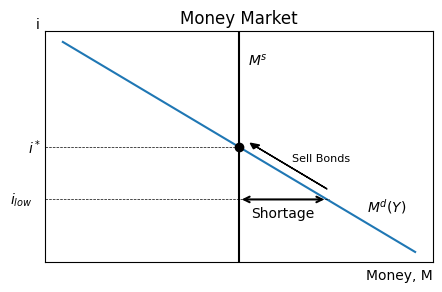
Equilibrium occurs where money demand equals money supply at the prevailing interest rate.
If the interest rate is below equilibrium, there is excess demand for money; people sell bonds, bond prices fall, and the interest rate rises.
Monetary Policy and Income Changes
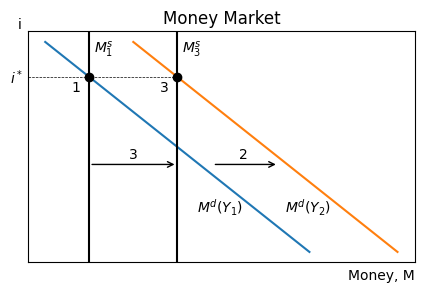
If income increases, money demand rises. To maintain the target interest rate, the central bank increases the money supply.
This is achieved through open market purchases of bonds.
Additional info: These notes synthesize and expand upon the provided material, including definitions, formulas, and graphical analysis, to provide a comprehensive study guide for core macroeconomic concepts.
