 Back
BackEconomic Growth and Income Disparity: Malthus, Solow, and Endogenous Growth
Study Guide - Smart Notes
 Tailored notes based on your materials, expanded with key definitions, examples, and context.
Economic Growth: Malthus and Solow Models
Introduction to Economic Growth
Economic growth refers to the sustained increase in a country's output and standard of living over time. Understanding the mechanisms behind growth helps explain why some countries converge to higher income levels while others lag behind.
Standard of Living: Measured by income, output, and access to public goods and services.
Convergence: The process by which developing countries catch up to developed countries in terms of income and living standards.
Key Factors: Capital accumulation, technology, population growth, and policy.
Malthusian Model
The Malthusian model emphasizes the role of population growth and natural resources in determining output.
Production Function: , where is output, is labor, and is capital.
Population Growth: Increases in population can strain resources, limiting per capita output.
Returns to Scale: The model assumes constant returns to scale in production.
Solow Growth Model
The Solow model introduces capital accumulation and technological progress as drivers of economic growth.
Production Function: , where represents technology.
Capital Accumulation: Investment in new capital increases output, but capital depreciates over time.
Steady State: The economy reaches a steady state when capital per worker () and output per worker remain constant.
Key Equations:
Golden Rule Quantity of Capital: The level of capital per worker that maximizes consumption per worker in the steady state.
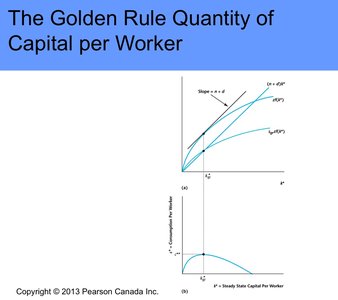
Explanation: The graph illustrates the relationship between capital per worker and consumption per worker. The Golden Rule level () is where the slope of the production function equals the sum of population growth and depreciation (), maximizing steady-state consumption.
Marginal Product of Capital (MPK)
The marginal product of capital measures the additional output generated by an extra unit of capital.
Formula:
Diminishing Returns: As capital increases, MPK decreases, leading to lower incremental gains in output.
Steady State Condition: (where is population growth rate, is depreciation rate)
Dynamic Inefficiency
Dynamic inefficiency occurs when excessive capital accumulation reduces consumption, violating the Golden Rule.
Goal: Maximize consumption () and welfare.
Investment: Needs to adjust over time to compensate for capital depreciation and changes in labor force.
Income Disparity Among Countries and Endogenous Growth
Introduction to Income Disparity
Income disparity refers to differences in income levels across countries, often resulting from variations in education, technology, and resource allocation.
Key Factors: Education, human capital, technology, and policy.
Endogenous Growth: Growth driven by internal factors such as innovation and human capital accumulation.
Human Capital and Education
Human capital, defined as the skills and knowledge acquired through education and experience, plays a crucial role in economic growth.
Non-rivalrous: Education does not diminish with use; multiple individuals can benefit simultaneously.
Returns to Education: Investment in education increases productivity and output.
Human Capital Accumulation: , where is human capital, is time spent learning, is time spent working, and is efficiency.
Production Function: , refined to include human capital contributions.
Income Inequality: Causes and Effects
Income inequality arises from differences in resource availability, education, and technology adoption.
Causes: Barriers to technology adoption, limited access to education, and investment constraints.
Effects: Lower demand for goods and services, limited savings, reduced welfare, and constrained investment.
Policy Remedies: Taxation, government transfers, and policies to encourage education and investment.
Convergence and Barriers
Convergence is the process by which poorer countries catch up to richer ones, but barriers such as lack of skilled labor and limited capital accumulation can prevent this.
Solow Model Implication: Countries with similar savings rates, population growth, and technology should converge, but real-world barriers often impede this process.
Policy Role: Effective policies can help overcome barriers and promote convergence.
Summary Table: Key Concepts in Economic Growth
Concept | Definition | Key Equation | Implication |
|---|---|---|---|
Malthusian Model | Growth limited by population and resources | Constant returns to scale | |
Solow Model | Growth driven by capital and technology | Steady state, convergence | |
Golden Rule | Maximizes consumption per worker | Optimal capital per worker | |
Human Capital | Skills and knowledge from education | Endogenous growth | |
Income Inequality | Differences in income levels | N/A | Lower welfare, limited growth |
Additional info: Some formulas and context were inferred from standard macroeconomics textbooks to clarify fragmented notes and ensure completeness.
