 Back
BackExchange Rate and the Balance of Payments: Study Notes for Macroeconomics
Study Guide - Smart Notes
 Tailored notes based on your materials, expanded with key definitions, examples, and context.
The Foreign Exchange Market
Introduction to Foreign Exchange
The foreign exchange market is a central component of international economics, enabling the exchange of one country's currency for another. This market is essential for international trade and investment, as it allows individuals and businesses to buy goods, services, and assets from other countries. - Foreign currency includes bank notes, coins, and deposits denominated in another country's money. - Foreign exchange rate is the price at which one currency is exchanged for another. - Currency depreciation occurs when the value of a currency falls relative to another. - Currency appreciation occurs when the value of a currency rises relative to another.
An Exchange Rate Is a Price
Exchange rates are determined in the foreign exchange market, which operates as a competitive market with many traders and no restrictions. - The exchange rate is the price of one currency in terms of another. - The Canadian dollar is both demanded and supplied by traders globally.
The Demand for One Money Is the Supply of Another
The demand for Canadian dollars is linked to the supply of other currencies, and vice versa. - When people exchange their currency for Canadian dollars, they supply their own currency and demand Canadian dollars. - Factors influencing demand for Canadian dollars also affect the supply of other currencies.
Demand in the Foreign Exchange Market
Demand for Canadian dollars arises from the need to buy Canadian goods, services, and assets. - The quantity of Canadian dollars demanded depends on the exchange rate and other factors.
The Law of Demand for Foreign Exchange
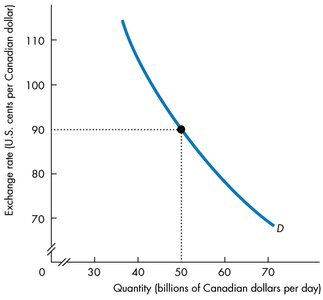
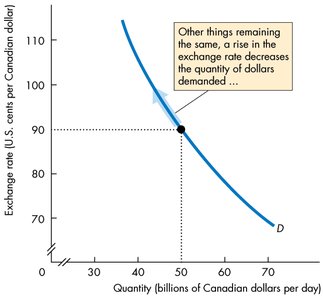
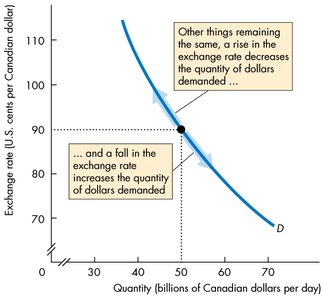
The demand for dollars is a derived demand. - Law of Demand: As the exchange rate rises, the quantity of Canadian dollars demanded decreases, other things being equal.
Exports Effect
- As the value of Canadian exports increases, the demand for Canadian dollars increases. - Lower exchange rates make Canadian exports more attractive, increasing demand for Canadian dollars.
Expected Profit Effect
- If traders expect the Canadian dollar to appreciate, they demand more Canadian dollars now. - Lower current exchange rates increase expected profit from holding Canadian dollars, boosting demand.
The Demand Curve for Canadian Dollars
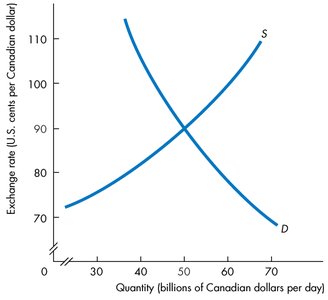
The demand curve shows the relationship between the exchange rate and the quantity of Canadian dollars demanded. 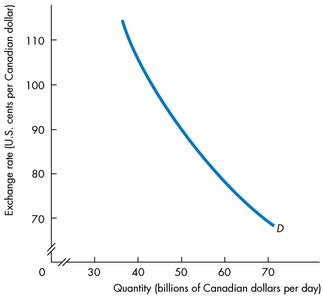
Supply in the Foreign Exchange Market
Supply of Canadian Dollars
The supply of Canadian dollars is the amount traders plan to sell at a given exchange rate. - The main factor influencing supply is the exchange rate.
The Law of Supply of Foreign Exchange
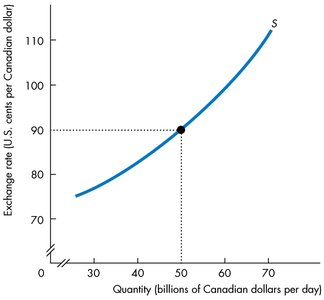
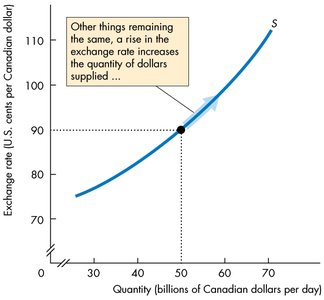
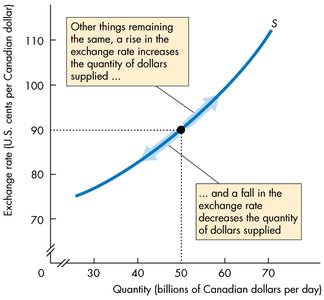
- As the exchange rate rises, the quantity of Canadian dollars supplied increases, other things being equal.
Imports Effect
- Higher Canadian imports increase the supply of Canadian dollars in the foreign exchange market. - Higher exchange rates make imports more attractive, increasing supply.
Expected Profit Effect
- If the expected future exchange rate is higher, traders are less likely to supply Canadian dollars now. - Lower current exchange rates reduce supply, as traders wait for better rates.
Supply Curve for Canadian Dollars
The supply curve shows the relationship between the exchange rate and the quantity of Canadian dollars supplied. 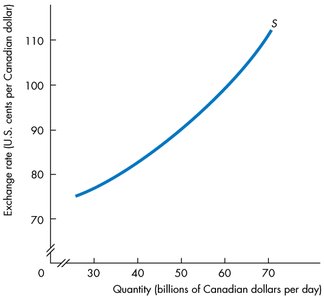
Market Equilibrium
Determining the Exchange Rate
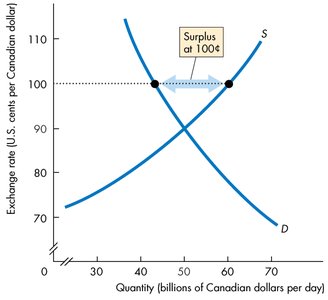
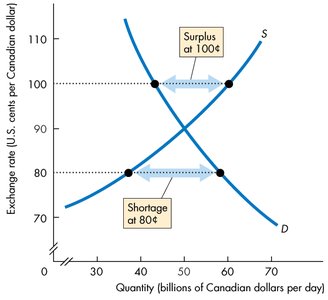
The equilibrium exchange rate is determined where the demand and supply curves intersect. - If the exchange rate is too high, a surplus of Canadian dollars drives it down. - If the exchange rate is too low, a shortage drives it up. - The market quickly moves to equilibrium, where there is neither a shortage nor a surplus. 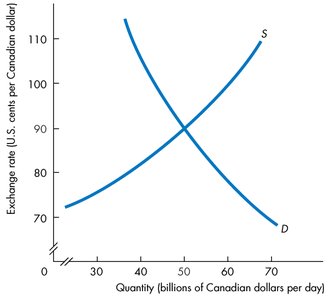
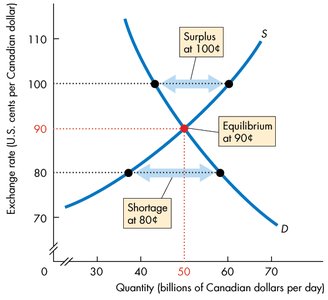
Exchange Rate Fluctuations
Changes in Demand for Canadian Dollars
Demand for Canadian dollars can shift due to: - World demand for Canadian exports - Canadian interest rate relative to foreign interest rates - Expected future exchange rate
World Demand for Canadian Exports
- Increased world demand for Canadian exports raises demand for Canadian dollars.
Interest Rate Differential
- Interest rate differential = Canadian interest rate - foreign interest rate. - Higher Canadian interest rates relative to foreign rates increase demand for Canadian dollars.
Expected Future Exchange Rate
- If the expected future exchange rate rises, demand for Canadian dollars increases today.
Shifts in the Demand Curve
Changes in these factors shift the demand curve for Canadian dollars. 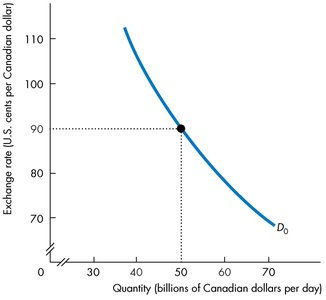
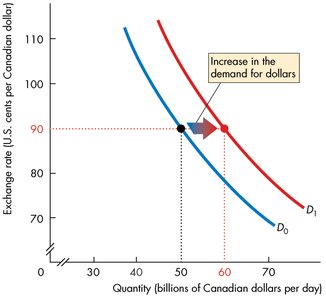
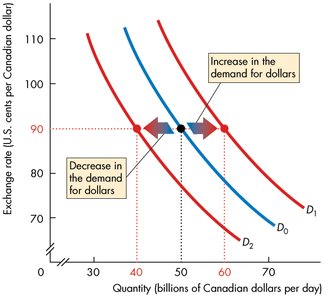
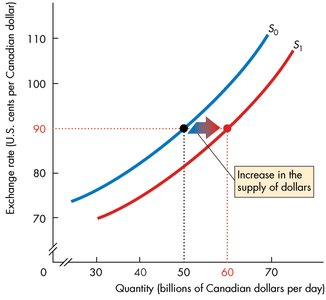
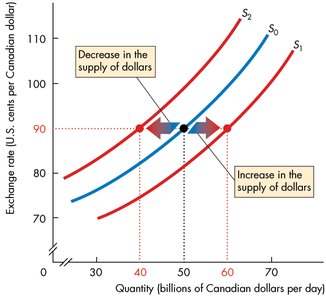
Changes in Supply of Canadian Dollars
Supply can shift due to: - Canadian demand for imports - Canadian interest rates relative to foreign rates - Expected future exchange rate
Canadian Demand for Imports
- Increased demand for imports raises the supply of Canadian dollars.
Interest Rate Differential
- Higher Canadian interest rates relative to foreign rates decrease the supply of Canadian dollars.
Expected Future Exchange Rate
- If the expected future exchange rate rises, supply of Canadian dollars decreases today.
Shifts in the Supply Curve
Changes in these factors shift the supply curve for Canadian dollars. 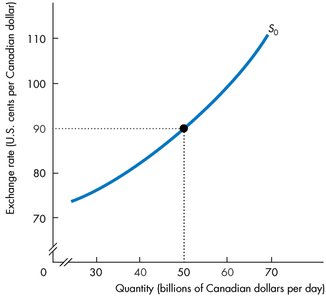
Changes in the Exchange Rate
- If demand increases and supply does not change, the exchange rate rises. - If demand decreases and supply does not change, the exchange rate falls. - If supply increases and demand does not change, the exchange rate falls. - If supply decreases and demand does not change, the exchange rate rises.
Arbitrage, Speculation, and Market Fundamentals
Arbitrage
Arbitrage is the practice of profiting from price differences in different markets. In the foreign exchange market, arbitrage ensures: - The law of one price - No round-trip profit - Interest rate parity - Purchasing power parity
The Law of One Price
- If an item can be traded in more than one place, its price will be the same everywhere.
No Round-Trip Profit
- Arbitrage eliminates profit from buying and selling currencies in a loop.
Interest Rate Parity
- A currency's value is determined by its interest rate and expected appreciation. - When returns on two currencies are equal, interest rate parity prevails. Where: = Canadian interest rate, = expected rate of appreciation, = foreign interest rate.
Purchasing Power Parity (PPP)
- PPP occurs when two currencies can buy the same quantity of goods and services. - PPP means equal value of money across countries.
The Expected Future Exchange Rate
- Exchange rate forecasts are uncertain and influence the actual exchange rate. - Expectations can cause short-run volatility in exchange rates.
Exchange Rate Volatility
- Exchange rates fluctuate as news and expectations change. - While short-term changes are unpredictable, long-term trends depend on market fundamentals.
Exchange Rate Policy
Types of Exchange Rate Policies
Governments and central banks can adopt different exchange rate policies: - Flexible exchange rate - Fixed exchange rate - Crawling peg
Flexible Exchange Rate
- The exchange rate is determined by market forces without central bank intervention.
Fixed Exchange Rate
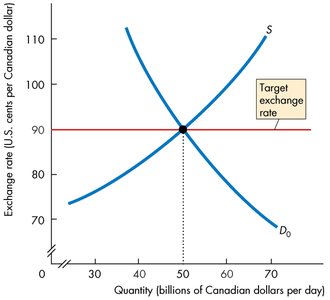
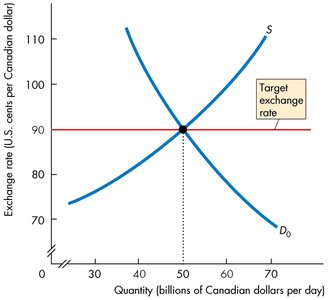
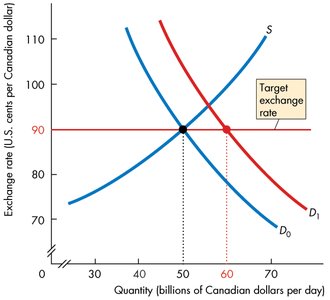
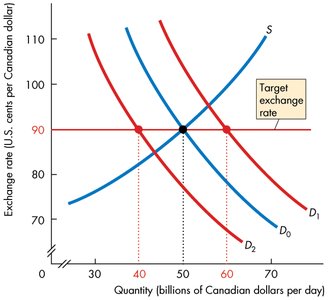
- The exchange rate is pegged at a target value by the government or central bank. - Achieved through direct intervention in the foreign exchange market.
Central Bank Intervention
The Bank of Canada can intervene to maintain a target exchange rate. - If demand for Canadian dollars increases, the Bank sells Canadian dollars to increase supply. 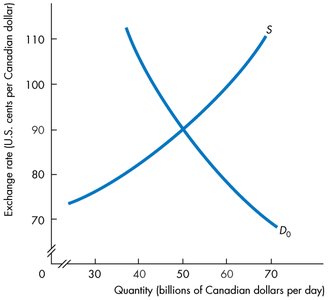
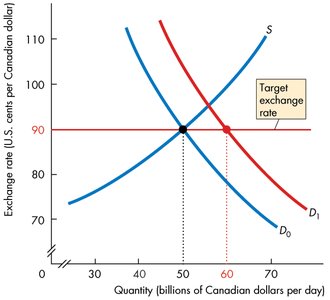 - If demand decreases, the Bank buys Canadian dollars to decrease supply. - Persistent intervention is unsustainable.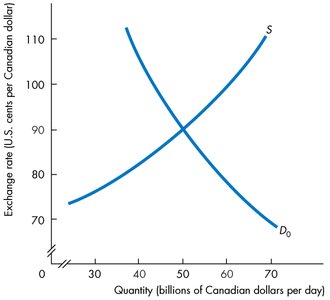
Crawling Peg
- A crawling peg is an exchange rate policy where the target value changes over time, determined by the government or central bank. - Active intervention is used to maintain the target, which is adjusted periodically. - The crawling peg aims to avoid large swings in the exchange rate and prevent depletion of reserves.
Summary Table: Exchange Rate Policies
Policy | Description | Intervention | Example |
|---|---|---|---|
Flexible Exchange Rate | Determined by market forces | No intervention | Most developed countries |
Fixed Exchange Rate | Pegged at a target value | Active intervention | Hong Kong |
Crawling Peg | Target value changes over time | Active intervention | China |
Key Terms and Concepts
Foreign exchange market: Market for exchanging currencies.
Exchange rate: Price of one currency in terms of another.
Currency appreciation/depreciation: Increase/decrease in value of a currency.
Law of demand/supply: Relationship between exchange rate and quantity demanded/supplied.
Interest rate parity: Equal returns on currencies when exchange rate changes are considered.
Purchasing power parity: Equal value of money across countries.
Flexible, fixed, crawling peg: Types of exchange rate policies.
Example Application
International Trade and Exchange Rate
When Canadian businesses export goods, foreign buyers must purchase Canadian dollars, increasing demand and potentially appreciating the currency. Conversely, when Canadians import goods, they supply Canadian dollars to buy foreign currency, increasing supply and potentially depreciating the currency.  Additional info: The image illustrates the role of international trade in the foreign exchange market, as goods are shipped across borders and currency exchanges facilitate these transactions.
