 Back
BackExchange Rates and the Foreign Exchange Market: An Asset Approach
Study Guide - Smart Notes
 Tailored notes based on your materials, expanded with key definitions, examples, and context.
Exchange Rates and the Foreign Exchange Market
Definitions and Quotation of Exchange Rates
Exchange rates are fundamental to international economics, allowing the comparison of prices and costs across countries. They are quoted as either foreign currency per unit of domestic currency or domestic currency per unit of foreign currency.
Exchange Rate: The price at which one currency can be exchanged for another.
Quotation Methods: For example, USD/JPY means how many yen can be exchanged for one dollar.
Application: Exchange rates enable the pricing of goods and services in a common currency, facilitating international trade.
Example: If a Nissan costs ¥2,500,000, the equivalent price in dollars depends on the current exchange rate.
Exchange Rate Tables and Interpretation
Exchange rate tables report mid-market rates for multiple currencies, showing the units of local currency per unit of base currency (e.g., USD, EUR, GBP). The 'Closing Mid' is the midpoint between bid and ask prices at market close, and 'Day’s Change' shows the daily change in the quote.
Interpretation: If 'local currency per USD' rises, the local currency depreciates against the USD; if it falls, it appreciates.
Example: If 1 USD = 1.3327 CAD today (up from yesterday), the Canadian dollar has depreciated against the USD.
Standard Currency Codes
International markets use three-letter codes to identify currencies (e.g., USD for US dollar, EUR for euro, JPY for Japanese yen).
Purpose: Standardization facilitates global trading and reporting.
Cross-Rate Calculations
Cross-rates allow calculation of exchange rates between two currencies using their rates with a third currency. For example, to find the CAD/EUR rate, multiply CAD/USD by USD/EUR.
Formula:
Example: If CAD/USD = 1.3020 and USD/EUR = 1.1701, then CAD/EUR = 1.5235.
Depreciation and Appreciation of Currencies
Depreciation
Depreciation is a decrease in the value of a currency relative to another currency.
Effect: The depreciated currency buys fewer units of foreign currency.
Example: If $1/€ increases to $1.20/€, the dollar has depreciated against the euro.
Impact: Imports become more expensive, exports become cheaper.
Appreciation
Appreciation is an increase in the value of a currency relative to another currency.
Effect: The appreciated currency buys more units of foreign currency.
Example: If $1/€ decreases to $0.90/€, the dollar has appreciated against the euro.
Impact: Imports become cheaper, exports become more expensive.
Relative Price Effects
Depreciation: Raises the price of imports, lowers the price of exports.
Appreciation: Lowers the price of imports, raises the price of exports.
Exchange Rate and Relative Prices Table
Table 14.2 shows how changes in the $/£ exchange rate affect the relative price of American jeans and British sweaters.
Example: As $/£ increases, the relative price (pairs of jeans per sweater) rises.
Real Exchange Rate
Definition and Calculation
The real exchange rate adjusts the nominal exchange rate for differences in price levels between countries, reflecting the relative purchasing power.
Formula:
Example: For GBP/EUR,
Change in Real Exchange Rate
Movements in nominal exchange rates and price levels affect the real exchange rate and thus the real purchasing power.
Formula:
Example: If GBP/EUR rises by 10%, Eurozone price level rises by 5%, UK price level rises by 2%, real exchange rate increases by about 13%.
Foreign Exchange Markets
Structure and Participants
The FX market is where currencies and related assets are traded. It is dominated by commercial banks, financial institutions, businesses, central banks, governments, and retail accounts.
Market Size: Daily turnover exceeds US$9.6 trillion (BIS, 2025).
Instruments: FX swaps (~42%), spot (~31%), forwards (~19%), options (~7%).
Participants: Commercial banks, non-bank financial institutions, businesses, central banks, governments, sovereign wealth funds, leveraged and retail accounts.
Market Integration and Arbitrage
Technological advances have integrated FX markets globally, eliminating significant differences in exchange rates across locations. Arbitrage opportunities are quickly exploited.
Arbitrage: Buying currency where it is cheaper and selling where it is more expensive for profit.
Spot Rates and Forward Rates
Definitions
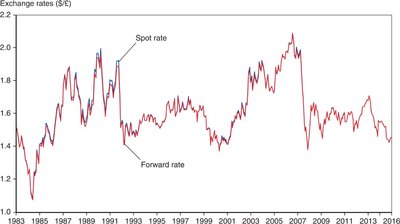
Spot rates are for immediate currency exchanges, while forward rates are for exchanges at a future date, typically 30, 90, 180, or 360 days ahead.
Negotiation: Forward rates are agreed upon today for future exchanges.
Forward Points and Rate Calculation
Forward points are added to the spot rate to obtain the forward rate. For most currencies, divide points by 10,000 and add to the spot rate.
Formula:
Example: Spot rate = 1.15885, 3-month forward points = 80.9, Forward rate = 1.16694.
Other Methods of Currency Exchange
Swaps, Futures, and Options
Foreign Exchange Swaps: Combine a spot sale with a forward repurchase.
Futures Contracts: Standardized contracts for currency delivery on a set date.
Options Contracts: Give the right, but not obligation, to buy/sell currency by a set date.
The Demand for Currency Deposits
Determinants of Demand
The demand for currency deposits is influenced by the expected rate of return, risk, and liquidity. In FX markets, risk and liquidity are assumed similar across currencies, so rate of return is primary.
Rate of Return: Percentage change in asset value over time.
Real Rate of Return: Adjusted for inflation.
Interest Rate: The main determinant for deposit returns.
Expected Appreciation/Depreciation: Also affects returns.
Comparing Returns on Domestic and Foreign Deposits
To compare returns, consider the interest rate and expected currency appreciation/depreciation.
Formula: /\euro} - E_{\/\euro}}$
Example: If dollar deposit rate is 2%, euro deposit rate is 4%, and expected exchange rate changes, calculate expected returns accordingly.
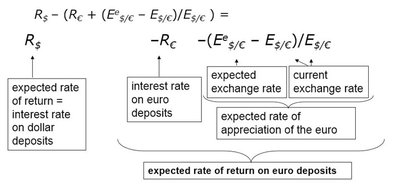
Table: Dollar/Euro Exchange Rate and Expected Returns
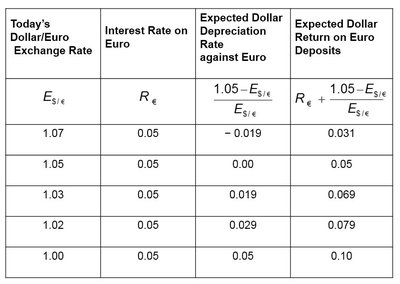
This table compares today's dollar/euro exchange rate, euro interest rate, expected dollar depreciation rate, and expected dollar return on euro deposits.
Today's Dollar/Euro Exchange Rate | Interest Rate on Euro | Expected Dollar Depreciation Rate against Euro | Expected Dollar Return on Euro Deposits |
|---|---|---|---|
1.07 | 0.05 | -0.019 | 0.031 |
1.05 | 0.05 | 0 | 0.05 |
1.03 | 0.05 | 0.019 | 0.069 |
1.02 | 0.05 | 0.029 | 0.079 |
1.00 | 0.05 | 0.05 | 0.10 |
Model of Foreign Exchange Markets
Interest Parity and Equilibrium
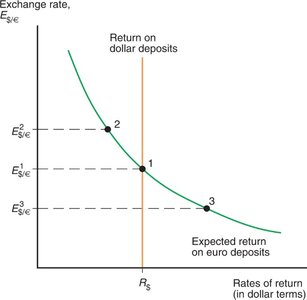
The foreign exchange market is in equilibrium when deposits in all currencies offer the same expected rate of return. This is known as interest parity.
Interest Parity Condition: } = R_{\text{euro}} + \frac{E^e_{\/\euro}}{E_{\
Implication: No arbitrage opportunities exist; assets are equally desirable.
Graphical Representation
Equilibrium occurs where the expected dollar returns on dollar and euro deposits are equal.
Effects of Changing Interest Rates
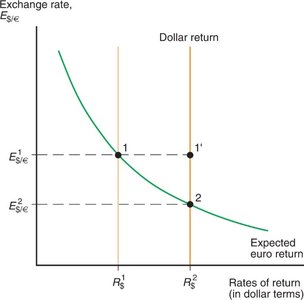
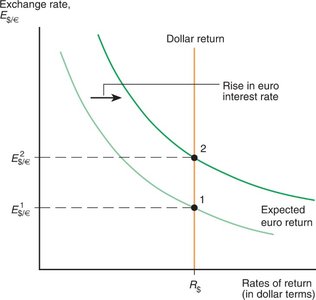
Changes in interest rates affect currency values:
Increase in Dollar Interest Rate: Dollar appreciates.
Increase in Euro Interest Rate: Dollar depreciates.
Expectations and Currency Movements
Expectations of future appreciation or depreciation can lead to actual currency movements, often becoming self-fulfilling prophecies.
Carry Trades and FX Risk
Yen-Funded Carry Trades
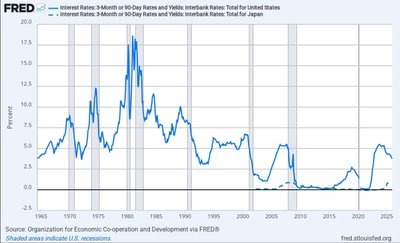
Carry trades exploit interest rate differentials, often borrowing in low-yield currencies (like JPY) and investing in higher-yield currencies. These trades are exposed to sharp reversals during risk-off episodes.
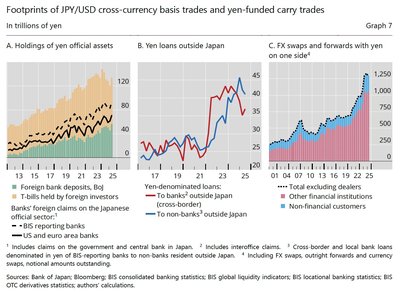
Crash Risk: The main risk is abrupt unwinding when global risk sentiment changes.
Covered Interest Parity and Forward Rates
Covered Interest Parity
Covered interest parity relates interest rates across countries and the rate of change between forward and spot exchange rates.
Formula: } = R_{\text{euro}} + \frac{F_{\/\euro}}{E_{\
Implication: Rates of return on dollar deposits and "covered" foreign currency deposits are equal.
Forward Rate Calculation
Formula:
Application: The currency with the higher interest rate trades at a discount in the forward market.
Example: For a 30-day term, if domestic rate is 2%, foreign rate is 3%, spot rate is 1.6555, then .
Forward Discounts and Premiums
Formula:
Interpretation: Forward rates are at a premium or discount depending on interest rate differentials.
