 Back
BackExchange Rates, Foreign Exchange Markets, and International Trade: Study Notes
Study Guide - Smart Notes
 Tailored notes based on your materials, expanded with key definitions, examples, and context.
Currencies and Exchange Rates
Foreign Exchange Market and the Exchange Rate
The foreign exchange market is where the currency of one country is exchanged for the currency of another. The foreign exchange rate is the price at which one currency exchanges for another. This rate can be expressed as the number of units of foreign currency per one US dollar.
Currency appreciation: An increase in the value of one currency relative to another.
Currency depreciation: A decrease in the value of one currency relative to another.
Nominal and Real Exchange Rates
The nominal exchange rate is the value of the US dollar in terms of foreign currency per US dollar. The real exchange rate measures the relative price of foreign-produced goods and services to domestic goods and services, adjusting for price levels.
Formula:
= Nominal exchange rate (units of foreign currency per US dollar)
= US price level
= Foreign country price level
Supply and Demand in the Foreign Exchange Market
Demand for US Dollars
The demand for US dollars in the foreign exchange market is determined by:
The exchange rate
World demand for US exports
Interest rates in the US and other countries
The expected future exchange rate
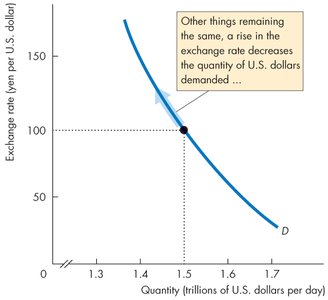
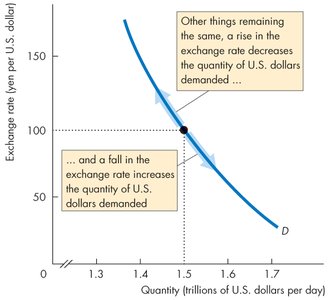
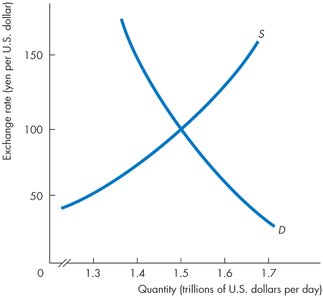
The law of demand for foreign exchange states that, all else equal, a higher exchange rate decreases the quantity of US dollars demanded, while a lower exchange rate increases it. This is due to the exports effect (lower exchange rates make US goods cheaper abroad) and the expected profit effect (lower exchange rates today increase expected profits from holding US dollars).
Shifts in the Demand for US Dollars
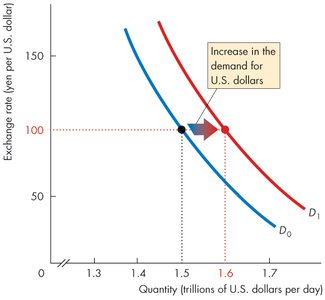
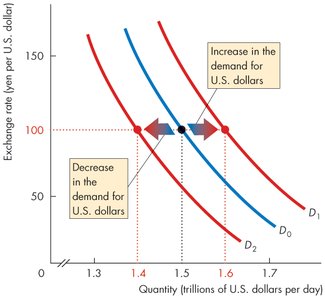
The demand curve for US dollars shifts due to changes in:
World demand for US exports
US interest rate differential
Expected future exchange rates
Supply of US Dollars
The supply of US dollars in the foreign exchange market is the amount traders plan to sell at a given exchange rate. It depends on:
The exchange rate
US demand for imports
Interest rates in the US and other countries
The expected future exchange rate
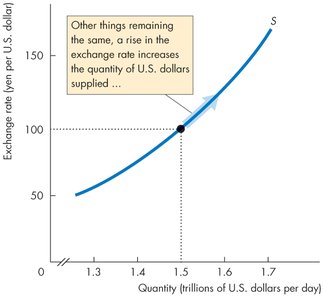
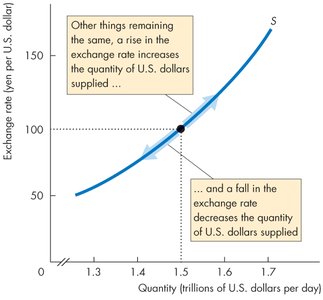
The law of supply of foreign exchange states that, all else equal, a higher exchange rate increases the quantity of US dollars supplied, while a lower exchange rate decreases it. This is due to the imports effect (higher exchange rates make foreign goods cheaper for US buyers) and the expected profit effect (lower exchange rates reduce the incentive to supply dollars).
Shifts in the Supply of US Dollars
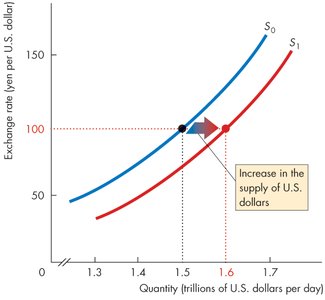
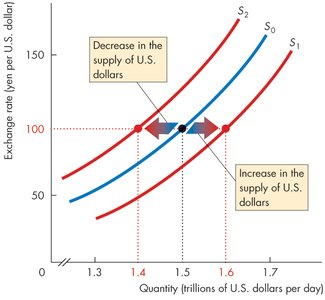
The supply curve for US dollars shifts due to changes in:
US demand for imports
US interest rate differential
Expected future exchange rates
Market Equilibrium and Exchange Rate Fluctuations
Market Equilibrium
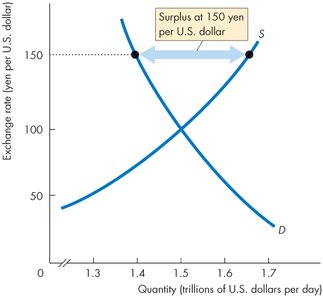
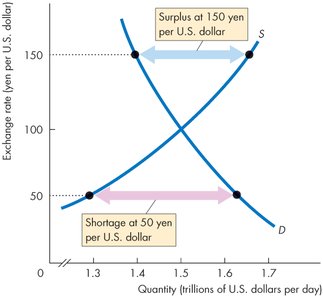
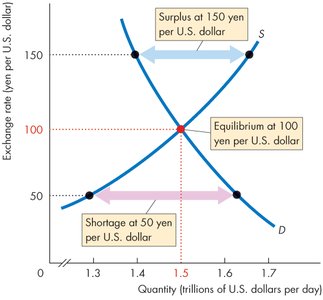
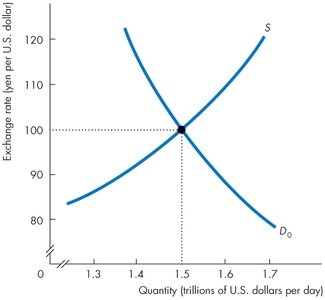
The equilibrium exchange rate is the rate at which the quantity of US dollars supplied equals the quantity demanded. At this rate, the foreign exchange market clears, and there is neither a surplus nor a shortage of US dollars.
Changes in the Exchange Rate
If demand for US dollars increases (supply unchanged), the exchange rate rises.
If demand decreases (supply unchanged), the exchange rate falls.
If supply increases (demand unchanged), the exchange rate falls.
If supply decreases (demand unchanged), the exchange rate rises.
Arbitrage, Speculation, and Exchange Rate Policies
Arbitrage and Speculation
Arbitrage: Buying in one market and selling in another for profit, enforcing the law of one price, interest rate parity, and purchasing power parity.
Speculation: Trading based on expectations of future exchange rate movements, causing exchange rates to respond quickly to new information.
Interest rate parity occurs when returns on two currencies are equal after accounting for expected exchange rate changes. Purchasing power parity occurs when equivalent amounts of different currencies buy the same quantity of goods and services.
Exchange Rate Policies
Governments and central banks can adopt different exchange rate policies:
Flexible exchange rate: Determined by market forces without central bank intervention.
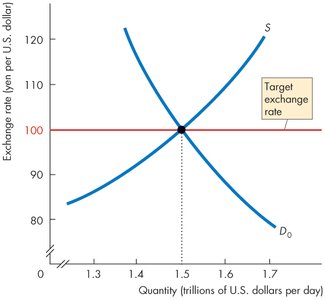
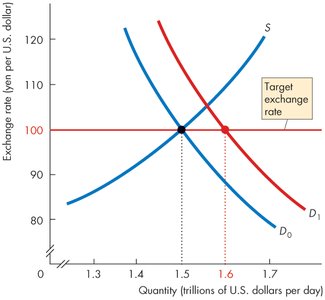
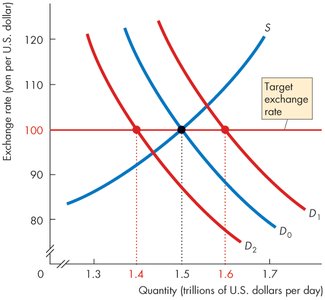
Fixed exchange rate: Pegged at a target value by central bank intervention.
Crawling peg: Target value is adjusted periodically, with intervention to maintain the path.
Financing International Trade
Balance of Payments Accounts
A country's balance of payments records all international transactions. It consists of three main accounts:
Current account: Records exports, imports, net interest income, and transfers.
Capital and financial account: Records foreign investment in the country minus domestic investment abroad.
Official settlements account: Records changes in official reserves.
Current account balance formula:
Net exports (NX) formula:
= Net taxes
= Government expenditure
= Saving
= Investment
International Borrowing and Lending
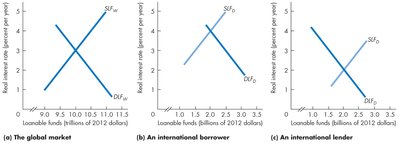
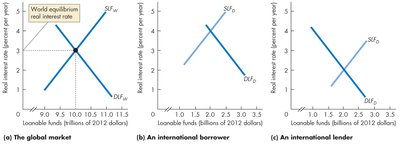
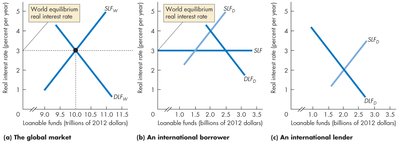
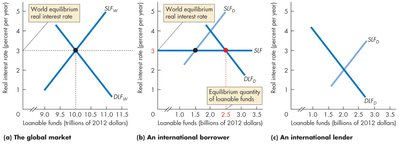
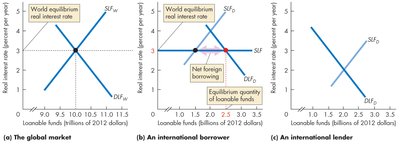
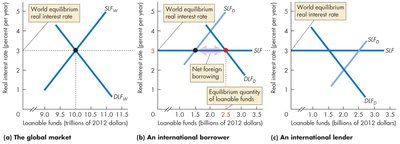
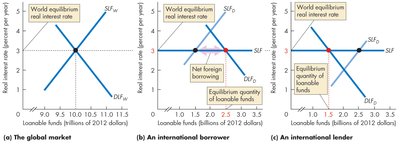
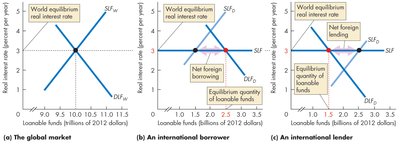
If a country's net exports are negative, it is a net borrower; if positive, it is a net lender. The world equilibrium real interest rate balances global supply and demand for loanable funds.
Borrowers, Lenders, Debtors, and Creditors
Net borrower: Borrows more from the rest of the world than it lends.
Net lender: Lends more to the rest of the world than it borrows.
Debtor nation: Has borrowed more over its history than it has lent.
Creditor nation: Has invested more abroad than others have invested in it.
Official Settlements Account
The official settlements account records changes in a country's official reserves. An increase in reserves makes the account negative. The sum of the balances of the current account, capital and financial account, and official settlements account always equals zero.
