 Back
BackFirms, the Stock Market, and Corporate Governance: Study Notes for Macroeconomics
Study Guide - Smart Notes
 Tailored notes based on your materials, expanded with key definitions, examples, and context.
Firms, the Stock Market, and Corporate Governance
Introduction
Firms play a central role in organizing the factors of production to produce goods and services in a market economy. Understanding the structure, funding, and governance of firms is essential for analyzing macroeconomic activity and the functioning of financial markets.
Three Main Categories of Firms
Sole Proprietorship
A sole proprietorship is a firm owned by a single individual who makes all important decisions and is responsible for day-to-day activities. The owner has unlimited liability, meaning personal assets can be used to pay business debts.
Business assets include inventories, equipment, real property, and computer infrastructure.
Unlimited liability exposes the owner to financial risk beyond the business investment.
Example: If a bakery fails and debts exceed business assets, the owner must pay remaining debts from personal savings or assets.



Partnership
A partnership is a firm owned jointly by two or more persons. Most partnerships feature unlimited liability for each partner, meaning all partners are responsible for business debts.
Common examples: law firms, medical practices, accounting firms, real estate companies.
Partners share decision-making and financial risk.

Corporation
A corporation is a legal form of business that provides owners with limited liability, protecting them from losing more than their investment if the business fails. Corporations make it easier to raise funds and are the dominant form for large firms.
Owners (shareholders) are not personally liable for corporate debts.
Corporations facilitate raising capital through stock and bond issuance.
Examples: Amazon, Microsoft.


Business Assets vs. Personal Assets
Business assets are owned by the firm and used in operations, while personal assets belong to the individual owner(s). In sole proprietorships and partnerships, personal assets may be at risk due to unlimited liability.


Comparison of Business Organizations
Differences Among Sole Proprietorships, Partnerships, and Corporations
Business organizations differ in ownership structure, liability, and ability to raise funds. Corporations, though fewer in number, account for most economic activity due to their size and access to capital.
Type | Ownership | Liability | Fundraising Ability |
|---|---|---|---|
Sole Proprietorship | Single owner | Unlimited | Limited |
Partnership | Two or more owners | Unlimited (usually) | Moderate |
Corporation | Shareholders | Limited | High |
Corporate Governance and the Principal–Agent Problem
Structure of Corporations
Corporations feature a separation of ownership (shareholders) from control (top management). Corporate governance refers to the structure and policies that influence corporate behavior.
Owners are typically not involved in day-to-day decisions.
Top management (CEO, CFO, etc.) runs operations.


Principal–Agent Problem
The principal–agent problem arises when agents (managers) pursue their own interests rather than those of principals (shareholders). This conflict can reduce firm efficiency and profitability.
Occurs due to difficulty in monitoring managers' actions.
Can also apply to managers and employees.
Resolution: Boards often tie managers' compensation to firm profits or stock price to align interests.
How Firms Raise Funds
Methods for Raising Funds
Firms need funds to operate and expand. Small business owners typically use three methods:
Retained earnings: Reinvesting profits in the firm.
Recruit additional owners: Increasing financial capital by adding partners or shareholders.
Borrowing: Obtaining loans from financial institutions or individuals.
Sources of External Funds
As firms grow, they increasingly rely on external funds, facilitated by the financial system. External funds are raised through:
Indirect finance: Funds flow from savers to borrowers via financial intermediaries (banks, credit unions).
Direct finance: Firms borrow directly from lenders in financial markets by selling securities (bonds, stocks).

Direct Finance: Debt and Equity
Direct finance involves issuing debt instruments (bonds) or equity securities (stocks).
Bonds: Contractual agreements to pay fixed amounts (coupon payments) until maturity.
Stocks: Represent ownership claims; shareholders receive dividends and have voting rights.


Bonds: Features and Interest Rates
Bonds vary by maturity (short-term, intermediate-term, long-term). The interest rate depends on default risk and expected inflation.
Coupon rate: Annual interest payment divided by face value.
Default risk: Higher risk requires higher interest rates.
Expected inflation: Higher inflation expectations increase interest rates.
Stocks vs. Bonds
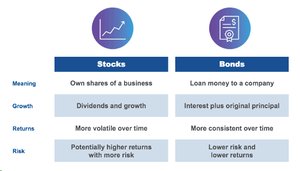
Stocks and bonds are the main types of securities issued by firms. They differ in ownership, risk, and returns.
Feature | Stocks | Bonds |
|---|---|---|
Ownership | Shares of business | Loan to company |
Growth | Dividends and growth | Interest plus principal |
Returns | More volatile | More consistent |
Risk | Higher risk, higher returns | Lower risk, lower returns |
Using Financial Statements to Evaluate a Corporation
Financial Statements
Corporations must disclose financial information to investors and regulators. The main financial statements are:
Income statement: Shows revenues, costs, and accounting profit over a period.
Balance sheet: Summarizes assets and liabilities at a specific point in time; net worth is assets minus liabilities.
Disclosure reduces information costs and increases investor confidence.
Explicit vs. Implicit Costs
Firms incur both explicit and implicit costs. Explicit costs are direct payments (taxes, rent, wages), while implicit costs represent opportunity costs (e.g., foregone returns on invested capital).
Explicit costs: Out-of-pocket expenses.
Implicit costs: Opportunity costs of resources used.
Economic vs. Accounting Profit
Accounting profit is total revenue minus explicit costs. Economic profit is total revenue minus both explicit and implicit costs.
Formula for Economic Profit:
Formula for Accounting Profit:
Regulation and Financial System Confidence
Regulations such as the Sarbanes-Oxley Act and Dodd-Frank Act require accurate financial reporting and oversight to protect investors and maintain stability in the financial system.
Sarbanes-Oxley Act: CEOs must certify financial statements; analysts disclose conflicts of interest.
Dodd-Frank Act: Reforms financial regulation; creates oversight councils and consumer protection bureaus.
