Back
BackFiscal Policy: Concepts, Effects, and Limitations in Macroeconomics
Study Guide - Smart Notes
 Tailored notes based on your materials, expanded with key definitions, examples, and context.
Fiscal Policy: Concepts and Applications
What Is Fiscal Policy?
Fiscal policy refers to the use of government spending and taxation to influence the macroeconomy, particularly aggregate demand (AD), real GDP, and the price level. It is a primary tool for managing economic fluctuations and achieving macroeconomic objectives such as full employment, price stability, and economic growth.
Automatic Stabilizers: Certain government expenditures and taxes automatically adjust with the business cycle, helping to stabilize the economy without explicit policy changes. Example: Unemployment insurance payments increase during recessions, providing income support and boosting AD.
Discretionary Fiscal Policy: Deliberate changes in government spending or taxation enacted by Congress and the President to influence economic conditions.
Federal Government Expenditures and Revenue
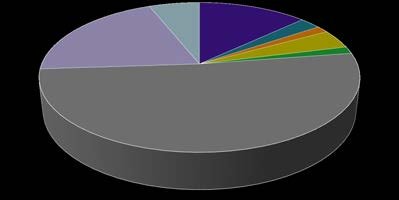
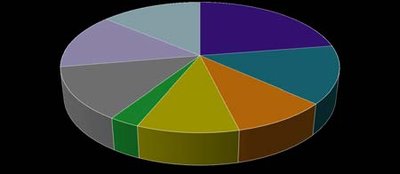
The composition of government spending and revenue changes over time, reflecting shifting priorities and demographic trends.
Expenditures: Include defense, social security, Medicare, Medicaid, welfare, pensions, and interest payments.
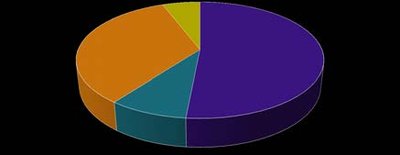
Revenue: Mainly from individual income taxes, corporate income taxes, social insurance taxes, and excise taxes.
Category | 1968 % Expenditure | 2025 % Outlay |
|---|---|---|
Social Security | 13% | 22% |
Medicare | 3% | 14% |
Medicaid | 1% | 10% |
Other Welfare | 4% | 10% |
Defense | 51% | 13% |
Nondefense | 20% | 14% |
Interest | 6% | 14% |
Gov. Employee Pensions | - | 3% |
Revenue Source | 2025 % Revenue |
|---|---|
Individual Income Taxes | 51% |
Corporate Income Taxes | 9% |
Social Insurance Taxes | 34% |
Excise Taxes and Duties | 6% |
Federal Reserve Deposits | 0% |
Effects of Fiscal Policy on Real GDP and the Price Level
Expansionary and Contractionary Fiscal Policy
Fiscal policy affects aggregate demand directly through government purchases and indirectly through changes in disposable income via taxation.
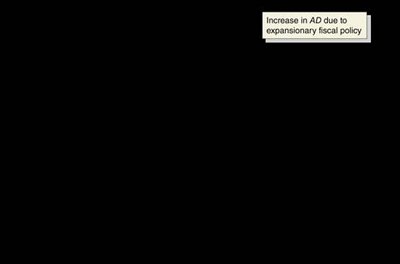
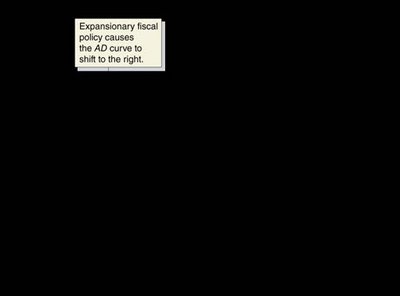
Expansionary Fiscal Policy: Increases government spending (G↑), decreases taxes (T↓), or both, to boost AD and real GDP, especially during recessions.
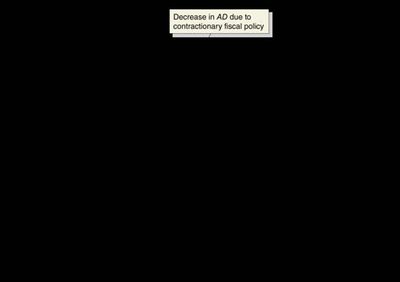
Contractionary Fiscal Policy: Decreases government spending (G↓), increases taxes (T↑), or both, to reduce AD and control inflation during economic expansions.
Government Purchases and Tax Multipliers
The Multiplier Effect
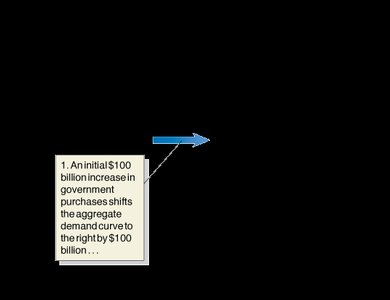
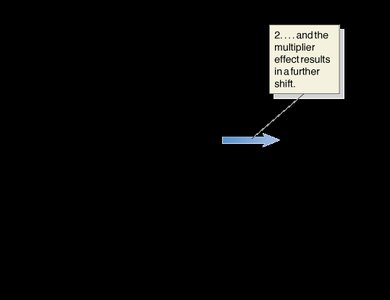
The multiplier effect describes how an initial change in government spending or taxes leads to a greater overall change in real GDP due to induced increases in consumption.
Government Purchases Multiplier (GPM): Measures the change in GDP resulting from a change in government purchases.
Tax Multiplier (TM): Measures the change in GDP resulting from a change in taxes.
Transfer Payments Multiplier (TRM): Measures the change in GDP resulting from a change in transfer payments.
Example | Change in Variable | Change in GDP | Multiplier |
|---|---|---|---|
Government Purchases | trillion | trillion | 2 |
Taxes | trillion | trillion | -1.5 |
Transfer Payments | trillion | trillion | 1.25 |

Limits of Fiscal Policy
Shortcomings and Lags
Fiscal policy faces several limitations that can reduce its effectiveness in stabilizing the economy:
Recognition Lag: Delay in identifying economic turning points.
Implementation Lag: Time required for Congress to approve and enact policy changes.
Impact Lag: Time for policy effects to be felt in the economy.
Crowding Out: Increased government spending may raise interest rates, reducing private investment and consumption.
Deficits, Surpluses, and Government Debt
Understanding Deficits and Debt
The federal deficit is the annual shortfall between government expenditures and revenues, while the federal debt is the cumulative sum of past deficits.
Deficits grow when: Expenditures increase, revenues decrease, or both.
Debt: The total amount owed by the government, funded by borrowing (selling Treasury bonds).
Debt per citizen: Calculated by dividing total debt by population.
Supply-Side Fiscal Policy and Economic Growth
Long-Run Fiscal Policy
Supply-side fiscal policy aims to increase the economy's productive capacity and long-run growth by influencing aggregate supply (AS).
Policy Initiatives:
Investment in technology (R&D subsidies)
Labor force expansion (tax breaks, subsidies)
Efficiency improvements (regulatory reform)
Labor productivity enhancements (education, training)
Factors Shifting LRAS: Technology, labor, capital, and productivity.
Summary and Key Takeaways
Fiscal policy uses government spending and taxation to influence aggregate demand and stabilize the business cycle.
Automatic stabilizers and discretionary policy are both important tools.
Multipliers amplify the effects of fiscal policy on real GDP.
Fiscal policy is subject to lags and crowding out, which can limit its effectiveness.
Deficits and debt are distinct concepts; debt is the sum of all past deficits.
Supply-side policies focus on long-run growth and productivity.