 Back
BackFiscal Policy: Mechanisms, Effects, and Long-Run Implications
Study Guide - Smart Notes
 Tailored notes based on your materials, expanded with key definitions, examples, and context.
Fiscal Policy
What Is Fiscal Policy?
Fiscal policy is a central tool used by governments to influence macroeconomic conditions. It involves changes in federal government purchases, transfer payments, and taxes to achieve macroeconomic policy objectives such as economic growth, low unemployment, and stable prices.
Definition: Fiscal policy refers to government actions regarding spending and taxation intended to affect the economy.
Automatic Stabilizers: Some government spending and taxes automatically adjust with the business cycle (e.g., unemployment insurance payments rise during recessions).
Discretionary Fiscal Policy: Intentional changes in government spending or taxes, such as stimulus packages.
Federal Government’s Share of Total Government Expenditures
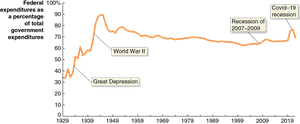
Historically, the federal government’s share of total government expenditures has increased, especially since the Great Depression.
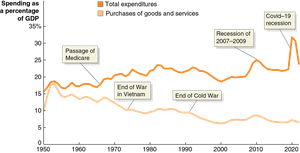
Federal Purchases and Expenditures as a Percentage of GDP
Federal expenditures now exceed 30% of GDP, with a smaller proportion spent on direct purchases of goods and services.
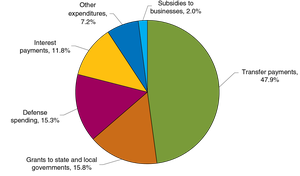
Federal Government Expenditures and Revenue
Federal expenditures are divided among defense, transfer payments (e.g., Social Security, Medicare), grants to state/local governments, and interest payments on debt.
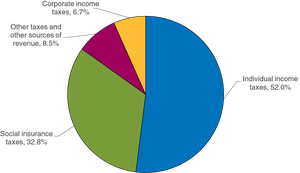
Most federal revenue comes from individual income taxes and payroll taxes, with smaller shares from corporate taxes, excise taxes, tariffs, and other fees.
The Effects of Fiscal Policy on Real GDP and the Price Level
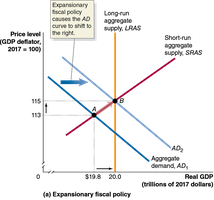
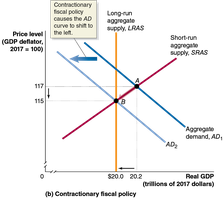
Fiscal policy affects aggregate demand through changes in government purchases and taxes. Expansionary fiscal policy increases aggregate demand, while contractionary fiscal policy decreases it.
Expansionary Fiscal Policy: Increasing government purchases or decreasing taxes to combat unemployment and restore equilibrium.
Contractionary Fiscal Policy: Decreasing government purchases or increasing taxes to reduce inflation.
Fiscal Policy During Economic Shocks
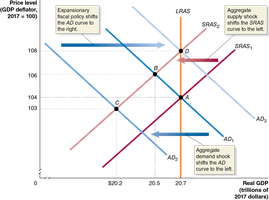
During the Covid-19 pandemic, both aggregate supply and demand shifted left, prompting expansionary fiscal policy to restore GDP, though at the cost of higher inflation.
Fiscal Policy in the Dynamic Aggregate Demand and Aggregate Supply Model
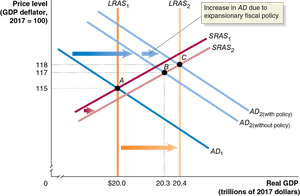
The dynamic model incorporates changes in potential GDP and price levels over time, providing a more realistic analysis of fiscal policy effects.
Expansionary Policy: Increases aggregate demand, raising both real GDP and the price level.
Contractionary Policy: Decreases aggregate demand, reducing inflationary pressures.
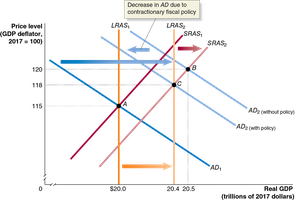
The Government Purchases, Tax, and Transfer Payments Multipliers
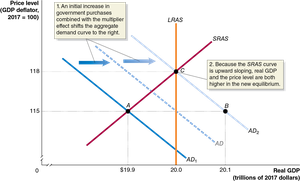
Multipliers measure the total effect of changes in government purchases, taxes, or transfer payments on real GDP. The multiplier effect occurs because initial spending increases income, which induces further consumption.
Government Purchases Multiplier: Direct increase in aggregate demand, followed by induced increases.
Tax Multiplier: Negative value; tax increases reduce GDP, tax cuts increase GDP, but less than equivalent government purchases.
Transfer Payments Multiplier: Positive value; increases in transfer payments raise disposable income and consumption.
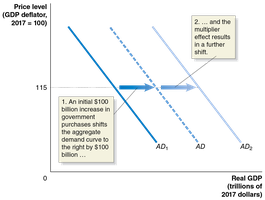
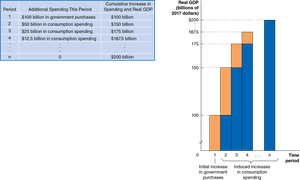
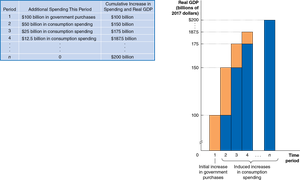
Multiplier Effect and Aggregate Supply
Because the short-run aggregate supply curve is upward sloping, increases in aggregate demand raise both real GDP and the price level.
The Limits to Using Fiscal Policy to Stabilize the Economy
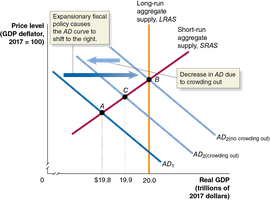
Fiscal policy faces several limitations, including timing delays and the risk of crowding out private spending.
Legislative Delay: Time required for Congress to approve actions.
Implementation Delay: Time required to begin large spending projects.
Crowding Out: Increased government purchases may reduce private consumption, investment, and net exports by raising interest rates.
Deficits, Surpluses, and Federal Government Debt
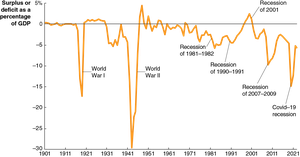
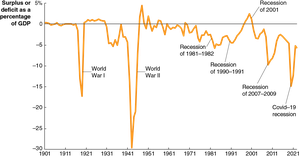
Understanding the federal budget is crucial for analyzing fiscal policy. A deficit occurs when expenditures exceed tax revenue; a surplus is the opposite. The federal government rarely balances its budget, especially during recessions.
Automatic Stabilizers
Automatic stabilizers, such as increased transfer payments during recessions, help limit the severity of economic downturns.
Federal Government Debt
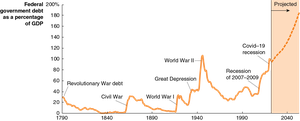
The national debt is the total value of outstanding Treasury securities. It increases during wars and recessions.
Ownership of National Debt
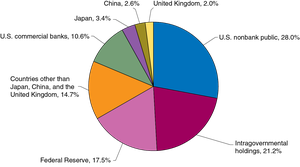
National debt is held by government trust funds, the Federal Reserve, U.S. banks, and foreign investors.
Long-Run Fiscal Policy and Economic Growth
Fiscal policy can affect long-run economic growth by influencing aggregate supply. Supply-side policies, such as tax reforms, aim to increase incentives to work, save, invest, and start businesses.
Tax Wedge: The difference between pretax and posttax returns to economic activity; larger wedges reduce economic activity.
Marginal Tax Rates: Affect labor supply, investment, and saving decisions.
Tax Simplification: Reducing complexity increases economic efficiency.
Long-Run Growth Rate of Real GDP
The growth rate of real GDP depends on the growth in hours worked and labor productivity:
Formula:
Summary Table: Key Fiscal Policy Concepts
Concept | Definition | Effect |
|---|---|---|
Expansionary Fiscal Policy | Increase spending or decrease taxes | Raises aggregate demand, reduces unemployment |
Contractionary Fiscal Policy | Decrease spending or increase taxes | Reduces aggregate demand, lowers inflation |
Multiplier Effect | Induced increases in spending from initial government action | Amplifies impact on real GDP |
Crowding Out | Government spending reduces private sector activity | Offsets some fiscal policy effects |
Automatic Stabilizers | Spending/taxes that adjust with the business cycle | Mitigate recessions automatically |
Tax Wedge | Difference between pretax and posttax returns | Reduces economic activity |
Additional info: These notes expand on textbook points with academic context, definitions, and formulas to ensure completeness and clarity for exam preparation.
