 Back
BackGDP: Measuring Total Production and Income – Comprehensive Study Notes
Study Guide - Smart Notes
 Tailored notes based on your materials, expanded with key definitions, examples, and context.
GDP: Measuring Total Production and Income
Introduction
Gross Domestic Product (GDP) is a fundamental concept in macroeconomics, serving as the primary measure of total production and income within a country. This chapter explores how GDP is calculated, its components, its limitations as a measure of well-being, and related measures of national income.
Gross Domestic Product Measures Total Production
Macroeconomics and Microeconomics
Macroeconomics studies the economy as a whole, including inflation, unemployment, and economic growth. Microeconomics focuses on individual households and firms, their choices, and market interactions.
The Business Cycle
Business cycle: Alternating periods of economic expansion and recession.
Expansion: Period when total production and employment increase.
Recession: Period when total production and employment decrease.
Economic growth: The ability of an economy to produce increasing quantities of goods and services.
Measuring Total Production: Gross Domestic Product
Gross Domestic Product (GDP): The market value of all final goods and services produced in a country during a period of time, typically one year.
GDP includes only final goods and services (purchased by final users), not intermediate goods (used as inputs in other goods).
GDP measures only new production; used goods are excluded.
Production, Income, and the Circular-Flow Diagram
GDP measures both total production and total income.
The circular-flow diagram illustrates the interaction between households and firms, showing how income and expenditure are linked.
Transfer payments: Payments by the government to households for which no new good or service is received (not included in GDP).
Components of GDP
Consumption (C): Spending by households on goods and services (excluding new houses).
Investment (I): Spending by firms on new factories, buildings, machinery, inventories, and by households/firms on new houses.
Government Purchases (G): Spending by federal, state, and local governments on goods and services.
Net Exports (NX): Exports minus imports.
GDP Equation:
Measuring GDP Using the Value-Added Method
Value added: The market value a firm adds to a product, calculated as the difference between the sale price and the cost of intermediate goods.
Does GDP Measure What We Want It to Measure?
Shortcomings in GDP as a Measure of Total Production
GDP does not include household production (goods/services produced for oneself).
GDP excludes the underground economy (shadow economy), which includes unreported or illegal transactions.
Shortcomings of GDP as a Measure of Well-Being
GDP does not include the value of leisure.
GDP is not adjusted for pollution or other negative effects of production.
GDP is not adjusted for changes in crime or other social problems.
GDP measures the size of the economic "pie," not how it is divided among the population.
Alternative Measures of Economic Welfare
Measure of Economic Welfare (MEW): Subtracts "bads" (e.g., pollution), excludes some services, and adds household production and leisure.
Efforts to create broader measures of well-being (e.g., UK's well-being index, UN's Human Development Index).
Real GDP versus Nominal GDP
Calculating Real GDP
Nominal GDP: Value of final goods and services at current-year prices.
Real GDP: Value of final goods and services at base-year prices.
Real GDP holds prices constant, making it a better measure of changes in production over time.
Comparing Real GDP and Nominal GDP
In years before the base year, real GDP is greater than nominal GDP; after the base year, real GDP is less than nominal GDP.
In the base year, real and nominal GDP are equal.
The GDP Deflator
GDP deflator: A measure of the price level, calculated as:
Other Measures of Total Production and Total Income
National Income Accounting
The Bureau of Economic Analysis (BEA) tracks total production and income using several measures:
Gross National Product (GNP): Value of final goods and services produced by residents of a country, regardless of location.
National Income: GDP minus depreciation (consumption of fixed capital).
Personal Income: Income received by households, including transfer payments and interest, minus retained corporate earnings.
Disposable Personal Income: Personal income minus personal tax payments; best measure of income available for spending.
Division of Income
GDP can be measured as total expenditure or total income received by households (gross domestic income).
Wages are the largest component of gross domestic income.
Application: World War II and GDP
GDP During World War II
GDP rose dramatically during World War II, primarily due to increased production of war goods. However, the well-being of the typical person did not necessarily improve, as production of consumption goods per person remained low until after the war.
GDP can give a misleading indication of prosperity if increases are driven by non-consumption goods (e.g., military production).
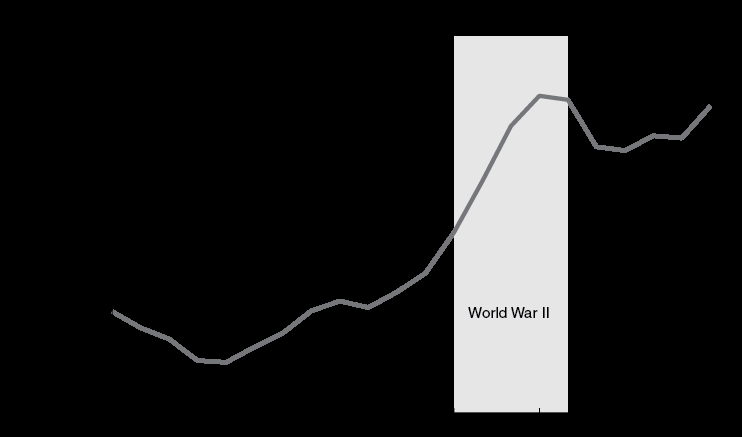
Example: The graph above illustrates the sharp rise in real GDP and the fall in unemployment during World War II, but also highlights that prosperity for the average person returned only after the war ended.
Summary Table: GDP and Related Measures
Measure | Definition | Key Differences |
|---|---|---|
GDP | Market value of all final goods and services produced within a country | Includes only domestic production |
GNP | Market value of all final goods and services produced by residents of a country | Includes foreign production by residents, excludes domestic production by foreigners |
National Income | GDP minus depreciation | Accounts for wear and tear on capital |
Personal Income | Income received by households | Includes transfer payments, excludes retained corporate earnings |
Disposable Personal Income | Personal income minus personal taxes | Income available for spending |
Key Terms and Definitions
Business cycle: Alternating periods of economic expansion and recession.
Consumption: Household spending on goods and services.
Economic growth: Increase in the economy's ability to produce goods and services.
Final good or service: Purchased by a final user.
GDP deflator: Measure of price level.
Government purchases: Government spending on goods and services.
Gross domestic product (GDP): Market value of all final goods and services produced in a country.
Inflation rate: Percentage increase in price level year-to-year.
Intermediate good or service: Input into another good or service.
Investment: Spending on new factories, buildings, machinery, inventories, and new houses.
Net exports: Exports minus imports.
Nominal GDP: Value of goods and services at current-year prices.
Price level: Average prices of goods and services in the economy.
Real GDP: Value of goods and services at base-year prices.
Recession: Period of declining production and employment.
Transfer payments: Government payments to households without new goods/services.
Underground economy: Concealed buying/selling to avoid taxes/regulations or for illegal goods/services.
Value added: Market value a firm adds to a product.
Conclusion
GDP is a crucial indicator of economic activity, but it has limitations as a measure of well-being. Understanding its calculation, components, and related measures is essential for analyzing the health and growth of an economy.
