 Back
BackInflation, Interest Rates, and National Income Accounting in Macroeconomics
Study Guide - Smart Notes
 Tailored notes based on your materials, expanded with key definitions, examples, and context.
Inflation and Interest Rates
Inflation: Definition and Measurement
Inflation is a key macroeconomic concept representing the growth in the cost of living over time. It is most commonly measured by the Consumer Price Index (CPI), which tracks the price changes of a fixed basket of consumer goods and services.
Consumer Price Index (CPI): The CPI is calculated as the ratio of the current cost of a basket of goods to the cost of the same basket in a base year, multiplied by 100%.
Formula:
Inflation Rate: If CPI in year t is , then inflation between t and t+1 is
Core CPI: Excludes volatile items (e.g., food and energy) to better reflect underlying inflation trends.
Annualized Inflation Rate
Inflation rates are often reported on an annualized basis, even if calculated monthly. To convert an annual rate to a monthly rate, compounding is used.
Monthly Inflation Rate Formula:
Example: If annual inflation is 3.2%, the monthly rate is approximately 0.26%.
Interest Rates: Types and Measurement
Interest rates represent the rate of return promised by borrowers to lenders. There are many types of interest rates in the economy:
Explicit Interest Rates: Rates on GICs, mortgages, credit cards.
Implied Interest Rates: Yields on government bonds.
Annualized Interest Rates: Most rates are quoted annually, but payments may occur more frequently (e.g., monthly or semi-monthly).
Effective Rate: The true rate after compounding over payment periods.
Nominal vs. Real Interest Rates
Inflation erodes the purchasing power of money, affecting the real return on loans and investments. The distinction between nominal and real interest rates is crucial:
Nominal Interest Rate (): The stated rate, not adjusted for inflation.
Real Interest Rate (): The inflation-adjusted rate, calculated as (where is the inflation rate).
Ex Post Real Rate: Uses actual inflation.
Ex Ante Real Rate: Uses expected inflation ():
Example: If the nominal rate is 5% and inflation is 2%, the real rate is 3%.
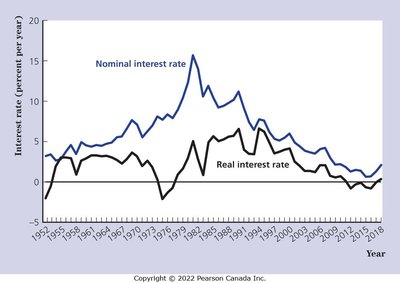
Implications for Borrowing
Both nominal and real interest rates have fluctuated over time. Real rates are more relevant for economic decisions, as they reflect the true cost of borrowing and the real return on savings. During periods of high inflation, real rates can become negative, as seen during the COVID-19 pandemic.
Recent Trends: Real interest rates in Canada have been lower in recent years compared to past decades.
Decision-Making: Borrowers and lenders should focus on real rates, not just nominal rates.
Nominal vs. Real Data in Macroeconomics
Nominal vs. Real Aggregate Data
Macroeconomic data is often collected in nominal terms (current prices), but economists are interested in real values (constant prices) to isolate changes in quantities from changes in prices.
Nominal Data: Reflects both price and quantity changes.
Real Data: Adjusted for inflation, reflects only quantity changes.
Base Year: Real GDP and price indices are defined relative to a base year; the choice of base year affects growth calculations.
Example: Two-Good Economy
Consider an economy producing computers and bicycles:
Nominal GDP: Sum of values at current prices.
Real GDP: Sum of values at base year prices.
Year | Product | Quantity | Price | Value |
|---|---|---|---|---|
2022 | Computers | 5 | $1,200 | $6,000 |
2022 | Bicycles | 200 | $200 | $40,000 |
2023 | Computers | 10 | $600 | $6,000 |
2023 | Bicycles | 250 | $240 | $60,000 |
GDP Deflator
The GDP deflator measures the change in prices of all goods and services included in GDP.
Formula:
Example: If nominal GDP is \frac{66,000}{62,000} \times 100\% = 106.5\%$
Real GDP per Capita
Real GDP per capita is a measure of average economic output per person, adjusted for inflation.
Formula:
Growth Rate Calculation
Growth rates are calculated using real GDP values from the same base year.
Formula:
Annualized Growth Rate: If , then
National Income Accounts: Three Approaches
Fundamental Identity
National income accounting relies on the identity that the value of total production equals total expenditure and total income. All are measures of Gross Domestic Product (GDP), denoted by .
Production Approach: Market value of final goods and services produced within a period.
Expenditure Approach: Total spending on final goods and services:
Income Approach: All income received from domestic production: wages, interest, dividends, rent, taxes net of subsidies, depreciation.
Expenditure in Canada (2019)
Category | Billions of dollars | % of GDP |
|---|---|---|
Private consumption (C) | 1335.3 | 57.7 |
Investment (I) | 520.1 | 22.5 |
Government consumption (G) | 489.6 | 21.2 |
Net exports (NX) | -32.0 | -1.4 |
Total (GDP) | 2313.7 | 100 |
Income in Canada (2019)
Category | Billions of dollars | % of GDP |
|---|---|---|
Compensation of employees | 1178.8 | 50.9 |
Gross operating surplus | 598.7 | 25.9 |
Gross mixed income | 598.7 | 25.9 |
Taxes less subsidies on production | 104.4 | 4.5 |
Taxes less subsidies on imports | 153.2 | 6.6 |
Total (GDP) | 2314.4 | 100 |
Example: Two Firms
Consider Apple Inc. and Juice Inc.:
Product Approach: Value-added is calculated by subtracting intermediate goods from total sales.
Expenditure Approach: Only final consumption by the public is counted.
Income Approach: Sum of wages, taxes, and profits.
Gross National Product (GNP) and Private Disposable Income
Gross National Product (GNP)
GNP measures overall income, including net factor payments from abroad (NFP):
Formula:
NFP: Income from abroad paid to domestic factors minus income paid to foreign factors used domestically.
Private Disposable Income
The income available to the private sector for spending:
Formula:
Net Government Revenue:
Savings and Wealth
Importance of Savings
GDP is a flow measure, while wealth is a stock. National wealth depends on past savings and investments:
Formula:
Capital Gains: Increases in the value of existing capital.
Measures of Saving
Private Saving:
Government Saving (Surplus):
National Saving:
Uses of Private Saving
Private saving is used for investment, covering budget deficits, and financing the current account.
Current Account:
Saving Identity:
Private Saving:
Savings Rates in Canada
Savings rates have fluctuated over time, with household saving rates declining since the 1980s but rising during COVID-19. The national saving rate has shown no clear trend.
Household Saving Rate:
Private Saving Rate:
National Saving Rate:
Example: Household savings rate and national savings rate as a percentage of national income have varied significantly over decades.
Additional info: Academic context and formulas have been expanded for clarity and completeness.
