 Back
BackInflation, Unemployment, and Federal Reserve Policy: Study Notes
Study Guide - Smart Notes
 Tailored notes based on your materials, expanded with key definitions, examples, and context.
Inflation, Unemployment, and Federal Reserve Policy
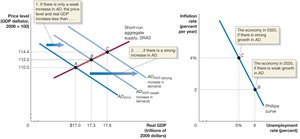
17.1 The Discovery of the Short-Run Trade-off between Unemployment and Inflation
The Federal Reserve faces two major macroeconomic challenges: unemployment and inflation. These two variables are interconnected, especially in the short run, as described by the Phillips curve. The Phillips curve illustrates the inverse relationship between the unemployment rate and the inflation rate.
Phillips Curve: A graphical representation showing that higher inflation is associated with lower unemployment, and vice versa, in the short run.
Short-Run Trade-off: Policymakers once believed they could choose a combination of inflation and unemployment, but this relationship is not permanent.
Structural Relationship: Initially thought to be stable, but later evidence showed it could shift over time.
Example: During the 1960s, the Phillips curve appeared stable, leading to the belief that a permanent trade-off existed.
17.2 The Short-Run and Long-Run Phillips Curves
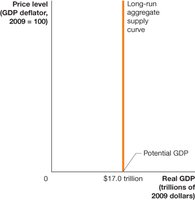
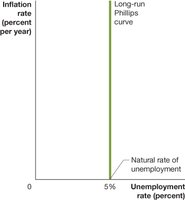
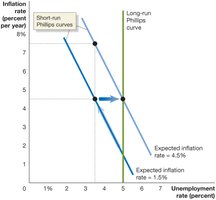
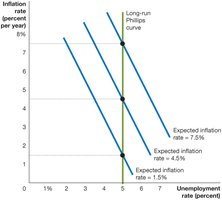
The relationship between inflation and unemployment changes over time. In the long run, the Phillips curve becomes vertical, indicating no permanent trade-off between inflation and unemployment. This is because employment is determined by potential GDP, and unemployment returns to its natural rate.
Long-Run Phillips Curve: Vertical at the natural rate of unemployment, showing that inflation does not affect unemployment in the long run.
Natural Rate of Unemployment: The rate of unemployment when the economy is at potential GDP, consisting of structural and frictional unemployment.
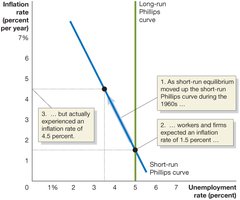
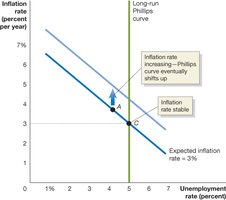
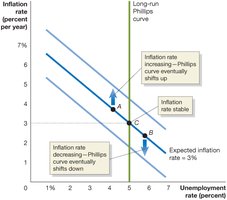
Short-Run Phillips Curve: Can shift based on expectations of inflation.
NAIRU: Non-Accelerating Inflation Rate of Unemployment; the unemployment rate at which inflation does not accelerate.
Example: In the 1960s, unexpected inflation led to lower unemployment, but as expectations adjusted, unemployment returned to its natural rate.
17.3 Expectations of the Inflation Rate and Monetary Policy
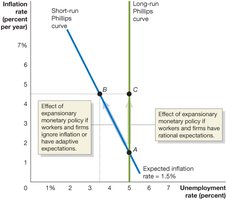
Expectations about future inflation play a crucial role in determining the effectiveness of monetary policy. The speed at which workers and firms adjust their expectations depends on the inflation environment. If expectations are rational, monetary policy may have limited effects on real variables.
Rational Expectations: Formed using all available information about an economic variable.
Adaptive Expectations: Based on past inflation rates; slower to adjust.
Monetary Policy: Expansionary policy can reduce unemployment if expectations are slow to adjust, but not if expectations are rational.
Real Business Cycle Models: Focus on real (not monetary) factors, such as technology shocks, to explain fluctuations in real GDP.
Example: If workers and firms expect inflation to be the same as last period, expansionary policy can temporarily reduce unemployment.
17.4 Federal Reserve Policy from the 1970s to the Present
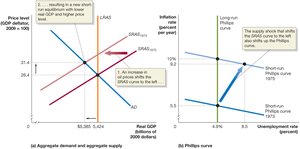
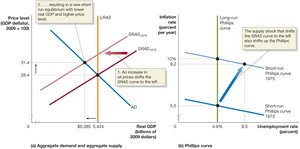
The Federal Reserve's approach to inflation and unemployment has evolved since the 1970s. Supply shocks, such as oil price increases, can shift the short-run Phillips curve. The Fed's credibility and transparency have become important factors in managing expectations and achieving low inflation.
Supply Shock: An unexpected event that changes the supply of goods, shifting the SRAS and Phillips curves.
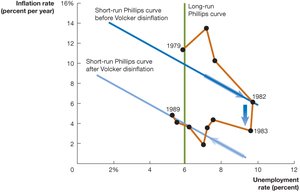
Disinflation: A significant reduction in the inflation rate, often requiring contractionary monetary policy.
Fed Credibility: Consistent policy actions are necessary for the public to believe in the Fed's commitment to low inflation.
Too-Big-to-Fail Policy: The Fed's intervention to prevent large financial firms from failing, with mixed consequences for financial stability.
Forward Guidance: The Fed's communication about future policy to influence expectations and long-term interest rates.
Central Bank Independence: Greater independence is associated with lower inflation rates.
Example: The Fed's actions under Paul Volcker in the 1980s successfully reduced inflation after several years of tight monetary policy.
Key Terms and Concepts
Phillips Curve: Shows the short-run relationship between unemployment and inflation.
Natural Rate of Unemployment: The unemployment rate when the economy is at potential GDP.
NAIRU: Non-Accelerating Inflation Rate of Unemployment.
Rational Expectations: Expectations formed using all available information.
Disinflation: Reduction in the inflation rate.
Too-Big-to-Fail Policy: Government intervention to prevent large financial firms from failing.
Forward Guidance: Central bank communication about future policy.
Central Bank Independence: Degree to which a central bank is free from government influence.
Important Equations
Real Wage:
Phillips Curve (Short-Run): Where is actual inflation, is expected inflation, is unemployment rate, is natural rate, and is a positive constant.
Summary Table: Phillips Curve Relationships
Curve | Shape | Key Feature | Implication |
|---|---|---|---|
Short-Run Phillips Curve | Downward Sloping | Inverse relationship between inflation and unemployment | Temporary trade-off |
Long-Run Phillips Curve | Vertical | Unemployment returns to natural rate | No permanent trade-off |
Additional info: These notes expand on the original content by providing definitions, examples, equations, and a summary table for clarity and completeness.
