 Back
BackInvestment in Macroeconomics: Determinants, Dynamics, and Taxation
Study Guide - Smart Notes
 Tailored notes based on your materials, expanded with key definitions, examples, and context.
Investment in Macroeconomics
The Role of Investment
Investment refers to spending on physical capital goods, such as machinery, buildings, and equipment. It is distinct from investment in financial assets (stocks and bonds), which constitutes savings. These savings are then used to purchase capital goods. Investment is a key component of GDP, accounting for about 20% on average, but it fluctuates sharply over the business cycle and contributes about 50% of the total decline in GDP during recessions. Investment is crucial for the long-run productive capacity and growth of the economy.
Physical Capital Investment: Spending on tangible assets that increase productive capacity.
Financial Investment: Purchase of financial assets, considered savings in macroeconomic terms.
Business Cycle Impact: Investment is highly sensitive to economic fluctuations.
Long-Run Growth: Sustained investment drives economic growth and productivity.
The Desired Capital Stock: Basic Model
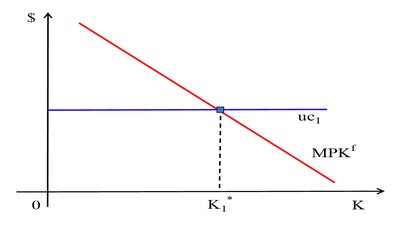
Firms aim to maximize profits by choosing the optimal level of capital stock. Managers compare the marginal benefit and marginal cost of using additional capital. The marginal benefit is the expected future marginal product of capital (MPKf), while the marginal cost is the user cost of capital.
Marginal Product of Capital (MPKf): The additional output generated by one more unit of capital.
User Cost of Capital (uc): The expected real cost of using a unit of capital for a specified period, given by: where = expected real rate of interest = depreciation rate = real price of capital goods in terms of consumption goods
Determining the Desired Capital Stock
The desired capital stock () is the level at which the marginal product of capital equals the user cost of capital: . The MPKf curve slopes downward due to diminishing returns, while the uc curve is horizontal for a given interest rate.
Diminishing Returns: As capital increases, MPKf decreases.
Equilibrium Condition: is where .
Changes in the Desired Capital Stock
Several factors can shift the desired capital stock:
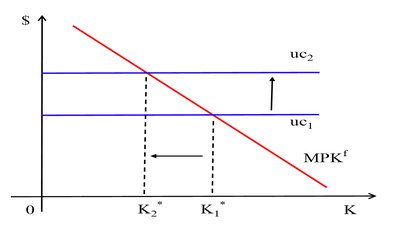
Interest Rate (): If rises, rises, leading to and a decrease in .
Depreciation Rate () and Price of Capital (): Increases in either raise and reduce .
Technological Improvement: Shifts the curve upward, increasing .
Taxes and the Desired Capital Stock
Taxes affect the after-tax return on capital. If is the effective tax rate, the after-tax return is . The desired capital stock is chosen so that:
Tax-Adjusted Equilibrium:
Impact of Taxes: An increase in raises the tax-adjusted user cost, reducing .
Marginal Effective Tax Rate (METR): Reflects the combined effect of various taxes on investment.
Marginal Effective Tax Rate in Canada
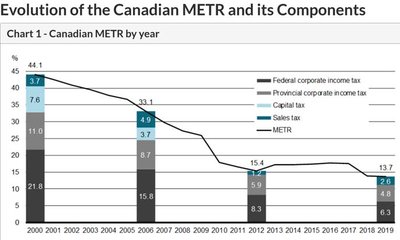
The METR in Canada has declined significantly since 2000, making it low relative to other G7 countries. The METR includes federal and provincial corporate income taxes, capital taxes, and sales taxes.
Year | Federal Corporate Income Tax | Provincial Corporate Income Tax | Capital Tax | Sales Tax | METR |
|---|---|---|---|---|---|
2000 | 21.8 | 7.6 | 3.7 | 11.0 | 44.1 |
2005 | 15.8 | 8.7 | 4.9 | 3.7 | 33.1 |
2011 | 5.9 | 2.6 | 0.0 | 6.9 | 15.4 |
2019 | 4.8 | 2.6 | 0.0 | 6.3 | 13.7 |
METR in G7 Countries
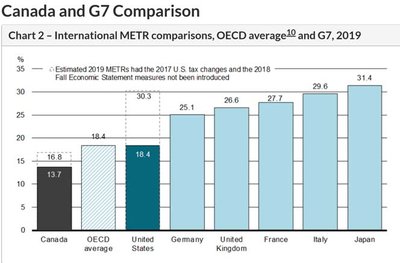
Canada's METR is low compared to other G7 countries. The chart below compares METR across the G7 and the OECD average.
Country | METR (%) |
|---|---|
Canada | 13.7 |
OECD average | 16.8 |
United States | 18.4 |
Germany | 25.1 |
United Kingdom | 26.6 |
France | 27.7 |
Italy | 29.6 |
Japan | 31.4 |
Investment Dynamics
Investment dynamics describe how the capital stock evolves over time. Gross investment () is the total purchase or construction of new capital goods in period . Net investment is the change in the capital stock:
Net Investment:
Desired Investment: If , then desired investment is
Factors Affecting Desired Investment: decreases in , , , and because decreases.
Example: If the depreciation rate increases, firms must invest more to maintain the same capital stock, but the desired capital stock may fall if the user cost rises.
Additional info: The METR is a comprehensive measure that helps policymakers assess the impact of tax policy on investment incentives. Lower METR generally encourages more investment, supporting economic growth.
