 Back
BackLabor Market Indicators, Unemployment, and Full Employment: Macroeconomics Study Guide
Study Guide - Smart Notes
 Tailored notes based on your materials, expanded with key definitions, examples, and context.
Labor Market Indicators
Key Concepts in Labor Market Measurement
The labor market is a central focus in macroeconomics, as it provides insight into the health of the economy through various statistical indicators. The three primary labor market indicators are the unemployment rate, labor force participation rate, and employment-to-population ratio.
Unemployment Rate: The percentage of the labor force that is unemployed. It is calculated as:
Labor Force Participation Rate: The percentage of the working-age population that is in the labor force.
Employment-to-Population Ratio: The percentage of working-age people who have jobs.
Labor Force Classification
The civilian working-age population is divided into two groups: those in the labor force (employed and unemployed) and those not in the labor force (students, retirees, homemakers).
Employed: Individuals working full-time or part-time.
Unemployed: Individuals without work who have actively sought employment in the past four weeks, are waiting to be recalled from a layoff, or are waiting to start a new job.
Not in the Labor Force: Individuals not employed or unemployed, such as full-time students, retirees, and homemakers.
Unemployment: Causes and Classifications
Types of Unemployment
Unemployment is classified into three main types, each with distinct causes and implications for the economy:
Frictional Unemployment: Arises from normal labor market turnover, such as people entering the labor force or switching jobs. It is generally short-term and considered healthy for the economy.
Structural Unemployment: Results from changes in technology or competition that alter the skills required for jobs or their locations. This type is often longer-term and may require retraining or relocation.
Cyclical Unemployment: Caused by fluctuations in the business cycle, such as recessions, when overall demand for labor falls.
Unemployment and Full Employment
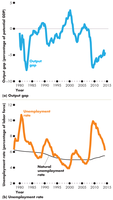
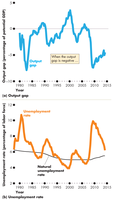
Full employment occurs when there is no cyclical unemployment, meaning all unemployment is either frictional or structural. The natural rate of unemployment is the unemployment rate at full employment, typically estimated around 6% in the U.S.
Natural Rate of Unemployment:
Actual Unemployment:
Labor Market Statistics: Calculation and Interpretation
Calculating Labor Market Statistics
Labor market statistics are calculated using data from surveys such as the U.S. Census Bureau's Current Population Survey. Key formulas include:
Labor Force:
Not in Labor Force:
Alternative Measures of Unemployment
The Bureau of Labor Statistics (BLS) reports six alternative measures of unemployment, ranging from narrow to broad:
Measure | Description |
|---|---|
U-1 | Unemployed for 15 or more weeks |
U-2 | Unemployed job losers |
U-3 | Official unemployment rate |
U-4 | U-3 plus discouraged workers |
U-5 | U-4 plus other marginally attached workers |
U-6 | U-5 plus part-time workers who want full-time jobs |

Marginally attached workers are those not working or looking for work but who want and are available for a job. Discouraged workers are marginally attached workers who have stopped looking due to repeated failure.
Unemployment Duration and the Business Cycle
Duration of Unemployment
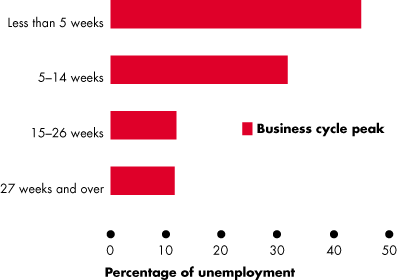
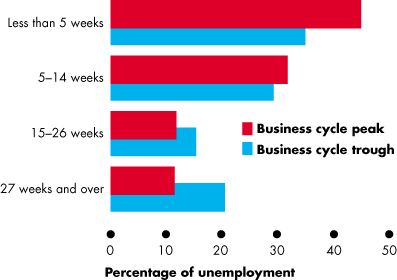
The duration of unemployment varies with the business cycle. During economic peaks, most unemployment spells are short; during troughs, long-term unemployment increases.
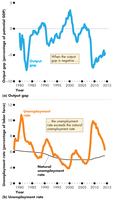
Output Gap and Unemployment
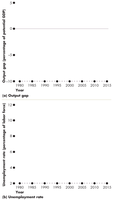
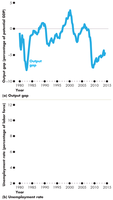
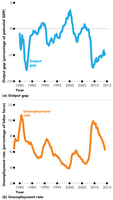
The output gap is the difference between actual real GDP and potential GDP. When the output gap is negative, unemployment exceeds the natural rate. These relationships fluctuate with the business cycle.
Wages and Real Wage Rate
Real Wage Rate
The real wage rate is the quantity of goods and services that can be purchased with an hour's work. It is calculated by dividing the nominal wage rate by the price level (e.g., GDP deflator):
Measures include median usual weekly real earnings, median monthly earnings, and real wages and salaries.
Summary Table: Labor Market Indicators
Indicator | Formula | Purpose |
|---|---|---|
Unemployment Rate | Measures underutilization of labor | |
Labor Force Participation Rate | Measures engagement in labor market | |
Employment-to-Population Ratio | Measures proportion of population employed |
Practice and Application
Example Calculation
Given: Number employed = 133.4 million, Number unemployed = 23.1 million, Adult population = 259.9 million
Labor force: million
Not in labor force: million
Unemployment rate:
Labor force participation rate:
Review Questions
Why is unemployment a problem?
How is the population decomposed for labor market statistics?
How do we define unemployment?
What are discouraged and marginally attached workers?
How are labor market statistics calculated?
Who falls into the pool of unemployed?
Define the three classifications of unemployment.
What is full employment?
What is the natural rate of unemployment?
What is the relationship between the output gap, unemployment, and its natural rate?
Additional info: Academic context and formulas have been expanded for completeness. Images included are directly relevant to the explanation of unemployment duration, output gap, and labor market indicators.
