 Back
BackMacroeconomics: Foundations, National Accounts, and Growth
Study Guide - Smart Notes
 Tailored notes based on your materials, expanded with key definitions, examples, and context.
Introduction to Macroeconomics
Aggregates in Macroeconomics
Macroeconomics examines the economy from a broad perspective, focusing on aggregates such as total output, income, and price levels, rather than individual actors. Aggregates are measured across regions or countries and are essential for comparing economic performance and living standards.
Domestic Product (GDP): The total value of all final goods and services produced within a country in a given period.
Per Capita GDP: GDP divided by the population, indicating average income and production per person.
Price Level: The average price of goods and services, used to assess purchasing power and living standards.


Example: In 2025, the US had a domestic product of $30,620 billion and a population of 348 million, resulting in a per capita GDP of about $88,000. Comparing this to the price of a meal ($38), the average American could afford approximately 2,300 meals per year. In Germany, the per capita GDP was €53,500, and with a meal costing €30, the average German could afford about 1,780 meals per year.
Economic Interaction and Actors
Macroeconomics studies the relationships between large groups of actors—households, companies, investors, and the government—rather than individuals. These groups interact through income, consumption, production, and investment, forming the basis for aggregate measures.
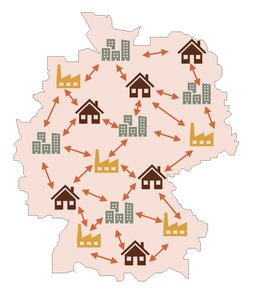
Households: Earn income and allocate it between consumption and saving.
Companies: Produce goods/services and employ labor from households.
Investors: Use savings to increase the capital stock (e.g., machines, buildings).
Understanding these interactions is crucial for analyzing policy impacts, such as changes in government spending or interest rates.
Development of Macroeconomics and Schools of Thought
Macroeconomic thought has evolved, with debates between market-based perspectives (favoring minimal government intervention) and those advocating active government roles (Keynesianism). Major events like the 2008-09 Financial Crisis have shifted consensus toward recognizing the importance of government intervention in stabilizing the economy.
Monetarism: Emphasizes central bank control of money supply to maintain price stability.
Keynesianism: Advocates active government intervention to manage demand and smooth business cycles.
Micro-founded Macroeconomics: Builds models from rational individual behavior.
Macroeconomics as Engineering: Focuses on empirical regularities and policy effectiveness, sometimes without microfoundations.
Collective and Individual Decisions in Macroeconomics
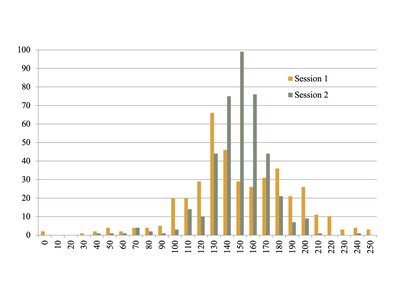
Macroeconomic outcomes often depend on collective behavior and expectations, not just individual rationality. Games and experiments (such as those run on platforms like classEx) illustrate how habits, moods, and feedback can drive aggregate outcomes, sometimes leading to market failures or justifying government intervention.

Example: In a classroom experiment, participants' choices about work hours or consumption can be influenced by the average behavior of others, leading to self-fulfilling expectations and collective outcomes that may not be individually optimal.
Measuring National Output and Income
Measurement of Domestic Product (GDP)
The domestic product (GDP) measures the total value of all final goods and services produced in a country during a specific period. Only final products are counted to avoid double-counting intermediate goods.
Final Products: Goods/services consumed by end users.
Intermediate Inputs: Goods/services used in the production of final products (not counted in GDP).
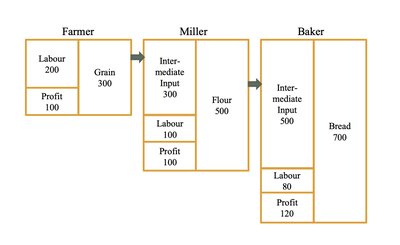
Example: In a bread production chain, only the value of the final bread is counted in GDP, not the intermediate sales of grain and flour.
Nominal vs. Real GDP
Nominal GDP values output at current market prices, while real GDP uses constant prices from a base year to remove the effects of inflation. The GDP deflator is used to measure the change in price level:
GDP Deflator =
An increase in the deflator indicates that nominal GDP growth is due to rising prices rather than increased output.
National Accounts and Economic Cycles
National accounts track the flow of goods, services, and income between households and companies. The circular flow model illustrates these relationships:
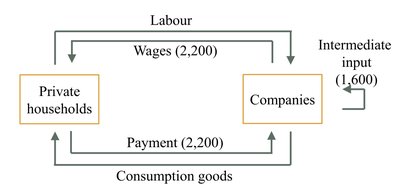
Companies pay wages to households for labor.
Households use income to purchase goods/services from companies.
Intermediate inputs are exchanged between companies.
Saving and Investment
Saving and investment are key components of national accounts. Gross investment includes spending on capital goods and inventory changes, while net investment subtracts depreciation:
Net Investment = Gross Investment - Depreciation
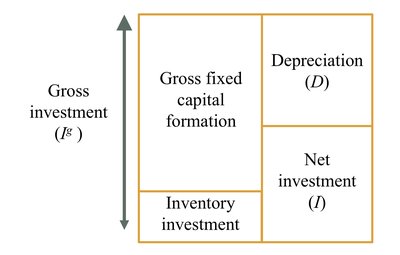
Private households save by not consuming all their income, and companies invest in capital goods. In a closed economy, aggregate saving always equals aggregate investment.
Productivity and Economic Growth
Differences in Standards of Living
Countries differ widely in per capita GDP, reflecting differences in productivity, capital, human capital, and technological progress. Growth theory analyzes how these factors contribute to long-run economic growth.

Case Study: China – Rapid growth in per capita GDP has been driven by high investment rates, government reforms, and technological adoption.
The Growth Model
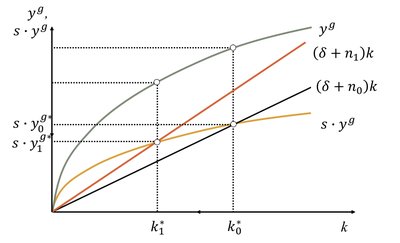
The Solow growth model explains how capital accumulation, population growth, and technological progress determine steady-state output per capita. The production function is typically:
Where is output, is technology, is labor, and is capital. The model predicts diminishing returns to capital and a steady-state where per capita variables are constant.
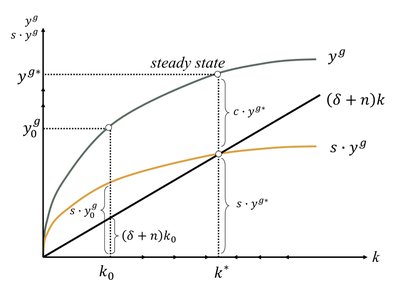
Effects of Saving, Investment, and Population Growth
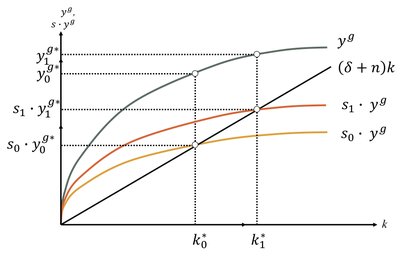
Increasing the saving/investment rate raises the steady-state level of output per capita, while higher population growth lowers it. Technological progress shifts the production function upward, enabling sustained growth in per capita output.
Empirical Evidence
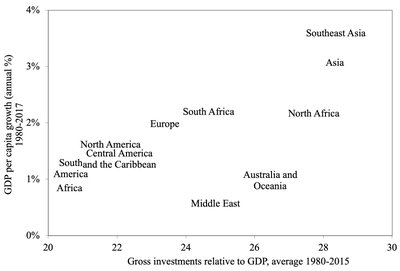
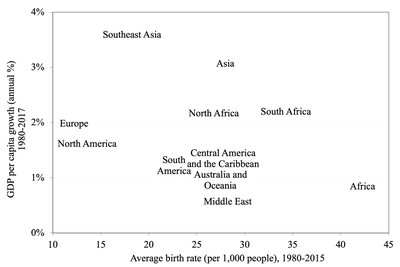
Empirical data show a positive correlation between investment rates and growth, and a negative correlation between population growth and per capita income growth.
Summary
Macroeconomics studies aggregates and their interactions, using national accounts to measure output, income, saving, and investment.
GDP (nominal and real) is a central measure, with per capita comparisons used to assess living standards.
Growth models explain long-run differences in income and the roles of capital, labor, and technology.
Empirical evidence supports the importance of investment and technological progress for economic growth.
