 Back
BackMacroeconomics: Government, Trade, and Equilibrium National Income – Step-by-Step Study Guidance ch 7
Study Guide - Smart Notes
 Tailored notes based on your materials, expanded with key definitions, examples, and context.
Q1. Adding Government: The Consumption Function Out of National Income
Background
Topic: Consumption Function, Disposable Income, and Government Sector
This question tests your understanding of how the consumption function is constructed, how disposable income is calculated, and how government taxes affect consumption and aggregate expenditure.
Key Terms and Formulas
Consumption Function:
Disposable Income:
Net Taxes:
Marginal Propensity to Consume (MPC):
MPC out of national income:
Step-by-Step Guidance
Start by identifying the parameters of the consumption function: .
For each value of disposable income (), substitute into the consumption function to fill in the table for desired consumption.
Calculate the slope of the consumption function, which is the marginal propensity to consume (MPC): .
When taxes are introduced (), calculate disposable income for each level of national income: .
Substitute into the consumption function to get as a function of (national income), then fill in the table for desired consumption out of national income.
Calculate the new slope (MPC out of national income): .
Try solving on your own before revealing the answer!
Q2. Government Budget Balance
Background
Topic: Government Purchases, Net Taxes, and Budget Balance
This question tests your ability to calculate the government budget balance at different levels of national income and determine whether there is a deficit or surplus.
Key Terms and Formulas
Government Purchases: (given as a constant)
Net Tax Revenue:
Budget Balance:
Deficit:
Surplus:
Step-by-Step Guidance
For each value of (100, 200, 300), calculate net tax revenue: .
Subtract government purchases () from net tax revenue to find the budget balance: .
Determine if the result is a deficit (negative) or surplus (positive) for each income level.
Try solving on your own before revealing the answer!
Q3. Foreign Trade: Exports and Imports
Background
Topic: Open Economy, Exports, Imports, and Exchange Rates
This question examines your understanding of how exports and imports are modeled, and how changes in the exchange rate affect these functions.
Key Terms and Formulas
Exports: (autonomous, not dependent on )
Imports: (induced by national income)
Marginal Propensity to Import:
Appreciation of the Canadian Dollar: Makes imports cheaper, exports more expensive for foreigners
Step-by-Step Guidance
Sketch the export function as a horizontal line at (since it is autonomous).
Sketch the import function as a straight line through the origin with slope ().
Show the effect of an appreciation of the Canadian Dollar: shift the export function down (exports decrease), and rotate the import function up (imports increase at each level of ).
Try solving on your own before revealing the answer!
Q4. Equilibrium National Income
Background
Topic: Aggregate Expenditure, Equilibrium, and Inventory Adjustments
This question tests your ability to construct the aggregate expenditure function, analyze inventory changes, and solve for equilibrium national income algebraically.
Key Terms and Formulas
Aggregate Expenditure:
Equilibrium Condition:
Inventory Adjustment: If , inventories fall; if , inventories rise
Step-by-Step Guidance
Write out the AE function using the given equations for , , , , , and .
For a given (e.g., or ), substitute into the AE function to find desired aggregate expenditure.
Compare to to determine if inventories are accumulating or depleting, and predict how firms will adjust output.
Set and solve algebraically for the equilibrium level of national income, but stop before the final calculation.
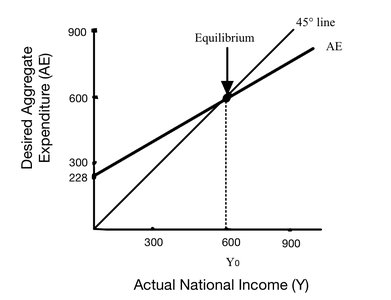
Try solving on your own before revealing the answer!
Q5. Marginal Propensity to Spend and the Simple Multiplier
Background
Topic: Multiplier Effect, Marginal Propensity to Spend, and Fiscal Policy
This question tests your understanding of how to calculate the marginal propensity to spend (), the simple multiplier (SM), and the effect of changes in government expenditure or tax rates on equilibrium national income.
Key Terms and Formulas
Marginal Propensity to Spend:
Simple Multiplier:
Change in Equilibrium Income:
Step-by-Step Guidance
Calculate using the given values for , , and .
Calculate the simple multiplier using .
For a change in government expenditure, use to set up the calculation for the change in equilibrium income.
For conceptual questions, explain how changes in the exchange rate or tax rate would affect and (e.g., an increase in lowers and ).
Try solving on your own before revealing the answer!
