Back
BackMacroeconomics in the Business Administration Curriculum: Course Structure Overview
Study Guide - Smart Notes
 Tailored notes based on your materials, expanded with key definitions, examples, and context.
Macroeconomics in the Business Administration Curriculum
Program Structure Overview
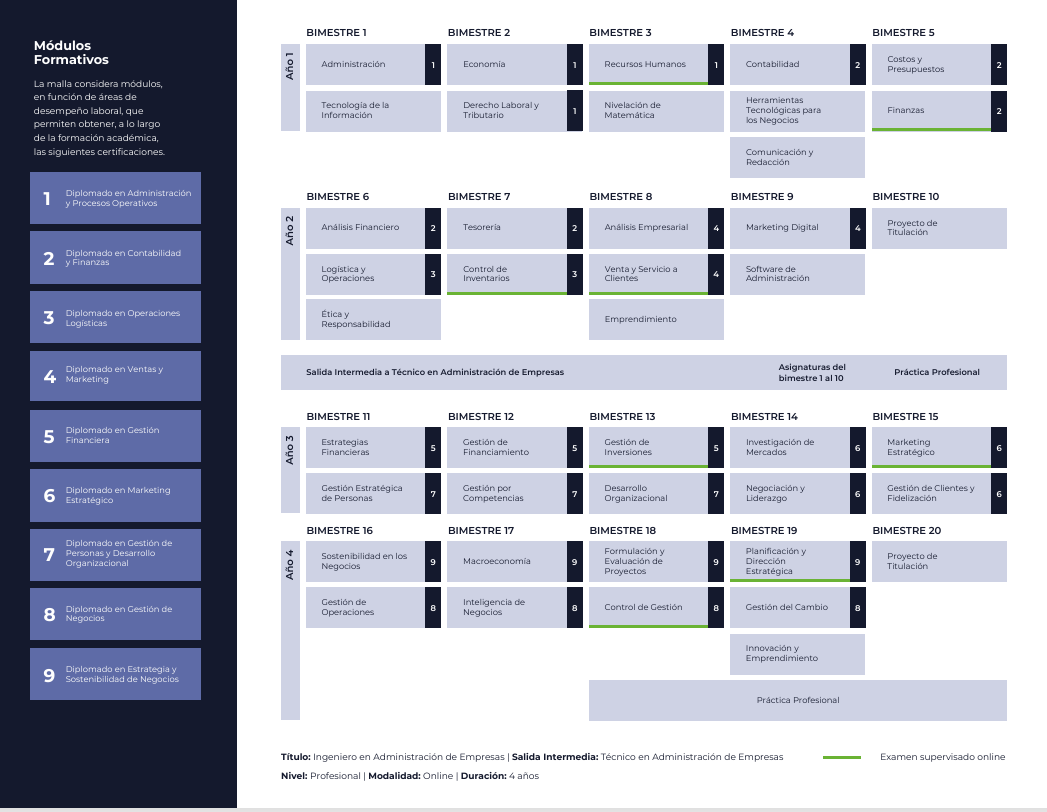
This document outlines the modular structure of a four-year online professional degree in Business Administration. The curriculum is divided into 20 bimesters, each containing courses that build foundational and advanced knowledge in business, finance, operations, and management. The program includes intermediate and advanced diplomas, culminating in a professional degree. Below is a summary of the curriculum with a focus on the inclusion and placement of macroeconomics within the broader context of business studies.
Year 1: Foundational Courses
Administration: Introduction to management principles and organizational structures.
Economics: Covers basic economic principles, likely including both microeconomics and macroeconomics foundations.
Technology in Information: Introduction to information systems in business.
Labor and Tax Law: Overview of legal frameworks affecting businesses.
Mathematics: Mathematical tools for business analysis.
Human Resources: Fundamentals of managing people in organizations.
Accounting: Principles of financial and managerial accounting.
Business Technology Tools: Application of technology in business operations.
Communication and Writing: Business communication skills.
Costs and Budgets: Cost analysis and budgeting techniques.
Finance: Introduction to financial management.
Year 2: Intermediate Business and Financial Skills
Financial Analysis: Techniques for analyzing financial statements and performance.
Treasury: Cash and liquidity management.
Business Analysis: Analytical tools for business decision-making.
Marketing Digital: Digital marketing strategies and tools.
Project Development: Capstone project for degree completion.
Logistics and Operations: Supply chain and operations management.
Inventory Control: Managing inventory systems and processes.
Sales and Customer Service: Techniques for effective sales and customer relationship management.
Software Administration: Business software applications.
Ethics and Responsibility: Business ethics and corporate social responsibility.
Entrepreneurship: Starting and managing new ventures.
Year 3: Advanced Business and Strategic Management
Financial Strategies: Advanced financial planning and strategy.
Financial Management: In-depth study of managing business finances.
Investment Management: Principles of investing and portfolio management.
Market Research: Methods for gathering and analyzing market data.
Strategic Marketing: Long-term marketing planning and execution.
Strategic Human Resources: Advanced HR management strategies.
Competency Management: Developing and managing employee competencies.
Organizational Development: Change management and organizational growth.
Negotiation and Leadership: Skills for effective negotiation and leadership in business.
Customer Management and Loyalty: Strategies for customer retention and loyalty.
Year 4: Integration and Specialization
Sustainability in Business: Sustainable business practices and strategies.
Operations Management: Advanced operations and process management.
Macroeconomics: In-depth study of macroeconomic theory and policy, including national income, inflation, unemployment, fiscal and monetary policy, and open-economy macroeconomics.
Business Intelligence: Data-driven decision-making in business.
Project Evaluation: Methods for evaluating and managing business projects.
Management Control: Systems for monitoring and controlling business performance.
Strategic Planning and Direction: Long-term business planning and strategic management.
Change Management: Leading and managing organizational change.
Innovation and Entrepreneurship: Fostering innovation and entrepreneurial thinking.
Capstone Project: Final project integrating program knowledge.
Placement of Macroeconomics
Macroeconomics is explicitly listed in Bimester 17 (Year 4), indicating its role as an advanced, integrative subject within the curriculum. This course likely covers:
Measurement of national output and income
Unemployment and inflation
Productivity and economic growth
The financial system
Aggregate demand and supply analysis
Monetary and fiscal policy
Open-economy macroeconomics
This placement ensures that students have a strong foundation in business, finance, and operations before tackling macroeconomic concepts, allowing for a deeper understanding of how macroeconomic forces impact business decisions and strategy.
Summary Table: Key Courses by Year
Year | Key Courses |
|---|---|
1 | Administration, Economics, Accounting, Finance |
2 | Financial Analysis, Treasury, Logistics, Marketing Digital |
3 | Financial Strategies, Investment Management, Market Research |
4 | Sustainability, Macroeconomics, Strategic Planning, Innovation |
Conclusion
The curriculum provides a comprehensive education in business administration, with macroeconomics serving as a capstone subject that integrates and applies knowledge from earlier courses. This structure prepares students to understand and respond to macroeconomic trends and policies in their professional careers.