Back
BackMacroeconomics Study Guide: Course Structure and Key Topics
Study Guide - Smart Notes
 Tailored notes based on your materials, expanded with key definitions, examples, and context.
Macroeconomics in the Business Administration Curriculum
Overview
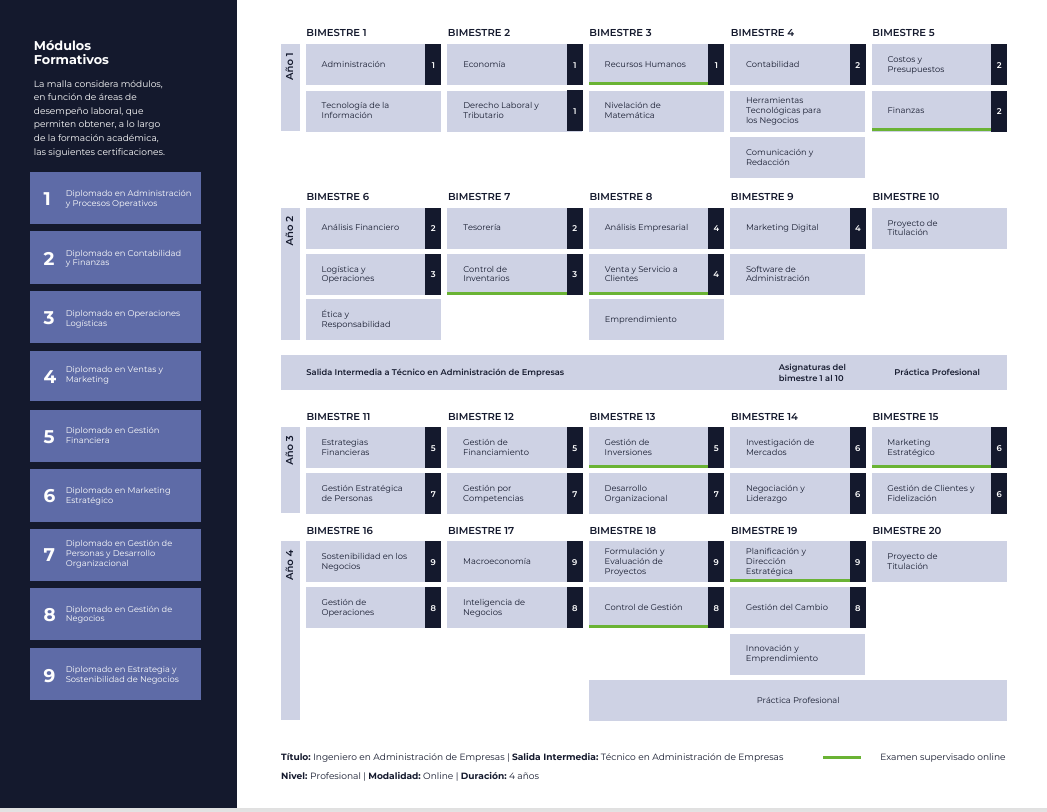
This syllabus outlines the structure of a professional-level Business Administration program, highlighting the inclusion of macroeconomics and related subjects. The curriculum is organized into 20 bimesters (two-month periods) over four years, with modules covering foundational business, finance, marketing, operations, and strategic management topics. Macroeconomics is explicitly included in Bimestre 17, and several other modules provide relevant context for macroeconomic study.
Year 4: Macroeconomics and Related Modules
Bimestre 17: Macroeconomía
Macroeconomía is a core module in the fourth year, focusing on the study of the economy as a whole. This subject covers:
National Output and Income: Understanding GDP, GNP, and other measures of economic performance.
Unemployment and Inflation: Analysis of labor markets, price levels, and their impact on economic stability.
Productivity and Economic Growth: Factors influencing long-term growth and development.
Aggregate Demand and Aggregate Supply: Examination of total spending and production in the economy.
Monetary and Fiscal Policy: Tools used by governments and central banks to influence macroeconomic outcomes.
Example: The module may include case studies on how fiscal stimulus affects national output or how inflation targeting stabilizes prices.
Bimestre 18: Formulación y Evaluación de Proyectos / Control de Gestión
These modules complement macroeconomic analysis by focusing on project evaluation and management control, which often require understanding macroeconomic indicators and trends.
Formulación y Evaluación de Proyectos: Assessing project viability in the context of economic cycles and market conditions.
Control de Gestión: Monitoring organizational performance with reference to macroeconomic benchmarks.
Bimestre 19: Planificación y Dirección Estratégica / Gestión del Cambio / Innovación y Emprendimiento
Strategic planning and change management are influenced by macroeconomic environments, such as shifts in global markets, trade policies, and economic growth rates.
Planificación y Dirección Estratégica: Aligning business strategies with macroeconomic forecasts.
Gestión del Cambio: Adapting to macroeconomic shocks and structural changes.
Innovación y Emprendimiento: Leveraging macroeconomic opportunities for business creation.
Supporting Modules Relevant to Macroeconomics
Year 1-3: Foundational Knowledge
Economía (Bimestre 2): Introduction to economic principles, including supply and demand, market structures, and basic models.
Costos y Presupuestos / Finanzas (Bimestre 5): Understanding financial flows and budgeting, which are influenced by macroeconomic conditions.
Gestión Financiera / Estrategias Financieras (Bimestres 11-12): Financial management in the context of economic cycles.
Gestión de Inversiones (Bimestre 13): Investment decisions based on macroeconomic analysis.
Sample Table: Macroeconomics-Related Modules Across the Curriculum
Bimestre | Module | Macroeconomic Relevance |
|---|---|---|
2 | Economía | Introductory economic models, supply and demand |
5 | Costos y Presupuestos / Finanzas | Budgeting, financial flows, impact of macroeconomic variables |
11-12 | Gestión Financiera / Estrategias Financieras | Financial management, economic cycles |
13 | Gestión de Inversiones | Investment decisions, macroeconomic analysis |
17 | Macroeconomía | Core macroeconomic concepts |
18-19 | Control de Gestión / Planificación Estratégica | Strategic planning, management control, macroeconomic context |
Degree and Modality
Degree: Ingeniero en Administración de Empresas
Intermediate Exit: Técnico en Administración de Empresas
Modality: Online
Duration: 4 years