Back
BackMacroeconomics Study Notes: Course Structure and Key Topics
Study Guide - Smart Notes
 Tailored notes based on your materials, expanded with key definitions, examples, and context.
Course Structure Overview
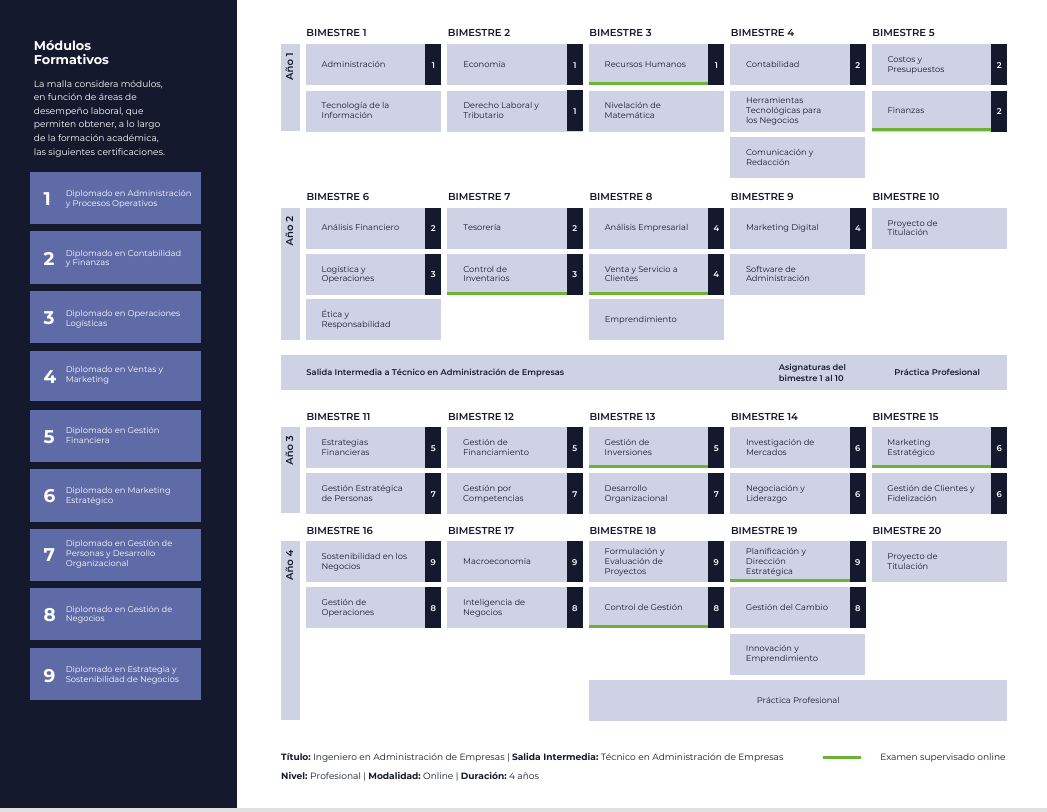
Program Outline
This syllabus outlines the structure of a professional-level program in Business Administration, with a focus on various diplomas and modules relevant to business, finance, and management. The program spans four years and includes a dedicated module on Macroeconomics in the fourth year, making it directly relevant to macroeconomics college students.
Duration: 4 years
Modality: Online
Intermediate Exit: Técnico en Administración de Empresas
Final Title: Ingeniero en Administración de Empresas
Macroeconomics Module
Macroeconomics (Bimestre 17, Year 4)
The Macroeconomics module is a core component of the curriculum, typically covered in the fourth year. This module introduces students to the fundamental concepts, models, and applications of macroeconomics, which are essential for understanding the broader economic environment in which businesses operate.
Definition: Macroeconomics is the branch of economics that studies the behavior and performance of an economy as a whole. It focuses on aggregate indicators such as GDP, unemployment rates, inflation, and national income.
Key Topics:
National income accounting
Economic growth and productivity
Unemployment and labor market dynamics
Inflation and price stability
Fiscal and monetary policy
Open economy macroeconomics (trade and exchange rates)
Core Models:
IS-LM Model: Analyzes the interaction between the goods market and the financial market.
AD-AS Model: Explains aggregate demand and aggregate supply in determining output and price levels.
Phillips Curve: Illustrates the relationship between inflation and unemployment.
Applications:
Policy analysis for governments and central banks
Business cycle forecasting
Understanding global economic trends
Example: IS-LM Model
The IS-LM model is a fundamental tool in macroeconomics for analyzing the equilibrium in the goods and financial markets. The model is represented by the following equations:
IS Curve:
LM Curve:
Where Y is output, C is consumption, T is taxes, I is investment, r is the interest rate, G is government spending, M is money supply, P is price level, and L is liquidity preference.
Related Modules and Academic Context
Financial and Economic Modules
Several other modules in the program provide foundational knowledge relevant to macroeconomics, including:
Economía (Bimestre 2): Introduction to economic principles, including micro and macro concepts.
Gestión Financiera (Bimestre 12): Financial management, which connects to macroeconomic policy and its impact on business.
Gestión de Inversiones (Bimestre 13): Investment management, influenced by macroeconomic conditions.
Planificación y Dirección Estratégica (Bimestre 19): Strategic planning, which requires understanding macroeconomic trends.
Diplomas and Specializations
The program offers diplomas in areas such as Financial Management, Marketing, Operations Logistics, and Strategy & Sustainability. These specializations often require macroeconomic knowledge for effective decision-making and analysis.
Summary Table: Macroeconomics in the Curriculum
The following table summarizes the placement and relevance of macroeconomics within the overall curriculum:
Year | Bimestre | Module | Relevance to Macroeconomics |
|---|---|---|---|
1 | 2 | Economía | Introductory economic concepts |
4 | 17 | Macroeconomía | Core macroeconomic theory and applications |
3 | 12 | Gestión Financiera | Financial management, policy impact |
3 | 13 | Gestión de Inversiones | Investment decisions, macro context |
4 | 19 | Planificación y Dirección Estratégica | Strategic planning, macro trends |
Conclusion
The curriculum provides a comprehensive foundation in business administration, with a strong emphasis on macroeconomics in the later stages. Students are equipped to analyze and interpret macroeconomic data, understand policy impacts, and apply economic theory to real-world business and financial decisions.