 Back
BackMacroeconomics Study Notes: GDP, Unemployment, Economic Growth, and Monetary Policy
Study Guide - Smart Notes
 Tailored notes based on your materials, expanded with key definitions, examples, and context.
Chapter 8: GDP – Measuring Total Production and Income
Definition of Aggregate Income and GDP
Aggregate Income represents the total value of all income earned by labor, land, capital, and entrepreneurship within an economy. Gross Domestic Product (GDP) is the primary measure of aggregate income and total economic output.
GDP is used to measure both total production and total income in the economy.
The Circular Flow: Aggregate Income = Aggregate Expenditure
In the circular flow model, aggregate income always equals aggregate expenditure because every dollar spent by one agent becomes income for another.
Households and firms interact in the circular flow, ensuring this equality.
Components of GDP: The Expenditure Approach
GDP is calculated as the sum of four main components:
Consumption (C): Spending by households on durable goods, nondurable goods, and services.
Investment (I): Spending on goods used for future production (e.g., machinery, tools, factories, new homes). Note: Investment does not include stocks or bonds.
Government Purchases (G): Spending by federal, state, and local governments on goods and services (excludes transfer payments).
Net Exports (NX): Exports minus imports. If imports exceed exports, NX is negative (trade deficit); if exports exceed imports, NX is positive (trade surplus).
GDP Equation:
Real vs. Nominal GDP
Nominal GDP: Measured using current year prices, not adjusted for inflation.
Real GDP: Adjusted for inflation, measured using base year prices.
GDP Deflator and Inflation
GDP Deflator: Measures the overall price level of all final goods and services produced in the economy.
Inflation Rate: Measures the percentage change in the price level from one period to another.
Limitations of GDP
Does not measure income distribution
Ignores non-market activities
Excludes underground/black market activity
Does not account for environmental costs
Does not measure well-being or happiness
Counts some negative activities as positive (e.g., disaster recovery)
Excludes quality improvements and digital goods
International comparisons can be problematic
Business Cycles: Expansions and Contractions
Economic Expansion: Period when the economy is growing (real GDP increases).
Economic Contraction (Recession): Period when the economy is declining (real GDP decreases).
Business cycles are influenced by interest rates, aggregate demand, investment, confidence, and external shocks.
Chapter 9: Unemployment and Inflation
Unemployment Rate: Definition and Calculation
Unemployment Rate: Percentage of the labor force that is unemployed and actively seeking work.
Labor force excludes full-time students, retirees, stay-at-home parents, discouraged workers, and others not seeking work.
Labor Market Indicators
Labor Force: Employed + Unemployed adults
Labor Force Participation Rate (LFPR): Percentage of the adult population in the labor force.
Limitations of the Unemployment Rate
Excludes discouraged and underemployed workers
Ignores job quality and long-term unemployment
Does not reflect regional or demographic differences
Types of Unemployment
Natural Rate of Unemployment: Unemployment rate when the economy is at full capacity (includes frictional and structural unemployment).
Cyclical Unemployment: Caused by downturns in the business cycle (recessions).
Components of Natural Unemployment
Frictional Unemployment: Temporary unemployment as workers search for jobs.
Structural Unemployment: Mismatch between workers’ skills and available jobs.
Public Policies and Frictional Unemployment
Improving job-matching information
Increasing labor-market flexibility
Combating discrimination and barriers
Unemployment insurance (UI)
Causes of Structural Unemployment
Minimum wage laws
Labor unions
Efficiency wage theory
Cost of Living and CPI
Cost of Living: Amount of money needed to maintain a certain standard of living.
Consumer Price Index (CPI): Measures the overall cost of goods and services purchased by a typical consumer.
Limitations and Applications of CPI
Substitution bias, introduction of new goods, unmeasured quality change
Used to compare dollar values across time and to separate nominal from real interest rates
CPI vs. GDP Deflator
CPI: Measures cost of living for consumers (selected goods and services).
GDP Deflator: Measures price level of all domestically produced goods and services.
Producer Price Index (PPI)
Measures average change over time in selling prices received by domestic producers.
Chapter 10: Economic Growth, Financial System, and Business Cycles
Business Cycles vs. Long-Run Economic Growth
Business Cycle: Short-term fluctuations in economic activity due to shocks.
Long-Run Economic Growth: Sustained increases in productivity and output over time, leading to higher living standards.
Growth Rate Calculations
Measures the percentage change in real GDP from one year to the next.
Rule of 70
Estimates the number of years for a variable to double at a given growth rate.
Productivity: Definition and Determinants
Productivity: Quantity of goods and services produced per worker or per hour of work.
Key determinants: human capital, physical capital, natural resources, technology.
Higher productivity leads to higher output and income.
Actual vs. Potential GDP
Actual GDP: Real output currently produced.
Potential GDP: Output possible when operating at full employment.
Savings and Investment
Private Savings:
Public Savings:
National Savings:
Budget Deficit:
Budget Surplus:
Savings-Investment Identity (Closed Economy):
Loanable Funds Model and Public Policy
Saving incentives increase supply of loanable funds (SLF), lower interest rates, and raise investment.
Investment incentives increase demand for loanable funds (DLF), raise interest rates, and increase investment.
Budget deficits reduce SLF, raise interest rates, and crowd out investment.
Budget surpluses increase SLF, lower interest rates, and boost investment.
Chapter 11: Long-Run Economic Growth: Sources and Policies
Public Policies and Economic Growth
Influence investment, taxation, human capital, public goods, infrastructure, and regulatory frameworks.
Economic Growth and Living Standards
Increases income, employment, and access to goods and services.
Benefits depend on distribution and public policy.
Productivity and Economic Growth
Productivity growth is key to long-run economic growth, higher living standards, and increased output.
Diminishing Returns to Capital
As capital per worker increases, output gains diminish.
Solow Growth Model: Focuses on technological change and capital quantity.
Technology and Productivity Growth
Technological progress transforms industries, improves efficiency, and creates new markets.
New Growth Model (Paul Romer)
Technological change is driven by economic incentives and the market system.
Catch-Up Effect
Poor countries can grow faster than rich countries due to lower initial capital per worker.
Public Policies and Loanable Funds Model
Public policies can shift supply and demand for loanable funds, affecting interest rates and investment.
Chapter 14: Banks, Money, and the Federal Reserve System
Definition and Role of Money
Money: Assets generally accepted in exchange for goods, services, or debt repayment.
Functions: medium of exchange, unit of account, store of value, standard of deferred payment.
Types of Money
Commodity Money: Has intrinsic value (e.g., gold).
Fiat Money: Government-issued, no intrinsic value, declared legal tender.
Money Supply: M1 and M2
M1: Currency + checkable deposits + traveler’s checks.
M2: M1 + savings deposits + small time deposits + money market funds.
Financial System: Commercial and Central Banks
Commercial Banks: Accept deposits and make loans.
Central Banks: Manage monetary policy, ensure financial stability, promote growth.
Fractional Reserve Banking System
Banks keep less than 100% of deposits as reserves.
Required Reserves: Minimum reserves by law.
Excess Reserves: Reserves above the required minimum.
Money Creation, Money Multiplier, Reserve Ratio
Reserve Ratio:
Money Multiplier:
Inverse relationship between money multiplier and reserve ratio.
Bank’s Balance Sheet
Assets: loans, reserves
Liabilities: deposits, borrowing
Role of Central Bank (Federal Reserve)
Implements monetary policy, acts as lender of last resort, regulates banking system.
Monetary Policy Tools and the Federal Funds Rate
Open market operations, discount rate, reserve requirements.
Federal Funds Rate: Interest rate at which banks lend reserves to each other overnight.
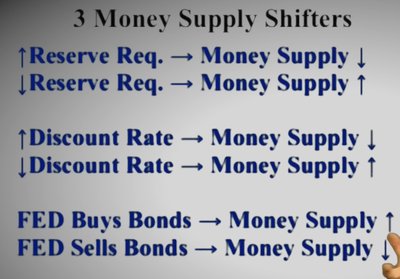
Money Supply Shifters
Reserve requirements, discount rate, and open market operations (buying/selling bonds) are the main tools for shifting the money supply.
Relation Between Money Growth and Inflation
In the long run, growth in the money supply leads to inflation.
Quantity Theory of Money
Links money growth to inflation.
M = money supply, V = velocity of money, P = price level, Y = real output
Monetary Neutrality and Classical Dichotomy
Monetary neutrality: changes in money supply affect only nominal variables, not real variables.
Classical dichotomy: real variables (output, employment) are independent of nominal variables (money supply, prices).
Cost of Inflation and Hyperinflation
Costs: menu costs, shoe-leather costs, redistribution of wealth.
Hyperinflation: Extremely high and accelerating inflation, leading to economic collapse.
Chapter 15: Monetary Policy
Definition and Goals of Monetary Policy
Central bank actions to manage money supply and interest rates to achieve macroeconomic goals.
Goals: price stability, high employment, financial stability, economic growth.
Monetary Expansion and Contraction
Monetary Expansion: Central bank increases money supply, lowers interest rates, stimulates investment and consumption.
Monetary Contraction: Central bank decreases money supply, raises interest rates, controls inflation.
Monetary Policy and Aggregate Demand/Supply
Interest rates affect aggregate demand by influencing consumption, investment, and net exports.
Changes in price levels shift aggregate demand curve.
Chapter 17: Inflation, Unemployment, and Federal Reserve Policy
Short-Run Trade-off: Unemployment and Inflation (Phillips Curve)
Short-run Phillips curve: inverse relationship between unemployment and inflation.
Disinflation: significant reduction in inflation rate.
Short-Run vs. Long-Run Phillips Curves
Long-run Phillips curve is vertical; no trade-off between inflation and unemployment.
Short-run curve shifts with changes in aggregate demand.
AD-AS Model and the Phillips Curve
Aggregate demand and supply curves help explain changes in inflation and unemployment.
Monetary Policy and Inflation Expectations
Expectations of inflation influence wage and price setting.
Rational expectations: formed using all available information.
Federal Reserve Policy Since the 1970s
Oil price shocks and policy responses have shaped inflation and unemployment trends.
Expansionary policy can reduce unemployment but may worsen inflation.
Chapter 18: Open Economy Macroeconomics
Open vs. Closed Economy
Open Economy: Engages in trade and financial interactions with other countries.
Closed Economy: No international trade or financial flows.
Components of an Open Economy
Output markets (goods/services trade), financial markets (capital flows), labor markets (worker mobility).
Net Exports: Exports minus imports; indicator of economic performance.
Net Capital Outflow (NCO): Net flow of funds invested abroad.
Exchange Rates
Nominal Exchange Rate: Value of one currency in terms of another.
Real Exchange Rate: Price of domestic goods in terms of foreign goods.
Appreciation and Depreciation
Appreciation: Currency value rises; exports become more expensive, imports cheaper.
Depreciation: Currency value falls; exports become cheaper, imports more expensive.
