 Back
BackMacroeconomics: The Big Picture – Core Concepts and Applications
Study Guide - Smart Notes
 Tailored notes based on your materials, expanded with key definitions, examples, and context.
Macroeconomics: The Big Picture
The Nature of Macroeconomics
Macroeconomics is the branch of economics that studies the behavior and performance of an economy as a whole. It contrasts with microeconomics, which focuses on individual markets and agents. Macroeconomics addresses broad phenomena such as national income, overall price levels, and unemployment rates.
Macroeconomic Questions: Concern the economy-wide phenomena, such as GDP growth, inflation, and unemployment.
Microeconomic Questions: Focus on individual markets, such as the price of a specific good or the output of a single firm.
Microeconomics | Macroeconomics |
|---|---|
How much should a firm produce? | What causes recessions? |
What determines the price of a good? | What determines the overall price level? |
How do consumers decide what to buy? | What causes unemployment? |
Paradox of Thrift: An example where individual savings can be beneficial for a person but, if everyone saves more during a recession, it can reduce overall demand and worsen the economic downturn.
Macroeconomics: Theory and Policy
Macroeconomic theory and policy have evolved over time, especially in response to major economic events.
Pre-1930s Conventional Wisdom: The economy is self-regulating; problems like unemployment resolve themselves without government intervention.
Post-1930s (Keynesian Economics): Economic slumps are caused by insufficient demand and can be mitigated by government policies.
Keynesian economics emphasizes the role of government intervention to manage economic cycles.
Monetary and Fiscal Policy
Since the 1930s, governments have used policy tools to stabilize the economy:
Monetary Policy: Central bank actions that influence the money supply and interest rates to achieve macroeconomic objectives like controlling inflation and smoothing the business cycle.
Fiscal Policy: Government decisions about taxation and spending to influence economic activity.
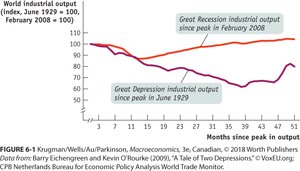
Comparing the Great Recession to the Great Depression
Major economic downturns, such as the Great Depression (1929) and the Great Recession (2008), have had profound impacts on industrial output and employment. Comparing these events helps economists understand the effectiveness of policy responses and the resilience of economies.
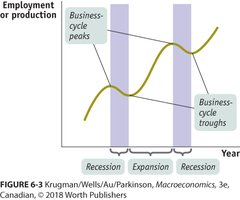
Charting the Business Cycle
The business cycle refers to the short-run alternation between periods of economic downturns (recessions) and upturns (expansions).
Recessions (Contractions): Periods when output and employment are falling.
Expansions (Recoveries): Periods when output and employment are rising.
Business Cycle: The recurring pattern of recession and expansion in the economy.
Long-Run Economic Growth
Long-run economic growth is the sustained upward trend in the economy’s output over time. It is the primary determinant of a country’s standard of living and is measured by increases in real GDP per capita.
Importance: Higher long-run growth leads to improved living standards, better health, and increased life expectancy.
Determinants: Productivity, technological progress, capital accumulation, and human capital development.
Inflation and Deflation
Inflation and deflation refer to changes in the overall price level in an economy.
Inflation: A general increase in prices across the economy, reducing the purchasing power of money.
Deflation: A general decrease in prices, increasing the real value of money but potentially leading to reduced spending and economic stagnation.
Price Stability: A situation where the overall price level changes very slowly, if at all, which is preferred for economic planning and stability.
The Causes of Inflation and Deflation
Short Run: Inflation is closely related to the business cycle and can be caused by demand-pull or cost-push factors.
Long Run: The overall level of prices is mainly determined by changes in the money supply.
The Pain of Inflation and Deflation
Inflation: Discourages people from holding cash, as its value erodes over time.
Deflation: Can cause people to delay spending, expecting lower prices in the future, which can worsen economic downturns.
Example: Hyperinflation in Venezuela has led to severe economic hardship, as prices rise uncontrollably and money loses value rapidly.
International Imbalances
Open-economy macroeconomics studies how countries interact through trade and financial flows. Trade imbalances occur when a country’s imports and exports are not equal.
Trade Deficit: When a country imports more goods and services than it exports.
Trade Surplus: When a country exports more than it imports.
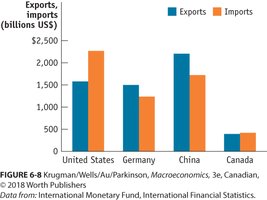
What Causes Trade Imbalances?
Investment and Savings: The main determinants of trade imbalances. Countries with high investment spending relative to savings tend to run trade deficits, while those with high savings relative to investment run trade surpluses.
Summary Table: Key Macroeconomic Concepts
Concept | Definition | Example/Application |
|---|---|---|
Business Cycle | Alternation between recessions and expansions | 2008 Great Recession |
Inflation | General rise in price level | Venezuela hyperinflation |
Trade Deficit | Imports > Exports | Canada in 2015 |
Monetary Policy | Central bank actions on money supply | Interest rate changes |
Fiscal Policy | Government spending/taxation | Stimulus packages |
