 Back
BackMeasuring a Nation’s Income: Gross Domestic Product and Economic Well-Being
Study Guide - Smart Notes
 Tailored notes based on your materials, expanded with key definitions, examples, and context.
Measuring a Nation’s Income
Introduction to Macroeconomic Measurement
Macroeconomics is the study of economy-wide phenomena, such as inflation, unemployment, and economic growth. One of the most important indicators used by economists and policymakers to monitor the performance of the overall economy is Gross Domestic Product (GDP). GDP measures the total income of a nation and is considered the best single measure of a society’s economic well-being.
The Economy’s Income and Expenditure
Equality of Income and Expenditure
For an economy as a whole, income must equal expenditure. This is because every transaction has a buyer and a seller, so every dollar of spending by a buyer is a dollar of income for a seller.
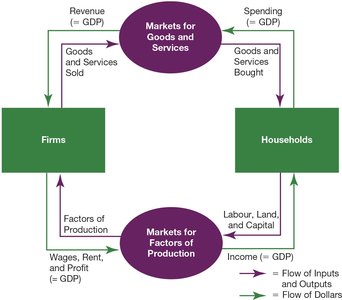
Key Points:
Firms produce goods and services using factors of production (labor, land, capital) and sell them in markets for goods and services.
Households own the factors of production and consume goods and services.
There is a circular flow of dollars and resources between firms and households.
The Measurement of Gross Domestic Product (GDP)
Definition of GDP
Gross Domestic Product (GDP) is the market value of all final goods and services produced within a country in a given period of time.
Market Value: GDP adds together many different products using their market prices.
All: Includes all items produced and sold legally in markets, including housing services. Excludes items that are difficult to measure or illegal.
Final: Only the value of final goods is included to avoid double counting. Intermediate goods are only counted if they are added to inventories.
Goods and Services: Includes both tangible goods (e.g., food, cars) and intangible services (e.g., haircuts, education).
Produced: Only currently produced goods and services are included, not those produced in the past.
Within a Country: Measures production within the geographic boundaries of a country.
In a Given Period of Time: Usually measured annually or quarterly.
The Components of GDP
Expenditure Approach
GDP can be divided into four main components:
Consumption (C): Spending by households on goods and services, except for new housing.
Investment (I): Spending on capital equipment, inventories, and structures, including new housing.
Government Purchases (G): Spending on goods and services by all levels of government.
Net Exports (NX): Exports minus imports; also called the trade balance.
The GDP identity is:
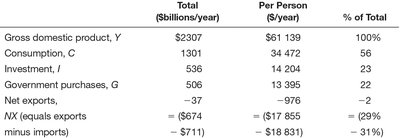
Example: In Canada, consumption is the largest component of GDP, followed by investment and government purchases. Net exports are often negative, reflecting a trade deficit.
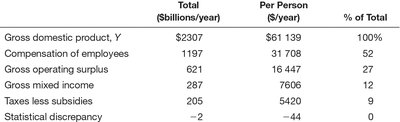
Additional info: The income approach to GDP sums compensation of employees, gross operating surplus, gross mixed income, and taxes less subsidies.
Real versus Nominal GDP
Distinguishing Output and Price Changes
When total spending rises from one year to the next, it could be due to increased production or higher prices. Economists distinguish between these effects using nominal and real GDP.
Nominal GDP: The value of goods and services at current prices.
Real GDP: The value of goods and services at constant (base year) prices.
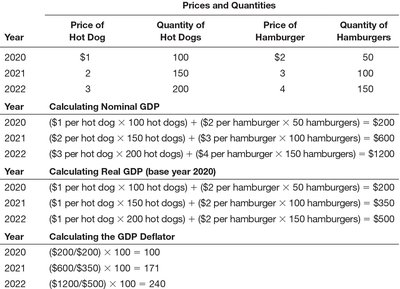
GDP Deflator: A measure of the price level, calculated as:
Inflation Rate: The percentage change in the GDP deflator from one period to the next:
Real GDP Over Time
Trends in Economic Growth
Real GDP is used to track the growth of an economy over time, adjusting for inflation. It provides a clearer picture of changes in output and living standards.
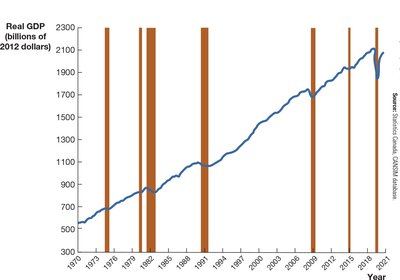
Example: The graph shows steady growth in real GDP over the past decades, with occasional recessions indicated by declines.
GDP and Economic Well-Being
Limitations of GDP as a Measure of Welfare
While GDP is a useful indicator of economic activity, it does not capture all aspects of well-being. Some important factors are omitted:
Leisure time
Non-market activities (e.g., home production, volunteer work)
Quality of the environment
Income distribution
GDP per capita is often used to compare living standards across countries, but it should be supplemented with other measures for a fuller picture of well-being.
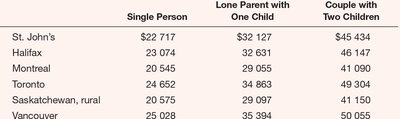
Example: The official poverty line varies by household type and location, reflecting differences in cost of living.
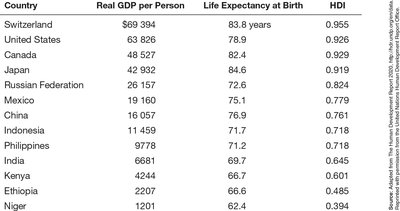
Example: Countries with higher GDP per person tend to have higher life expectancy and Human Development Index (HDI) scores, but there are exceptions.
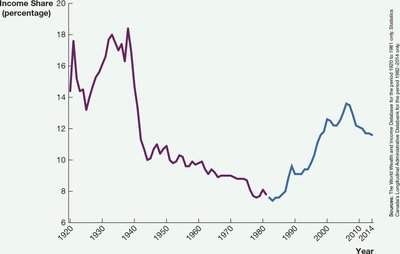
Additional info: The distribution of income, as shown by the income share of the top 1 percent, is an important aspect of economic well-being not captured by GDP alone.
