 Back
BackMeasuring National Output and National Income: GDP, GNP, and Their Applications
Study Guide - Smart Notes
 Tailored notes based on your materials, expanded with key definitions, examples, and context.
Measuring National Output and National Income
Introduction
This chapter explores how economists measure the overall economic activity of a country, focusing on the concepts of Gross Domestic Product (GDP), Gross National Product (GNP), and related measures. Understanding these concepts is essential for analyzing economic growth, comparing economies, and formulating policy.
Gross Domestic Product (GDP)
Definition and Fundamentals
Gross Domestic Product (GDP): The total market value of all final goods and services produced within a given period by factors of production located within a country.
GDP measures the value of output produced within a country's borders, regardless of who owns the productive resources.
National income and product accounts: Data compiled by government agencies (e.g., the U.S. Bureau of Economic Analysis) to track the components of national income and output.
Final Goods, Intermediate Goods, and Value Added
Final goods and services: Goods and services produced for final use, not for resale or further processing.
Intermediate goods: Goods used as inputs in the production of other goods.
Value added: The difference between the value of a firm's output and the value of the intermediate goods it purchases.
GDP can be calculated by summing the value added at each stage of production or by taking the value of final sales.
Example: Value Added in Gasoline Production
Stage of Production | Value of Sales | Value Added |
|---|---|---|
Oil drilling | $3.00 | $3.00 |
Refining | $3.30 | $0.30 |
Shipping | $3.60 | $0.30 |
Retail sale | $4.00 | $0.40 |
Total value added | $4.00 |
Exclusions from GDP
Used goods and purely financial transactions are not included in GDP, as they do not represent new production.
GDP excludes output produced abroad by domestically owned factors of production.
Gross National Product (GNP)
Gross National Product (GNP): The total market value of all final goods and services produced within a given period by factors of production owned by a country's citizens, regardless of where the output is produced.
GNP = GDP + Net receipts of factor income from abroad.
Calculating GDP
The Expenditure Approach
The expenditure approach sums all spending on final goods and services produced within a country during a given period.
Personal consumption expenditures (C): Household spending on goods and services.
Gross private domestic investment (Ia): Spending on new capital (plant, equipment, inventory, and new residential structures).
Government consumption and gross investment (G): Government spending on final goods and services.
Net exports (EX − IM): Exports minus imports.
Expenditure Approach Formula:
Example: U.S. GDP Components (2017)
Component | Billions of Dollars ($) | Percentage of GDP (%) |
|---|---|---|
Personal consumption expenditures (C) | 13,395.5 | 69.1 |
Gross private domestic investment (Ia) | 3,212.8 | 16.6 |
Government consumption and gross investment (G) | 3,353.8 | 17.3 |
Net exports (EX − IM) | -571.6 | -2.9 |
Gross domestic product | 19,390.6 | 100.0 |
The Income Approach
The income approach sums all incomes earned by factors of production in the creation of output.
Compensation of employees: Wages, salaries, and supplements paid to households.
Proprietors’ income: Income of unincorporated businesses.
Rental income: Income received by property owners.
Corporate profits: Income of corporations.
Net interest: Interest paid by businesses.
Indirect taxes minus subsidies: Taxes such as sales taxes, less government subsidies.
Net business transfer payments and surplus of government enterprises are also included.
Example: National Income Components (2017)
Component | Billions of Dollars ($) | Percentage of National Income (%) |
|---|---|---|
Compensation of employees | 10,307.2 | 62.1 |
Proprietors’ income | 1,386.0 | 8.3 |
Rental income | 743.9 | 4.5 |
Corporate profits | 2,164.6 | 13.0 |
Net interest | 586.4 | 3.5 |
Indirect taxes minus subsidies | 1,268.8 | 7.6 |
Net business transfer payments | 161.8 | 1.0 |
Surplus of government enterprises | -11.0 | -0.1 |
National income | 16,607.7 | 100.0 |
Nominal versus Real GDP
Definitions and Calculation
Nominal GDP: GDP measured in current dollars (current prices).
Real GDP: GDP measured in constant dollars, adjusted for changes in the price level using a base year.
Base year: The year chosen for the weights in a fixed-weight procedure.
GDP deflator: A measure of the overall price level, calculated as the ratio of nominal GDP to real GDP.
GDP Deflator Formula:
Problems with Fixed Weights
Fixed-weight procedures do not account for changes in consumption patterns or substitution between goods as relative prices change.
Structural changes in the economy can make fixed weights less accurate over time.
Limitations of the GDP Concept
GDP and Social Welfare
GDP does not measure nonmarket activities (e.g., household labor, volunteer work).
GDP does not account for the distribution of income or wealth among individuals.
GDP does not reflect changes in social welfare due to crime, leisure, or environmental quality.
The Informal Economy
The informal economy includes unreported transactions and income, which are not captured in GDP statistics.
Gross National Income (GNI) and Human Development Index (HDI)
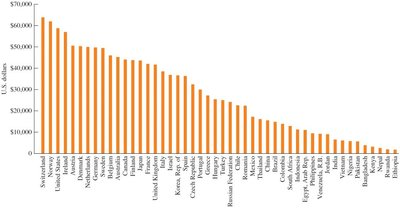
Gross National Income (GNI): GNP converted into dollars using average exchange rates, adjusted for inflation.
Human Development Index (HDI): An alternative measure developed by the United Nations to compare well-being across nations, considering factors such as life expectancy, education, and income.
Key Terms and Equations
Base year
Change in business inventories
Compensation of employees
Depreciation
Disposable personal income
Durable goods
Expenditure approach
Final goods and services
Fixed-weight procedure
Gross domestic product (GDP)
Gross national income (GNI)
Gross national product (GNP)
Income approach
Informal economy
Intermediate goods
National income
Net exports (EX − IM)
Nominal GDP
Nondurable goods
Personal consumption expenditures (C)
Personal income
Personal saving
Personal saving rate
Value added
Key Equations
Expenditure approach to GDP:
GDP and inventories:
Capital accumulation:
Additional info: The Human Development Index (HDI) and Gross National Income (GNI) are increasingly used to supplement GDP in international comparisons, as they provide a broader view of economic and social well-being.
