 Back
BackMeasuring the Cost of Living: Consumer Price Index and Inflation
Study Guide - Smart Notes
 Tailored notes based on your materials, expanded with key definitions, examples, and context.
Measuring the Cost of Living
Introduction to the Cost of Living and Inflation
The cost of living is a fundamental concept in macroeconomics, reflecting the amount of money required to maintain a certain standard of living. Economists use the Consumer Price Index (CPI) to monitor changes in the cost of living over time. When the CPI rises, families must spend more to maintain their standard of living. Inflation describes a situation where the overall price level in the economy is rising, and the inflation rate is the percentage change in the price level from the previous period.
The Consumer Price Index (CPI)
Definition and Purpose
The Consumer Price Index (CPI) is a measure of the overall cost of goods and services bought by a typical consumer. It is calculated and reported monthly by national statistical agencies, such as Statistics Canada, using data on hundreds of goods and services.
How the CPI Is Calculated
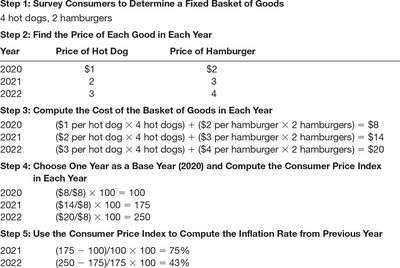
The calculation of the CPI involves several steps:
Determine the basket: Identify which goods and services are most important to the typical consumer.
Find the prices: Collect prices for each item in the basket at different points in time.
Compute the basket’s cost: Calculate the total cost of the basket for each period.
Choose a base year: Select a base year and compute the index for each period.
Compute the inflation rate: Calculate the percentage change in the CPI from one period to the next.
Formulas:
CPI:
Inflation Rate:
What Is in the CPI’s Basket?
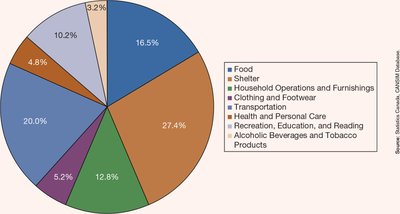
The CPI basket is composed of various categories of goods and services, weighted according to their importance in consumer spending. Major categories include food, shelter, transportation, and health care.
Problems in Measuring the Cost of Living
The CPI is not a perfect measure due to several biases:
Commodity substitution bias: Consumers may substitute cheaper goods for those that have risen in price.
Introduction of new goods: New products can change the basket and consumer choices.
Unmeasured quality change: Improvements or deteriorations in quality are not always fully captured.
These biases can cause the CPI to overstate the cost of living by about 0.5 percentage points per year.
Price Changes Over Time
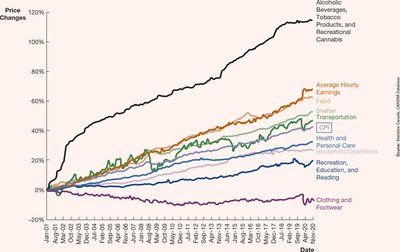
Different categories of goods and services experience varying rates of price change over time. Tracking these changes helps economists understand inflation trends and their impact on consumers.
The GDP Deflator Versus the Consumer Price Index
Comparing Measures of Inflation
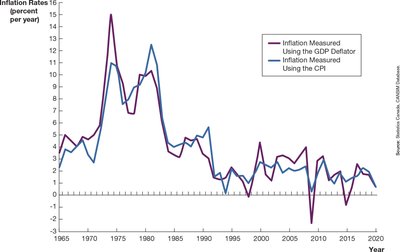
Both the GDP deflator and the CPI are used to gauge inflation, but they differ in scope:
The GDP deflator reflects prices of goods and services produced domestically.
The CPI reflects prices of goods and services bought by consumers, including imports.
The GDP deflator compares prices of currently produced goods and services with those in the base year, while the CPI compares a fixed basket over time.
Correcting Economic Variables for the Effects of Inflation
Comparing Dollar Figures from Different Times
To compare prices or incomes from different years, economists adjust for inflation using the CPI. This process is called indexation.
Formula:
Example: Adjusting the price of gasoline from 1957 to 2021 using CPI values.
Indexation
Indexation is the automatic correction of a dollar amount for the effects of inflation by law or contract. For example, a cost-of-living allowance (COLA) automatically raises wages when the CPI increases.
Real and Nominal Interest Rates
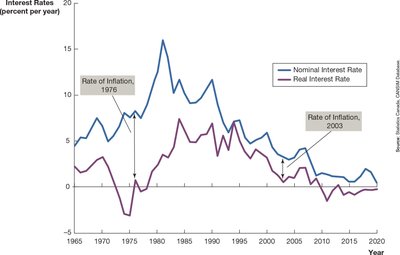
Interest rates must be adjusted for inflation to reflect true changes in purchasing power:
Nominal interest rate: The reported rate, not adjusted for inflation.
Real interest rate: The nominal rate minus the inflation rate, showing the actual increase in purchasing power.
Formula:
Student Price Index Activity
Creating a Personalized Price Index
Students can create their own price index by selecting specific products they purchase, determining quantities, finding prices, and calculating the total cost. This exercise helps understand how inflation affects personal spending.
Summary Table: CPI Calculation Example
Year | Price of Hot Dog | Price of Hamburger | Basket Cost | CPI | Inflation Rate |
|---|---|---|---|---|---|
2020 | $1 | $2 | $8 | 100 | - |
2021 | $2 | $3 | $14 | 175 | 75% |
2022 | $3 | $4 | $20 | 250 | 43% |
Key Terms
Consumer Price Index (CPI): Measures the cost of a fixed basket of goods and services purchased by a typical consumer.
Inflation: The rate at which the general level of prices for goods and services is rising.
GDP Deflator: A measure of price inflation for all domestically produced goods and services.
Indexation: Adjusting monetary values for inflation.
Nominal Interest Rate: The stated interest rate, not adjusted for inflation.
Real Interest Rate: The nominal rate minus the inflation rate.
Additional info:
Biases in CPI measurement can affect policy decisions and economic analysis.
Comparing CPI and GDP deflator helps understand differences in inflation measurement.
Indexation is crucial for maintaining purchasing power in long-term contracts.
