 Back
BackMeasuring the Cost of Living: CPI, Inflation, and Real vs. Nominal Values
Study Guide - Smart Notes
 Tailored notes based on your materials, expanded with key definitions, examples, and context.
Measuring the Cost of Living
The Consumer Price Index (CPI)
The Consumer Price Index (CPI) is a key economic indicator that measures the average change over time in the prices paid by urban consumers for a market basket of consumer goods and services. It is widely used to assess price changes associated with the cost of living.
CPI Definition: Measures the typical consumer’s cost of living.
Purpose: Used to track inflation and adjust dollar values for changes in purchasing power.
How the CPI Is Calculated
The calculation of the CPI involves several steps to ensure it accurately reflects consumer spending patterns and price changes.
Fix the “basket”: The Bureau of Labor Statistics (BLS) surveys consumers to determine the typical items purchased.
Find the prices: The BLS collects data on the prices of all goods in the basket.
Compute the basket’s cost: Use the prices to compute the total cost of the basket.
Choose a base year and compute the index: The CPI in any year is calculated as:
Compute the inflation rate: The percentage change in the CPI from the preceding period:
Example: Calculating CPI and Inflation Rate
Suppose the CPI basket consists of 10 lbs. of beef and 20 lbs. of chicken. Prices change over three years:
2023 (base year): Beef $4, Chicken $4
2024: Beef $5, Chicken $5
2025: Beef $9, Chicken $6
To compute CPI and inflation rate:
CPI in 2024: Calculate the cost of the basket in 2024 and divide by the cost in 2023, then multiply by 100.
Inflation rate from 2024–2025: Use the formula above to find the percentage change.
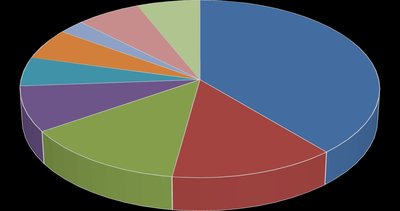
What’s in the CPI’s Basket?
The CPI basket is composed of various categories of goods and services, reflecting typical consumer expenditures. The largest components are housing, transportation, and food & beverages.
Major categories: Housing, Transportation, Food & Beverages, Medical Care, Recreation, Education & Communication, Apparel, Energy, Other.
Problems with the CPI
While the CPI is a useful measure, it has several limitations that can lead to an overstatement of the true increase in the cost of living.
Substitution Bias
Some prices rise faster than others, causing consumers to substitute toward relatively cheaper goods.
The CPI uses a fixed basket and misses these substitutions, overstating cost increases.
Example: If beef becomes expensive, consumers may buy more chicken, but the CPI does not reflect this change.
Introduction of New Goods
New goods increase variety and allow consumers to better meet their needs.
The CPI’s fixed basket misses the effect of new goods, overstating cost increases.
Unmeasured Quality Change
Improvements in quality increase the value of each dollar spent.
The BLS attempts to account for quality changes, but some improvements are difficult to measure.
Contrasting the CPI and GDP Deflator
The GDP deflator is another measure of price changes, but it differs from the CPI in several ways:
Imported consumer goods: Included in CPI, excluded from GDP deflator.
Basket composition: CPI uses a fixed basket; GDP deflator uses a basket of currently produced goods and services.
Capital goods & government spending: Excluded from CPI, included in GDP deflator if produced domestically.
Comparison Table: CPI vs. GDP Deflator
Feature | CPI | GDP Deflator |
|---|---|---|
Imported Goods | Included | Excluded |
Basket Type | Fixed | Current Production |
Capital Goods | Excluded | Included (domestic) |
Government Spending | Excluded | Included |
Correcting Variables for Inflation
Comparing Dollar Figures from Different Times
Inflation makes it difficult to compare dollar amounts from different years. To adjust for inflation, use the CPI to convert past figures into today’s dollars:
Formula:
Example: Minimum wage in 1964 (\text{Amount in 2024 dollars} = 1.15 \times \frac{313.7}{31.0} = 11.64$
Real vs. Nominal Interest Rates
The distinction between real and nominal interest rates is crucial for understanding the impact of inflation on savings and loans.
Nominal interest rate: The rate not corrected for inflation; measures growth in dollar value.
Real interest rate: Corrected for inflation; measures growth in purchasing power.
Formula:
Example: If nominal rate is 9% and inflation is 3.5%, real rate is 5.5%.
Summary Table: Real vs. Nominal Interest Rates
Type | Definition | Formula |
|---|---|---|
Nominal | Not corrected for inflation | — |
Real | Corrected for inflation | Nominal rate - Inflation rate |
Applications and Examples
Tuition increases: To compare tuition costs over time, convert past values to current dollars using the CPI, then calculate percentage increases.
Interest rates: Real interest rates provide a better measure of the true return on savings or cost of borrowing.
Additional info: These notes expand on the original slides by providing full definitions, formulas, and context for CPI, inflation, and real vs. nominal values, ensuring a self-contained study guide for macroeconomics students.
