 Back
BackMoney, Interest Rates, and Exchange Rates: Study Guide
Study Guide - Smart Notes
 Tailored notes based on your materials, expanded with key definitions, examples, and context.
Money: Definition and Measures
What Is Money?
Money is an asset that is widely used as a means of payment. It can be defined narrowly or broadly, depending on which assets are included. The most liquid forms of money are currency in circulation, checking deposits, and debit card accounts. Less liquid assets, such as savings deposits and time deposits, may be included in broader definitions of money.
Monetary assets (liquid assets): Easily used for transactions, e.g., currency, checking deposits.
Nonmonetary assets (illiquid assets): Require substantial transaction costs to convert to money, e.g., bonds, stocks, real estate.
Liquidity: The ease with which an asset can be converted to cash for payment.
Money Measures in Canada: M1, M2, and M2+
Money is measured in different aggregates, reflecting varying degrees of liquidity:
M1 (narrow money): Currency in circulation + chequable deposits. Most liquid, used directly for transactions.
M2: M1 + savings deposits + non-chequable notice deposits. Still highly liquid, used for spending and precautionary saving.
M2+ (broad money): M2 + term deposits and other short-term deposits. Captures money held as stores of value.
Example: In Canada (2025), M2+ ≈ $3.5 trillion, reflecting household savings and deposits.
Money Supply and Central Bank Policy
How Central Banks Influence Liquidity
The money supply is the quantity of monetary assets available in the economy. Central banks influence, but do not mechanically fix, the money supply. In Canada, the Bank of Canada (BoC) implements monetary policy by setting the policy interest rate and managing liquidity in settlement balances.
Direct control: Currency in circulation and settlement balances held by financial institutions at the central bank.
Indirect influence: Bank deposits and broad money (M2, M2+) through interest rates, lending conditions, and expectations.
Modern central banks: Steer money through prices (interest rates), not quantities; money aggregates respond endogenously.
Money Demand
Determinants of Money Demand
Money demand represents the amount of monetary assets people are willing to hold instead of illiquid assets. It is influenced by several factors:
Interest rates: Higher interest rates on nonmonetary assets increase the opportunity cost of holding money, reducing money demand.
Risk: Unexpected inflation reduces the purchasing power of money, but this risk is shared by many assets.
Liquidity: Greater need for liquidity occurs when transaction prices or quantities increase.
Prices: Higher average prices increase the need for liquidity, raising money demand.
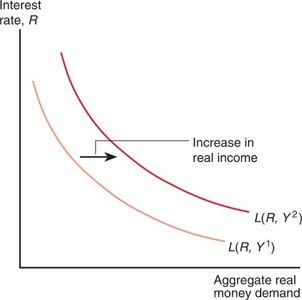
Income: Higher real national income (GNP) increases the need for money to conduct transactions.
Aggregate Money Demand Model
The aggregate demand for money can be expressed as:
P: Price level
Y: Real national income
R: Interest rate on nonmonetary assets
L(R, Y): Aggregate demand for real monetary assets, a function of income and interest rates
Example: As real income increases, the demand for real money balances rises at every interest rate, shifting the demand curve upward.
The Money Market
Equilibrium in the Money Market
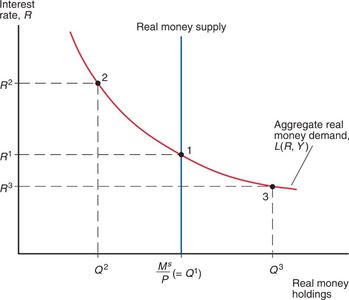
The money market is where monetary assets are lent and borrowed. Equilibrium occurs when the quantity of real monetary assets supplied matches the quantity demanded:
Excess supply of money: Leads to increased demand for interest-bearing assets, lowering interest rates.
Excess demand for money: Leads to increased supply of interest-bearing assets, raising interest rates.
Effects of Changes in Money Supply and Income
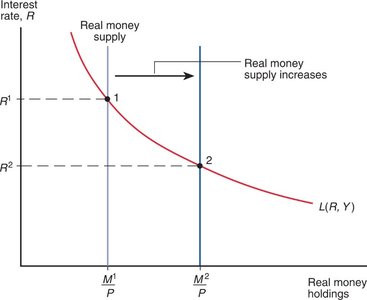
Increase in money supply: For a given price level and real income, an increase in money supply reduces the equilibrium interest rate.
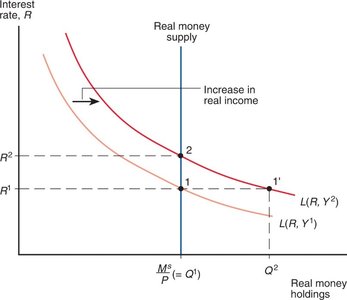
Increase in real income: For a given money supply, an increase in real income raises the equilibrium interest rate.
Money, Interest Rates, and Exchange Rates
Simultaneous Equilibrium in Money and Foreign Exchange Markets
Both the money market and the foreign exchange market must be in equilibrium. The interest rate and exchange rate are determined such that money supply equals money demand and the interest parity condition holds.
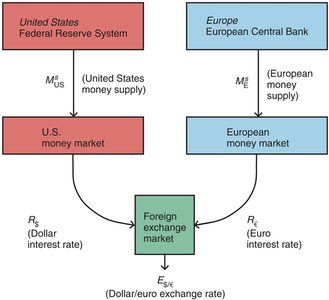
Effects of Changes in Money Supply on Exchange Rates
Increase in domestic money supply: Causes interest rates to fall, rates of return on domestic currency deposits to fall, and the domestic currency to depreciate.
Decrease in domestic money supply: Causes interest rates to rise, rates of return on domestic currency deposits to rise, and the domestic currency to appreciate.
Increase in foreign money supply: Causes the foreign currency to depreciate and the domestic currency to appreciate.
Short Run and Long Run Analysis
Short Run vs. Long Run Effects
Short run: Prices do not adjust quickly; analysis focuses on asset markets and interest rates.
Long run: Prices of factors and output adjust; real output and interest rates are determined by productive capacity, not money supply.
Long run equilibrium: Money supply changes affect price levels proportionally, but not real output or interest rates.
Money Growth and Inflation
Over long horizons, higher money growth is associated with higher inflation, especially in high-inflation environments. In low-inflation regimes, money growth is a noisy signal due to velocity and portfolio shifts.
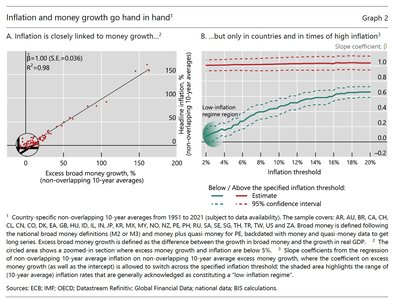
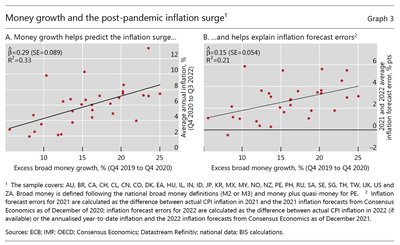
Money and Prices in the Long Run
Excess demand for goods and services: Higher money supply increases demand, leading to higher wages and prices.
Inflationary expectations: If workers and producers expect prices to rise, wages and prices adjust upward.
Exchange Rate Overshooting
The exchange rate may overshoot its long-run response to a change in money supply, especially when monetary policy affects interest rates immediately but prices adjust slowly. This explains exchange rate volatility.
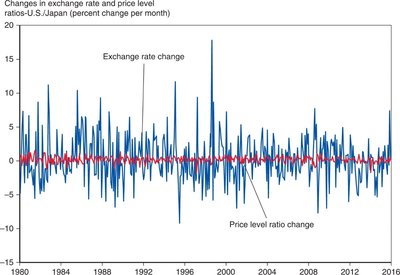
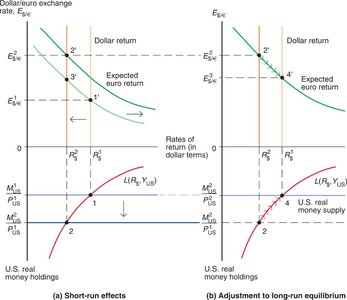
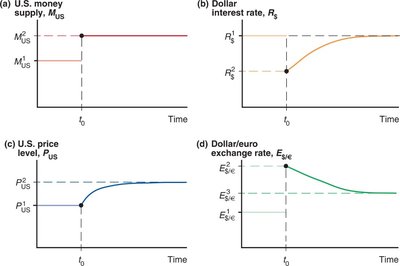
Overshooting: The exchange rate initially moves more than its long-run change, then settles to its equilibrium.
Summary Table: Money Supply Effects
Change | Interest Rate | Currency Value | Price Level (Long Run) |
|---|---|---|---|
Increase in Money Supply | Falls | Depreciates | Rises |
Decrease in Money Supply | Rises | Appreciates | Falls |
Increase in Foreign Money Supply | Foreign rate falls | Domestic appreciates | No change (domestic) |
Key Equations
Aggregate money demand:
Money market equilibrium:
Inflation rate:
Conclusion
Understanding the relationships between money, interest rates, and exchange rates is crucial for macroeconomic analysis. Central banks influence liquidity and financial conditions through monetary policy, affecting both domestic and international markets. The effects of money supply changes differ in the short run and long run, with important implications for inflation and exchange rates.
