 Back
BackProduction, Productivity, and Growth Accounting in Macroeconomics
Study Guide - Smart Notes
 Tailored notes based on your materials, expanded with key definitions, examples, and context.
Production, Productivity, and Growth Accounting
Aggregate Production Function
The aggregate production function is a foundational concept in macroeconomics, relating the total output of an economy to the quantities of capital and labor employed, as well as the effectiveness with which these inputs are used.
Definition: The general form is , where:
= Real output produced (GDP)
= Total Factor Productivity (TFP), measuring the effectiveness of input use
= Capital stock (quantity of capital used)
= Number of workers employed
TFP (): Captures technology, organizational efficiency, and other factors not directly measured by or .
Why ignore other inputs? Inputs like materials are often subsumed into or considered less central for macro-level analysis.
Properties of the Production Function
The production function exhibits several important properties that help explain economic growth and productivity.
Constant Returns to Scale (CRS): If all inputs are increased by a factor , output increases by the same factor: .
Example (Cobb-Douglas): , with typically around 0.3 for capital.
Doubling all inputs: (output doubles).
Increasing only one input: Output increases less than proportionally due to diminishing returns.
Marginal Products
Marginal products measure the additional output generated by increasing one input while holding the other constant.
Marginal Product of Labour (MPN): (holding fixed).
MPN is positive: Increasing increases .
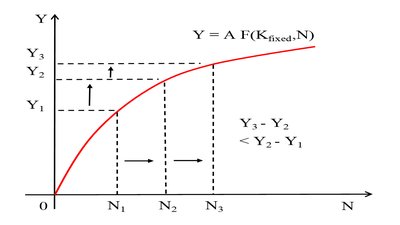
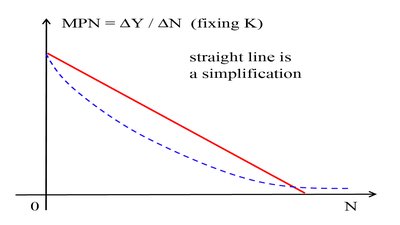
Diminishing MPN: As increases, declines due to the fixed amount of capital.
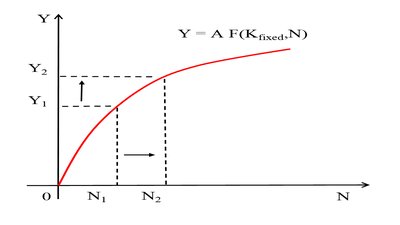
Diminishing Marginal Productivity: Successive increases in yield smaller increases in .
Marginal Product of Capital (MPK): (holding fixed). MPK also diminishes as increases.
Graphical Representation of MPN
The marginal product of labor can be illustrated as a downward-sloping curve, reflecting diminishing returns.
Supply (Productivity) Shocks
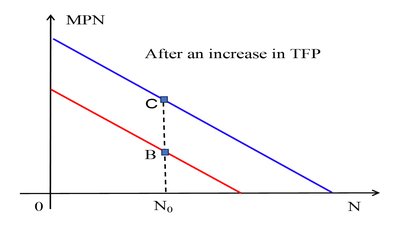
Supply shocks refer to changes in total factor productivity (), which shift the production function and marginal product curves.
Positive supply shock: An increase in allows more output for any given and .
Effect on MPN and MPK: Both curves shift upward, indicating higher productivity of each input.
Growth Accounting
Growth accounting decomposes the growth rate of output into contributions from capital, labor, and TFP.
Cobb-Douglas function:
Growth rate decomposition:
TFP growth:
Interpretation: TFP growth captures improvements in efficiency and technology not explained by increases in capital or labor.
GDP per Capita and Labor Productivity
GDP per capita is a key measure of economic well-being, and its growth depends on labor force participation and labor productivity.
GDP per capita:
: Fraction of population in the labor force
: Output per worker (labor productivity)
Growth in GDP per capita:
If is stable, growth in GDP per capita comes from growth in labor productivity.
Labor Productivity and Capital-Labor Ratio
Labor productivity is closely linked to the capital-labor ratio and TFP.
From Cobb-Douglas:
Growth in labor productivity:
TFP growth is a major determinant of long-run increases in labor productivity and GDP per capita.
Summary Table: Growth Accounting Decomposition
Component | Formula | Interpretation |
|---|---|---|
Output Growth | Total growth rate of output | |
TFP Growth | Growth due to technology/efficiency | |
Capital Contribution | Growth due to capital accumulation | |
Labor Contribution | Growth due to labor input |
Additional info: The Cobb-Douglas production function is widely used in empirical macroeconomics due to its tractable properties and ability to fit observed data on output, capital, and labor shares.
