 Back
BackResource Market and Labor Market: Principles of Macroeconomics Study Notes
Study Guide - Smart Notes
 Tailored notes based on your materials, expanded with key definitions, examples, and context.
Resource Market and Labor Market
Overview of Macroeconomic Markets
The macroeconomy is composed of several key markets that interact to determine overall economic outcomes. Understanding these markets is essential for analyzing aggregate demand and aggregate supply.
Resource Market: Where firms demand and households supply resources such as labor, capital, land, and entrepreneurship.
Credit Market (Loanable Funds Market): Where funds are borrowed and lent, determining interest rates.
Foreign Exchange Market (Forex Market): Where currencies are traded, affecting exchange rates.
Product Market (Goods and Services Market): Where final goods and services are bought and sold; modeled using the AD/AS framework.
Macroeconomic Goals and Policy
Macroeconomic policy aims to achieve several desirable goals:
Full Employment: Maximizing the use of available labor resources.
Price Stability: Minimizing inflation and deflation.
Economic Growth: Increasing the economy's productive capacity over time.
Fiscal Policy involves government spending and taxation to influence macroeconomic outcomes, while Monetary Policy involves controlling interest rates. In this module, it is assumed these policies remain unchanged.
Resource Market
Definition and Components
The resource market is a highly aggregated market where firms demand resources and households supply them. The largest component is the labor market.
Labor: Includes both unskilled labor and human capital (knowledge and skills from education and training).
Physical Capital: Tools, machines, buildings used in production.
Natural Resources: "Gifts of nature" such as land, minerals, and energy sources.
Entrepreneurship: The human skill to organize and combine other resources for production.
Examples of Resource Use
Producing education services (such as a university lecture) involves:
Capital: Lecture hall, classroom furniture, projector, instructor's laptop.
Labor: Instructor's human capital.
Natural Resources: Electricity generated from natural gas.
Additional info: These examples illustrate how multiple resource types are combined in real-world production.
Demand and Supply in the Resource Market
Derived Demand and Supply
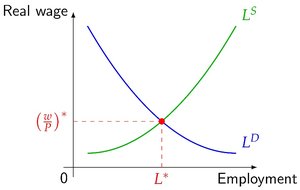
Resource demand is called derived demand because firms demand resources to produce goods and services that households want. The demand curve for resources is downward sloping, reflecting that higher wages (or prices) reduce the quantity demanded. Households supply resources in exchange for income, and the supply curve is upward sloping, indicating that higher wages increase the quantity supplied.
Demand Curve: Downward sloping; firms demand fewer resources at higher prices.
Supply Curve: Upward sloping; households supply more resources at higher prices.
Equilibrium in the Labor Market
Equilibrium occurs where the quantity of labor demanded by firms equals the quantity supplied by households. The equilibrium wage and employment level are determined at this intersection.
Equilibrium Wage (): The real wage rate at which labor supply equals labor demand.
Equilibrium Employment (): The quantity of labor employed at equilibrium.
The equilibrium ensures that the labor market clears, meaning there is no excess supply (unemployment) or excess demand (labor shortages) at the equilibrium wage.
Labor Market in the News
Current Trends
Recent news highlights a shrinking number of available jobs in the US, with hiring rates at their lowest since the pandemic. This reflects changes in labor market equilibrium and can signal broader macroeconomic challenges such as reduced economic growth or increased unemployment.
Job Openings: Fewer available positions indicate a tighter labor market.
Hiring Rate: Lower rates suggest reduced demand for labor.
Additional info: Monitoring labor market trends is crucial for understanding macroeconomic health and policy needs.
