 Back
BackTen Principles of Economics: Foundations of Macroeconomic Thinking
Study Guide - Smart Notes
 Tailored notes based on your materials, expanded with key definitions, examples, and context.
Introduction to Macroeconomics
What is Economics?
Economics is the study of how society manages its scarce resources. The term 'economy' originates from the Greek word for 'one who manages a household.' Because resources are limited, societies must make choices about how to allocate them efficiently and equitably.
Scarcity: Resources are limited, so not all wants can be satisfied.
Economics: The discipline that examines how individuals and societies allocate scarce resources.
Resource allocation is determined by the combined actions of households and firms.
How People Make Decisions
Principle 1: People Face Tradeoffs
Every decision involves tradeoffs because resources are scarce. Choosing one thing often means giving up something else.
Efficiency: Getting the most from scarce resources.
Equity: Distributing economic prosperity fairly among society's members.
Principle 2: The Cost of Something Is What You Give Up to Get It
The true cost of any decision is its opportunity cost—the value of the next best alternative foregone.
Opportunity Cost: Whatever must be given up to obtain an item.
Example: The opportunity cost of going to a movie includes the ticket price, snacks, and the value of your time.
Principle 3: Rational People Think at the Margin
Rational individuals make decisions by comparing marginal benefits and marginal costs, making small incremental adjustments to their plans.
Rational People: Those who systematically and purposefully do the best they can to achieve their objectives.
Marginal Changes: Small, incremental adjustments to an existing plan.
Example: Deciding whether to repair a car depends on the marginal benefit versus the marginal cost of the repair, not on past expenditures (sunk costs).
Principle 4: People Respond to Incentives
Incentives are rewards or penalties that motivate people to act. Changes in costs or benefits can alter behavior.
Incentive: Something that induces a person to act.
Example: A higher price for a good encourages buyers to consume less and sellers to produce more.
How People Interact
Principle 5: Trade Can Make Everyone Better Off
Trade allows individuals, firms, and countries to specialize in what they do best and to enjoy a greater variety of goods and services. Specialization and exchange increase overall economic welfare.
Trade benefits all parties involved when each specializes according to their comparative advantage.
Principle 6: Markets Are Usually a Good Way to Organize Economic Activity
Market economies allocate resources through the decentralized decisions of many firms and households as they interact in markets for goods and services. Adam Smith described this process as being guided by an 'invisible hand.'
Market Economy: An economy that allocates resources through the decentralized decisions of many firms and households.
Prices act as signals that guide the allocation of resources.
Principle 7: Governments Can Sometimes Improve Market Outcomes
Governments are necessary to enforce property rights and, in some cases, to intervene in the economy to promote efficiency and equity. Market failures, such as externalities and market power, may require government intervention.
Property Rights: The ability of individuals to own and control scarce resources.
Market Failure: When the market fails to allocate resources efficiently.
Externality: The impact of one person’s actions on the well-being of a bystander.
Market Power: The ability of a single economic actor or group to influence market prices.
How the Economy as a Whole Works
Principle 8: A Country’s Standard of Living Depends on Its Ability to Produce Goods and Services
The standard of living in a country is determined by the productivity of its workers—the amount of goods and services produced per hour of labor.
Productivity: The quantity of goods and services produced from each hour of a worker’s time.
Principle 9: Prices Rise When the Government Prints Too Much Money
Inflation is an increase in the overall level of prices in the economy. It is often caused by rapid growth in the quantity of money, which reduces the value of money.
Inflation: An increase in the overall price level.
Principle 10: Society Faces a Short-Run Tradeoff between Inflation and Unemployment
In the short run, reducing inflation often leads to higher unemployment, and vice versa. This tradeoff is a key concept in the analysis of the business cycle.
Business Cycle: The irregular and largely unpredictable fluctuations in economic activity, as measured by the production of goods and services or the number of people employed.
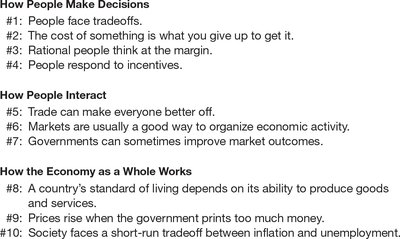
Summary Table: The Ten Principles of Economics
How People Make Decisions | How People Interact | How the Economy as a Whole Works |
|---|---|---|
#1: People face tradeoffs | #5: Trade can make everyone better off | #8: Standard of living depends on productivity |
#2: The cost of something is what you give up to get it | #6: Markets are usually a good way to organize economic activity | #9: Prices rise when the government prints too much money |
#3: Rational people think at the margin | #7: Governments can sometimes improve market outcomes | #10: Society faces a short-run tradeoff between inflation and unemployment |
#4: People respond to incentives |
Application: Marginal Analysis Example
Consider the decision to repair a car before selling it. The cost of the repair should be compared to the increase in the car's value (the marginal benefit). Past costs (sunk costs) are irrelevant to the decision.
Example: If repairing a transmission costs $600 and increases the car's value by $800, the repair is worthwhile. If it increases the value by only $500, it is not.
Quick Quiz: Sample Questions
What is the opportunity cost of going to a movie? (Answer: The total cash expenditure plus the value of your time.)
What is a marginal change? (Answer: An incremental alteration to an existing plan.)
Why does trade benefit nations? (Answer: Because all nations can specialize in what they do best.)
Why might governments intervene in markets? (Answer: To correct market failures and achieve a more equitable distribution of income.)
Additional info:
These principles form the foundation for understanding more advanced macroeconomic topics such as aggregate demand and supply, fiscal and monetary policy, and economic growth.
