 Back
BackThe Balance of Payments: Structure, Accounts, and Macroeconomic Implications
Study Guide - Smart Notes
 Tailored notes based on your materials, expanded with key definitions, examples, and context.
Balance of Payments: Overview
Definition and Importance
The balance of payments (BOP) is a comprehensive record of a country’s economic transactions with the rest of the world over a specific period. It is crucial for understanding the relationship between national saving, investment, and international trade, and for analyzing the determinants of a country's real interest rate and goods market equilibrium in an open economy.
Credit items: Transactions that bring funds into the country (e.g., exports, asset sales).
Debit items: Transactions that send funds out of the country (e.g., imports, asset purchases).
Structure of the Balance of Payments
Current Account (CA)
The current account measures trade in currently produced goods and services, net factor payments, and current transfers between countries.
Net exports (NX): Exports minus imports of goods and services.
Net factor payments from abroad (NFP): Income received from foreign investments minus income paid to foreign investors.
Current transfers: Transfers not related to goods, services, or production factors (e.g., foreign aid).
Formula:
Capital and Financial Account (KA)
The capital and financial account records transactions involving existing assets, including direct and portfolio investments, and other capital transfers.
Financial account: Records purchases and sales of financial assets (e.g., stocks, bonds, real estate).
Capital account: Records transfers such as migrants’ funds, inheritances, and intellectual property transactions.
Financial inflow: Sale of Canadian assets to foreigners (credit).
Financial outflow: Purchase of foreign assets by Canadians (debit).
Official Settlement Balance
The official settlement balance (or official reserves account) tracks changes in the central bank’s holdings of foreign assets, such as gold, foreign government securities, and deposits at the IMF. It reflects the net result of all international transactions and is part of the capital and financial account.
If financial inflows exceed outflows, the official settlement balance increases (surplus).
If financial outflows exceed inflows, the official settlement balance decreases (deficit).
Accounting Identity and Equilibrium
Balance of Payments Identity
The sum of the current account and the capital and financial account (including the official settlement balance and statistical discrepancy) must always equal zero:
This identity ensures that all international transactions are accounted for, with any measurement errors captured as a statistical discrepancy.
Goods Market Equilibrium in an Open Economy
In an open economy, the equilibrium condition for the goods market is:
Where:
= Desired national saving
= Desired domestic investment
= Current account balance
If net factor payments are negligible (), this simplifies to:
Net Foreign Assets and International Flows
Net Foreign Assets (NFA)
Net foreign assets represent the difference between a country’s foreign assets and its foreign liabilities. Changes in NFA occur when:
The value of existing foreign assets or liabilities changes.
The country acquires new foreign assets or incurs new liabilities.
The net acquisition of foreign assets is equal to the current account surplus.
Empirical Example: Canada’s Balance of Payments (2018)
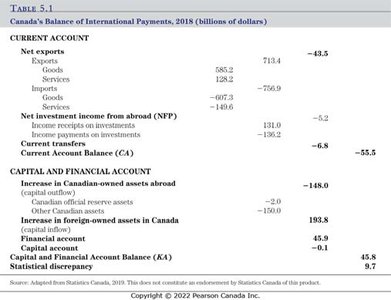
The following table summarizes Canada’s balance of international payments for 2018, illustrating the relationships among the current account, capital and financial account, and the statistical discrepancy.
CURRENT ACCOUNT | ||
|---|---|---|
Net exports | -43.5 | |
Exports | 713.4 | |
Imports | 756.9 | |
Net investment income from abroad (NFP) | -5.2 | |
Current transfers | -6.8 | |
Current Account Balance (CA) | -55.5 | |
CAPITAL AND FINANCIAL ACCOUNT | ||
Increase in Canadian-owned assets abroad | -148.0 | |
Increase in foreign-owned assets in Canada | 193.8 | |
Financial account | 45.9 | |
Capital account | -0.1 | |
Capital and Financial Account Balance (KA) | 45.8 | |
Statistical discrepancy | 9.7 | |
Illustrative Cases: Why CA + KA = 0
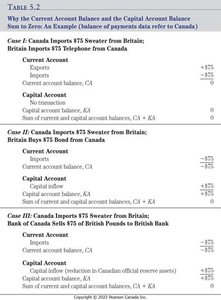
The following table demonstrates, through three cases, why the current account and capital account balances must sum to zero. Each case shows how international transactions are recorded and how the accounting identity is maintained.
Case | Current Account | Capital Account | Sum (CA + KA) |
|---|---|---|---|
I: Canada imports $75 sweater from Britain; Britain buys $75 telephone from Canada | +75 (exports) -75 (imports) = 0 | No transaction | 0 |
II: Canada imports $75 sweater from Britain; Britain buys $75 bond from Canada | -75 (imports) | +75 (capital inflow) | 0 |
III: Canada imports $75 sweater from Britain; Bank of Canada sells $75 of British pounds to British bank | -75 (imports) | +75 (reduction in Canadian official reserves) | 0 |
Summary Table: Key Balance of Payments Accounts
Account | Main Components | Examples |
|---|---|---|
Current Account (CA) | Net exports, Net factor payments, Current transfers | Goods/services trade, investment income, foreign aid |
Capital and Financial Account (KA) | Direct/portfolio investment, capital transfers | Foreign asset purchases, inheritance transfers |
Official Settlement Balance | Central bank foreign assets/liabilities | Gold, foreign reserves, IMF deposits |
Key Takeaways
The balance of payments provides a comprehensive view of a country’s international economic position.
The current account and capital and financial account must sum to zero, ensuring all transactions are balanced.
Goods market equilibrium in an open economy links national saving, investment, and the current account.
Changes in net foreign assets reflect the country’s current account surplus or deficit.
