 Back
BackThe Economics of Political Action: Government, Markets, and Public Choice
Study Guide - Smart Notes
 Tailored notes based on your materials, expanded with key definitions, examples, and context.
The Size and Growth of the U.S. Government
Government Spending as a Share of the Economy
Government spending in the United States has increased significantly over the past century, both in absolute terms and as a share of Gross Domestic Product (GDP). This growth reflects the expanding role of government in economic activity, including federal, state, and local levels.
Historical Trends: In 1930, total government spending was only 9.9% of GDP. By 1980, it had risen to 33.7%, and by 2019, it reached 36.2%.
Federal vs. State and Local: The federal share of spending has grown more rapidly than state and local spending, especially during periods of crisis and reform.
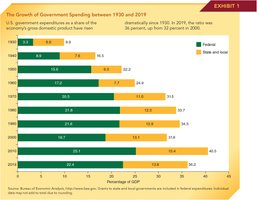
Example: Major increases in government spending occurred during the Great Depression, World War II, and the expansion of social programs in the 1960s and 1970s.
How the Federal and State/Local Governments Spend
Government expenditures are allocated across various categories, reflecting different priorities at the federal and state/local levels.
Federal Spending: Major categories include Social Security, Medicare and Medicaid, national defense, and interest on the debt.
State and Local Spending: Main areas are public welfare, education, health and hospitals, and police/fire protection.
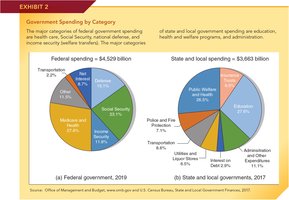
Example: In 2019, Social Security and health programs made up the largest share of federal spending, while education and public welfare dominated state and local budgets.
The Growth of Government Transfer Payments
Transfer payments are government payments to individuals for which no current goods or services are exchanged. These include Social Security, unemployment benefits, and welfare programs. Transfer payments have grown substantially as a share of GDP over the past eight decades.
Definition: Transfer payments redistribute income from taxpayers to recipients, often with the goal of reducing poverty or providing social insurance.
Trend: Transfer payments have increased from less than 1% of GDP in 1930 to over 17% in 2019.
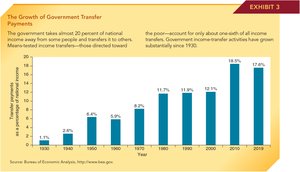
Example: Social Security and Medicare are the largest transfer programs in the U.S.
Political and Market Allocation: Similarities and Differences
Similarities Between Government and Markets
Both government and markets are mechanisms for allocating resources and making collective decisions. In both systems, individuals pursue their own interests, and outcomes depend on the aggregation of these interests.
Self-Interest: Individuals act in their own self-interest in both markets and politics.
Resource Allocation: Both systems allocate scarce resources, though the mechanisms differ (prices vs. votes).
Differences Between Government and Markets
Despite similarities, there are important differences in how decisions are made and resources are allocated in markets versus government.
Voluntary Exchange vs. Coercion: Market transactions are voluntary, while government can compel participation through taxation and regulation.
Information and Incentives: Markets use prices to convey information and incentives, while government relies on political processes and bureaucratic rules.
Decision-Making: Markets aggregate preferences through buying and selling; government aggregates preferences through voting and legislation.
Public Choice Analysis
Overview of Public Choice
Public choice analysis applies economic reasoning to the study of political behavior. It examines how self-interest and incentives influence the actions of voters, politicians, and bureaucrats.
Key Groups: Voter-taxpayers, politicians, and bureaucrats interact in the political process.
Self-Interest: All groups are assumed to act in their own self-interest, seeking to maximize their utility or power.
Example: Politicians may support policies that increase their chances of reelection, even if those policies are not economically efficient.
The Voter-Consumer
Voters act as consumers of government services, supporting policies and candidates that they believe will benefit them personally or align with their values.
The Politician-Supplier
Politicians supply government policies and programs, seeking support from voters and interest groups to win elections and maintain power.
Government Bureaucrats
Bureaucrats administer government programs and may seek to expand their budgets and influence, sometimes at the expense of efficiency.
When the Political Process Works Well
Distribution of Benefits and Costs Among Voters
The effectiveness of representative government depends on how the benefits and costs of policies are distributed among voters. There are four possible combinations:
Widespread Costs | Concentrated Costs | |
|---|---|---|
Widespread Benefits | Type 1 | Type 4 |
Concentrated Benefits | Type 2 | Type 3 |
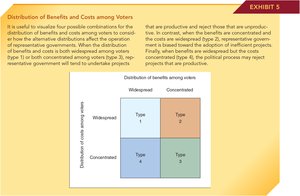
Type 1 & 3: Projects with both widespread or both concentrated benefits and costs tend to be productive and are usually adopted or rejected appropriately.
Type 2: Projects with concentrated benefits and widespread costs are often inefficient but may be adopted due to political pressures.
Type 4: Projects with widespread benefits and concentrated costs may be rejected even if they are efficient.
When Voting Works Well
Voting aligns with economic efficiency when costs are allocated in proportion to benefits received. In such cases, all voters gain from productive projects, and unproductive projects are rejected.
Proportional Cost Allocation: Ensures harmony between good politics and economic efficiency.
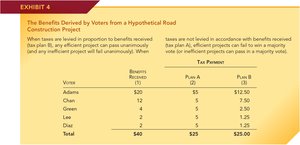
Example: In a hypothetical road project, if each voter pays according to the benefits received, all support the project. If costs are split equally, some may oppose it, leading to rejection even if the project is efficient.
When the Political Process Works Poorly
Special Interest Effect
The special interest effect occurs when a small group receives large benefits from a policy, while the costs are spread thinly across many taxpayers. This can lead to the adoption of inefficient policies because the beneficiaries are highly motivated and organized, while the costs to individuals are small and often unnoticed.
Rational Ignorance: Voters may remain uninformed about policies that have little personal impact, allowing special interests to dominate.
Example: Agricultural subsidies benefit a small group of farmers but are paid for by all taxpayers.
Trading Votes and Passing Counterproductive Legislation
Legislators may engage in vote trading (logrolling) to pass projects that benefit their own districts, even if the overall effect is negative for society. By supporting each other's projects, they can secure enough votes for passage.
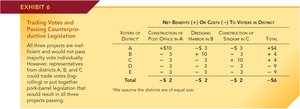
Counterproductive Legislation: Projects that would not pass individually may be approved through coalition-building, resulting in a net loss for society.
Shortsightedness Effect
The shortsightedness effect refers to the political tendency to favor policies with immediate, visible benefits and delayed, less visible costs. This can lead to underinvestment in long-term projects and overinvestment in short-term gains.
Rent Seeking
Rent seeking is the use of resources to obtain economic gains through the political process rather than through productive activity. This includes lobbying for subsidies, tariffs, or regulatory advantages.
Economic Inefficiency: Rent seeking diverts resources from productive uses and can reduce overall economic welfare.
Government Operated Firms
Government-operated firms may lack the profit motive and competitive pressures that drive efficiency in private markets, leading to higher costs and lower quality of service.
Political Favoritism, Crony Capitalism, and Government Failure
Political Favoritism and Crony Capitalism
As government involvement in the economy grows, so does the potential for political favoritism and crony capitalism. In crony capitalism, resources are allocated based on political connections rather than market forces, undermining economic efficiency and public trust.
Market Entrepreneurs: Succeed by meeting consumer needs efficiently.
Crony Capitalists: Succeed by securing government favors, such as contracts, subsidies, or regulatory advantages.
Example: Bailouts and targeted subsidies often benefit politically connected firms rather than the most efficient producers.
Bootleggers and Baptists
This concept describes coalitions of unlikely allies—one group with a moral or public interest argument ("Baptists") and another with a financial interest ("Bootleggers")—who support the same regulation for different reasons.
Example: Regulations on alcohol sales may be supported by both religious groups (for moral reasons) and illegal sellers (to reduce competition).
The Economic Way of Thinking About Markets and Government
Applying Economic Reasoning
Economists use the same analytical tools to study both markets and government. Both systems are subject to incentives, information problems, and unintended consequences. Understanding these parallels helps in evaluating the strengths and weaknesses of each system.
Market Failure: Occurs when markets do not allocate resources efficiently (e.g., externalities, public goods).
Government Failure: Occurs when government intervention leads to inefficiency due to information problems, incentives, or political pressures.
Conclusion: Both markets and governments have strengths and limitations. Effective policy requires understanding the incentives and constraints in both systems.
