 Back
BackThe Federal Reserve and Monetary Policy: Tools, Effects, and Macroeconomic Analysis
Study Guide - Smart Notes
 Tailored notes based on your materials, expanded with key definitions, examples, and context.
The Federal Reserve and Monetary Policy
Introduction to Monetary Policy
Monetary policy refers to the actions undertaken by a nation's central bank, such as the Federal Reserve (the Fed), to manage the money supply and interest rates to achieve macroeconomic objectives like controlling inflation, maximizing employment, and stabilizing the financial system. The Federal Open Market Committee (FOMC) is responsible for setting the federal funds rate target range, which influences overall economic activity.
Monetary Policy Tools of the Federal Reserve
Interest on Reserve Balances (IORB): The interest paid on funds that banks hold in their reserve accounts at the Federal Reserve. This is the primary tool for guiding the federal funds rate (FFR).
Overnight Reverse Repurchase Agreements (ON RRP): The Fed offers financial institutions the opportunity to deposit funds overnight and earn interest, setting a floor for the FFR.
Discount Window: The Fed lends to banks at the discount rate, which acts as a ceiling for the FFR.
Open Market Operations (OMO): The buying and selling of government securities to influence the amount of reserves in the banking system and thus the FFR.
Tool | Description | In Practice |
|---|---|---|
Interest on Reserve Balances (IORB) | Interest paid on funds banks hold at the Fed | Primary tool for guiding FFR |
Overnight Reverse Repurchase Agreements (ON RRP) | Fed offers interest for overnight deposits | Supplementary tool; sets floor for FFR |
Discount Window | Lending to banks at the discount rate | Puts ceiling on FFR |
Open Market Operations | Buying/selling government securities | Ensures ample reserves |
Key Concepts:
Reservation Rate: The lowest rate banks are willing to accept for lending funds.
Arbitrage: Profiting from price differences by simultaneous buying and selling.
How Monetary Policy Affects the Economy
Monetary policy influences the economy through its impact on interest rates, which in turn affect aggregate demand (AD) components: consumption (C), investment (I), government spending (G), and net exports (NX). The AD-AS (Aggregate Demand-Aggregate Supply) model is used to evaluate these effects.
Consumption (C): Lower interest rates encourage borrowing and spending on durable goods; higher rates discourage it.
Investment (I): Lower rates make borrowing cheaper for businesses and households, boosting investment; higher rates have the opposite effect.
Government Spending (G): Generally not sensitive to interest rates.
Net Exports (NX): Higher U.S. rates attract foreign investment, strengthening the dollar and reducing net exports.
The aggregate demand equation is:
Contractionary Monetary Policy
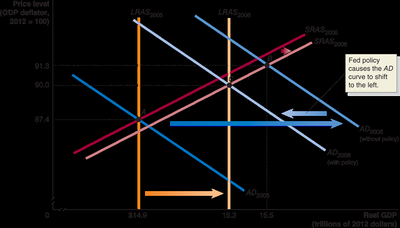
Contractionary monetary policy is used to combat inflation during an economic expansion. The Fed increases the federal funds rate target, raising borrowing costs and reducing spending and investment. This shifts the aggregate demand curve to the left, lowering the price level and bringing real GDP back to potential GDP.
Scenario: Real GDP exceeds potential GDP, price level is rising (inflationary gap).
Fed Action: Increase FFR target or sell Treasuries to decrease money supply.
Result: Aggregate demand shifts left, price level falls, real GDP returns to potential.
Expansionary Monetary Policy
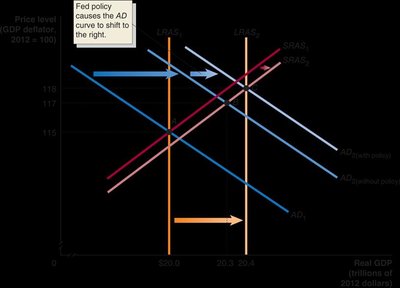
Expansionary monetary policy is used to address high unemployment and recession. The Fed decreases the federal funds rate target, lowering borrowing costs and encouraging spending and investment. This shifts the aggregate demand curve to the right, increasing the price level and real GDP toward potential GDP.
Scenario: Real GDP is below potential GDP, price level is low (recessionary gap).
Fed Action: Decrease FFR target or purchase Treasuries to increase money supply.
Result: Aggregate demand shifts right, price level rises, real GDP returns to potential.
Countercyclical Nature of Monetary Policy
Monetary policy is countercyclical, meaning it acts against the current phase of the business cycle. During expansions (inflation), contractionary policy is used; during recessions (high unemployment), expansionary policy is applied.
Economic Condition | Fed Policy | Action |
|---|---|---|
Inflation (Expansion) | Contractionary | Increase interest rates or reduce money supply |
High Unemployment (Contraction) | Expansionary | Decrease interest rates or increase money supply |
Monetary Policy Transmission Mechanism
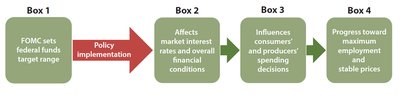
The process by which monetary policy decisions affect the economy involves several steps:
FOMC sets the federal funds target range.
Policy implementation affects market interest rates and financial conditions.
Changes in rates influence consumer and producer spending decisions.
These changes impact progress toward maximum employment and stable prices.
Potential Issues: Poorly Timed Monetary Policy
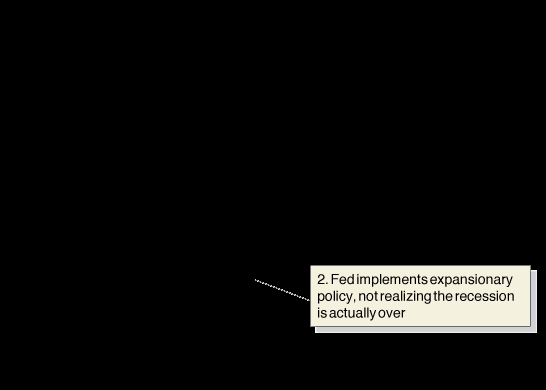
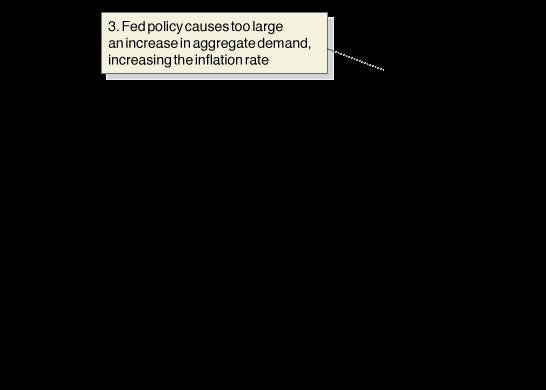
If monetary policy is not well-timed, it can destabilize the economy. For example, implementing expansionary policy after a recession has ended can cause excessive aggregate demand and inflation.
Example: The Fed implements expansionary policy, not realizing the recession is over, leading to higher inflation.
Dynamic AD-AS Analysis of Monetary Policy
The dynamic AD-AS model helps analyze the effects of monetary policy over time. The Fed uses current economic indicators to forecast and adjust policy accordingly.
Recession Scenario: Job growth slows, unemployment rises, household spending falls. The Fed uses expansionary policy to offset unemployment.
Expansion Scenario: Aggregate demand grows too quickly, inventories are low, and inflation is a concern. The Fed uses contractionary policy to offset inflationary pressures.
Can the Fed Eliminate Recessions?
While the Fed cannot eliminate recessions entirely, effective monetary policy can make recessions shorter and milder than they would be without intervention.
Quantitative Easing (QE)
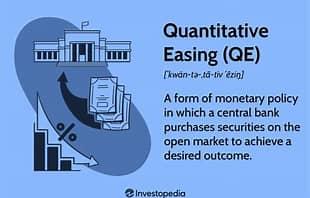
Quantitative easing is a form of monetary policy where the central bank purchases securities on the open market to achieve desired economic outcomes, such as lowering long-term interest rates and stimulating economic activity.
Summary Table: Effects of Monetary Policy
Policy Type | Fed Action | Interest Rates | AD Curve Shift | Economic Outcome |
|---|---|---|---|---|
Expansionary | Buy Treasuries, lower FFR | Decrease | Right | Higher GDP, lower unemployment |
Contractionary | Sell Treasuries, raise FFR | Increase | Left | Lower inflation, stable prices |
Application: Group Project Topics
Students are encouraged to select a narrowly focused macroeconomic topic for group research and presentation. Topics may include the economic impact of climate change, digital currency, housing bubbles, immigration policy, and more. Each group must present quantitative analysis and submit individual written assignments.
Additional info: The notes above expand on the brief points in the slides, providing definitions, context, and examples for each concept. Tables and images are included only where they directly reinforce the explanation.
