Back
BackThe Goods Market in an Open Economy (Chapter 18) – Study Notes
Study Guide - Smart Notes
 Tailored notes based on your materials, expanded with key definitions, examples, and context.
The Goods Market in an Open Economy
Introduction
This chapter explores the determination of equilibrium output in an open economy, emphasizing the roles of both domestic and foreign demand. It extends the closed-economy goods market model to include international trade, exchange rates, and policy implications. Understanding these concepts is crucial for analyzing real-world macroeconomic events, such as global recessions and policy coordination among countries.
18-1 The IS Relation in the Open Economy
Equilibrium in the Open Economy
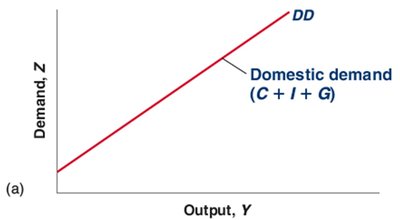
Goods Market Equilibrium: In an open economy, the demand for domestic goods (Z) is given by:
C: Consumption
I: Investment
G: Government spending
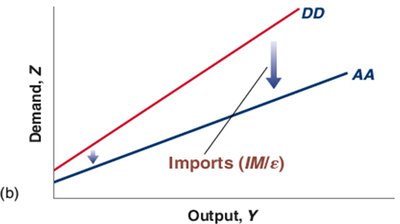
IM: Imports (depend on domestic income and the real exchange rate)
X: Exports (depend on foreign income and the real exchange rate)
Domestic demand is the sum of consumption, investment, and government spending, which can be written as:
Imports: (positively related to domestic income and the real exchange rate)
Exports: (positively related to foreign income, negatively to the real exchange rate)
Net Exports and Trade Balance
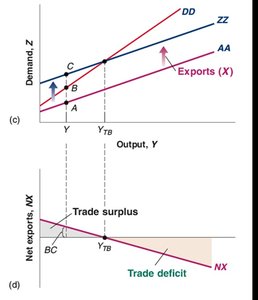
Net Exports (NX):
The trade balance is a decreasing function of output: as output rises, imports increase, worsening the trade balance.

18-2 Equilibrium Output and the Trade Balance
Determination of Equilibrium Output
Equilibrium occurs where output equals demand for domestic goods:
Graphically, equilibrium is at the intersection of the demand curve (ZZ) and the 45-degree line.
At equilibrium, the trade balance may be in deficit or surplus depending on the relative levels of imports and exports.

18-3 Increases in Demand—Domestic or Foreign
Effects of Domestic and Foreign Demand Shocks
Domestic Demand Increase: Raises output but worsens the trade balance (increases deficit).
Foreign Demand Increase: Raises output and improves the trade balance (increases surplus).
Multiplier Effect: The output multiplier is smaller in an open economy because some demand leaks into imports.


Policy Implication: Shocks in one country affect others, making international policy coordination complex.
18-4 Depreciation, the Trade Balance, and Output
Exchange Rate Effects
Real Exchange Rate:
Net Exports:
Depreciation: Increases exports, decreases imports, and raises the relative price of foreign goods.
Marshall-Lerner Condition: A real depreciation improves net exports if the sum of the absolute values of the price elasticities of exports and imports exceeds one.
Policy Mix: To reduce a trade deficit without reducing output, a country must both depreciate its currency and reduce government spending.

Exchange Rate and Fiscal Policy Combinations
Initial Conditions | Trade Surplus | Trade Deficit |
|---|---|---|
Low Output | e unknown, G increases | e decreases, G unknown |
High Output | e increases, G unknown | e unknown, G decreases |
Additional info: This table summarizes the combinations of exchange rate (e) and government spending (G) policies needed to address different macroeconomic situations.
Focus: The G20 and the 2009 Fiscal Stimulus
The G20 coordinated fiscal and monetary responses to the 2008-2009 global financial crisis, highlighting the importance of international cooperation in open economies.
Focus: The Disappearance of Current Account Deficits in Greece
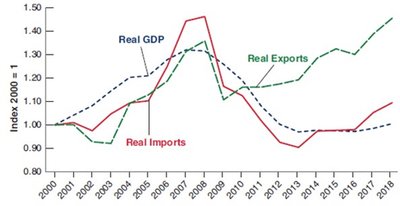
Case Study: Greece (2000–2018)
Greece's current account deficit disappeared after the crisis, but this was due to a sharp decline in imports and output, not a surge in exports.
This example illustrates that eliminating a deficit can come at the cost of lower output and welfare.