 Back
BackThe Influence of Fiscal Policy on Aggregate Demand
Study Guide - Smart Notes
 Tailored notes based on your materials, expanded with key definitions, examples, and context.
The Influence of Fiscal Policy on Aggregate Demand
Overview
This module explores how fiscal policy—government decisions on spending and taxation—affects aggregate demand in both closed and open economies. It also examines the theoretical debate over whether policymakers should use fiscal policy to stabilize the economy, and discusses the mechanisms and limitations of fiscal interventions.
Fiscal Policy and Aggregate Demand
Definition and Direct Effects
Fiscal policy is the setting of the level of government spending and taxation by government policymakers.
Changes in government purchases directly influence aggregate demand: an increase shifts the aggregate-demand curve to the right, while a decrease shifts it to the left.
The Multiplier Effect
The multiplier effect refers to the additional shifts in aggregate demand that result when expansionary fiscal policy increases income and thereby increases consumer spending. When the government spends money, the initial recipients (firms and workers) spend part of their increased income, which becomes income for others, and so on, amplifying the initial impact.
Marginal Propensity to Consume (MPC): The fraction of extra income that a household consumes rather than saves.
Marginal Propensity to Save (MPS): The fraction of extra income that a household saves; MPC + MPS = 1.
The total change in income () from an initial change in government spending () is given by the multiplier ():
For example, if MPC = 0.75, then . An initial $5 billion increase in government spending leads to a $20 billion increase in total income.
Round | Change in Income (ΔY) | Change in Consumption (ΔC = MPC × ΔY) | Change in Saving (ΔS = MPS × ΔY) |
|---|---|---|---|
1 | $5 | $3.75 | $1.25 |
2 | $3.75 | $2.81 | $0.94 |
3 | $2.81 | $2.11 | $0.70 |
... | ... | ... | ... |
Total | $20 | $15 | $5 |
Table: The Multiplier Effect (values in billions)
In an open economy, the marginal propensity to import (MPI)—the fraction of extra income spent on imports—reduces the multiplier:
Higher MPI means a smaller multiplier, as more spending leaks abroad.
The Crowding-Out Effect
The crowding-out effect works in the opposite direction to the multiplier effect. When expansionary fiscal policy raises the interest rate, it reduces investment spending, offsetting some of the increase in aggregate demand.
Increased government spending raises income and demand for money, pushing up interest rates.
Higher interest rates discourage private investment and consumption, reducing the net increase in aggregate demand.
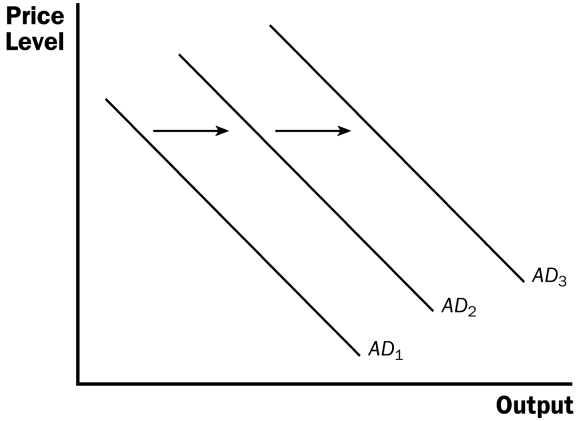
Figure: The crowding-out effect on investment. An initial rightward shift in aggregate demand (from AD1 to AD2) is partially offset by higher interest rates, resulting in a smaller net shift (to AD3).
Crowding-Out Effect on Net Exports
In a small open economy with a flexible exchange rate, expansionary fiscal policy causes the domestic currency to appreciate, making exports more expensive and imports cheaper.
This reduces net exports, further offsetting the impact of fiscal expansion on aggregate demand.
Under a fixed exchange rate, the central bank can offset these effects, allowing fiscal policy to have a larger impact.
Tax Changes and Aggregate Demand
Tax cuts increase households' disposable income, raising consumption and shifting aggregate demand to the right.
The size of the shift depends on the multiplier and crowding-out effects.
Under flexible exchange rates, tax cuts can crowd out net exports similarly to government spending increases.
Automatic Stabilizers
Definition and Mechanisms
Automatic stabilizers are changes in fiscal policy that stimulate aggregate demand automatically when the economy goes into a recession, without deliberate action by policymakers.
Examples include the tax system (taxes fall as incomes fall) and government transfer payments (such as employment insurance and social assistance).
These mechanisms help reduce the severity of economic fluctuations by supporting household income and spending during downturns.
Debate: Should Policymakers Stabilize the Economy?
Arguments For and Against Active Stabilization
For: Keynesian economists argue that active use of fiscal and monetary policy can reduce the costs of recessions and booms (unemployment, inflation, uncertainty).
Against: Critics point to long implementation lags and the risk that policy actions may take effect after economic conditions have changed, potentially destabilizing the economy.
All economists agree that time lags reduce the effectiveness of stabilization policy in the short run.
Key Terms and Concepts
Fiscal policy
Multiplier effect
Crowding-out effect on investment
Crowding-out effect on net exports
Automatic stabilizers
Examples and Applications
Example 1: A $20 billion tax cut with MPC = 0.75 leads to an initial $15 billion increase in aggregate demand, but the total effect (with a multiplier of 4) is $60 billion. A $20 billion increase in government purchases has a larger total effect ($80 billion) because the full amount directly increases demand.
Example 2: If the government wants to shift aggregate demand by $20 billion and MPC = 0.8, the multiplier is 5, so government spending should increase by $4 billion. If there is crowding out, a larger increase is needed.
Example 3: During a recession, tax revenues fall and government spending on transfers rises automatically, helping to stabilize the economy. A strict balanced-budget rule would require tax increases or spending cuts, making the recession worse.
Review Questions
If government spending increases in a closed economy, the effect on aggregate demand is larger if the central bank maintains a fixed interest rate (by increasing money supply) than if it takes no action.
Increased government spending raises the value of the domestic currency, making exports less competitive and imports cheaper, which reduces net exports.
Summary
Fiscal policy can influence aggregate demand and short-run economic fluctuations through government spending and taxation. The effectiveness of fiscal policy depends on the size of the multiplier, the extent of crowding-out effects, and the openness of the economy. Automatic stabilizers play a crucial role in moderating economic cycles, while debates continue over the desirability and effectiveness of active stabilization policies.
