 Back
BackThe Influence of Monetary Policy on Aggregate Demand
Study Guide - Smart Notes
 Tailored notes based on your materials, expanded with key definitions, examples, and context.
The Influence of Monetary Policy on Aggregate Demand
Overview
This module explores how monetary policy impacts aggregate demand in both closed and open economies. It covers the theory of liquidity preference, the mechanisms through which monetary policy affects interest rates and aggregate demand, the role of exchange rate regimes, and the debate over the use of stabilization policy by central banks.
Theory of Liquidity Preference
Interest Rate Determination in the Money Market
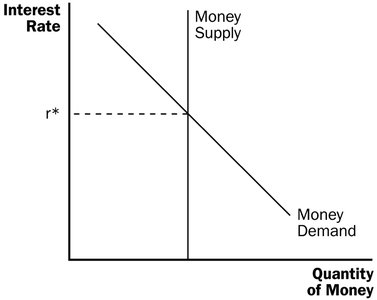
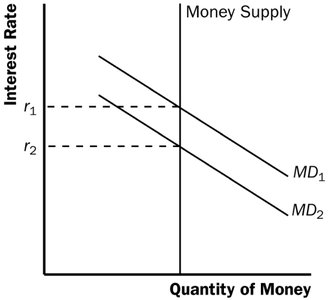
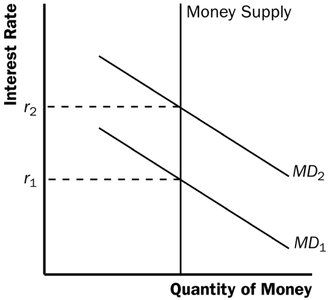
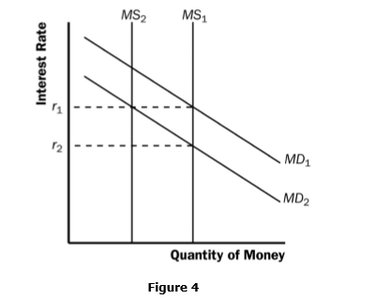
The theory of liquidity preference, developed by Keynes, posits that the interest rate adjusts to balance the supply and demand for money. The central bank (e.g., the Bank of Canada) controls the money supply, which is depicted as a vertical line because it does not depend on the interest rate. The demand for money is downward sloping, reflecting that as the interest rate rises, the quantity of money demanded falls due to the higher opportunity cost of holding money.
Money Supply (MS): Set by the central bank, independent of the interest rate.
Money Demand (MD): Inversely related to the interest rate; higher rates reduce the quantity of money demanded.
Equilibrium Interest Rate (r*): The rate at which money supply equals money demand.
Formula:
where is the money supply and is the money demand as a function of the interest rate .
Shifts in Money Demand and Aggregate Demand
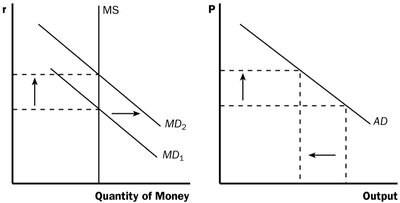
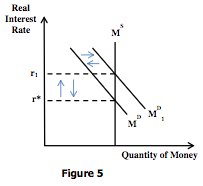
Changes in the price level or real GDP shift the money demand curve. For example, an increase in the price level raises the demand for money, shifting the money demand curve to the right and increasing the equilibrium interest rate. Higher interest rates reduce consumption and investment, causing aggregate demand to fall.
Wealth Effect: Higher prices reduce real wealth, lowering consumption.
Interest Rate Effect: Higher prices increase money demand, raising interest rates and reducing investment.
Exchange Rate Effect: Higher prices make domestic goods more expensive abroad, reducing net exports.
Monetary Policy and Aggregate Demand
Monetary Policy in a Closed Economy
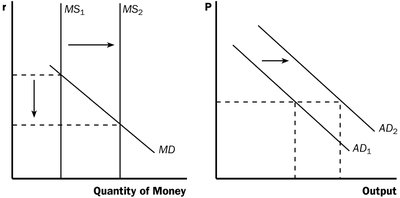
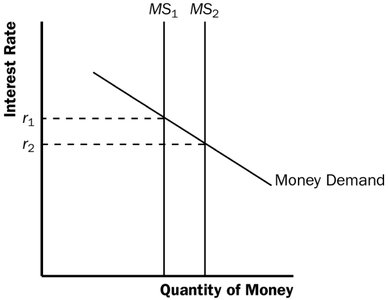
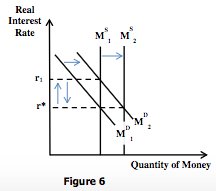
When the central bank increases the money supply (e.g., by buying government bonds), the money supply curve shifts right, lowering the equilibrium interest rate. Lower interest rates stimulate consumption and investment, shifting the aggregate demand curve to the right. However, as demand for goods and services rises, money demand also increases, causing a partial offsetting rise in interest rates.
Expansionary Monetary Policy: Increases money supply, lowers interest rates, raises aggregate demand.
Contractionary Monetary Policy: Decreases money supply, raises interest rates, lowers aggregate demand.
Formula:
where is investment as a function of the interest rate .
Monetary Policy in an Open Economy
The effect of monetary policy depends on the exchange rate regime:
Flexible Exchange Rate: A monetary injection causes the domestic currency to depreciate, boosting net exports and shifting aggregate demand further to the right than in a closed economy.
Fixed Exchange Rate: The central bank must intervene to maintain the exchange rate, which can offset the effects of monetary policy on the money supply and aggregate demand.
Definitions:
Flexible Exchange Rate: The exchange rate is determined by market forces without central bank intervention.
Fixed Exchange Rate: The central bank maintains the exchange rate at a set value by buying or selling currency.
Examples of Monetary Policy Effects
Case Studies in Closed and Open Economies
Open Market Operations: Central bank buys bonds, increasing money supply, lowering interest rates, and shifting aggregate demand right. In an open economy, this also depreciates the currency, further increasing aggregate demand.
Credit Card Availability: Reduces money demand, lowering interest rates and increasing aggregate demand.
Increased Money Holding (e.g., holiday shopping): Raises money demand, increasing interest rates and reducing aggregate demand.
Exchange Rate Policy and Monetary Policy Effectiveness
Flexible vs. Fixed Exchange Rates
Under a flexible exchange rate, monetary policy is more effective in influencing aggregate demand because currency depreciation amplifies the effect. Under a fixed exchange rate, the central bank's interventions to maintain the exchange rate can neutralize the impact of monetary policy on aggregate demand.
Debate: Should Central Banks Stabilize the Economy?
Arguments For and Against Active Stabilization Policy
For: Monetary policy can reduce the costs of economic fluctuations (unemployment, inflation, uncertainty) by stabilizing aggregate demand, especially under flexible exchange rates.
Against: Policy effects are subject to long and variable lags, making it difficult to time interventions correctly. Poor forecasting can lead to destabilizing outcomes.
Flexible Exchange Rate as a Stabilizer
Allowing the exchange rate to fluctuate helps insulate the domestic economy from foreign shocks. For example, if net exports fall due to a foreign recession, the currency depreciates, boosting net exports and stabilizing aggregate demand and output.
Practice Questions and Applications
Sample Multiple Choice
In a closed economy, if the central bank wants to expand aggregate demand, it can increase the money supply, which would decrease the interest rate.
When the Bank of Canada increases the bank rate, commercial banks are discouraged from borrowing, causing the money supply to contract.
In a small open economy, the increase in aggregate demand from a monetary expansion is larger if the exchange rate is flexible than if it is fixed.
Sample Application
More ATMs reduce money demand, lowering interest rates and increasing aggregate demand unless the central bank contracts the money supply to offset this effect.
To reduce aggregate demand by a set amount, the central bank must contract the money supply more in a closed economy than in an open economy with a flexible exchange rate.
Summary
Monetary policy can influence aggregate demand and short-run economic fluctuations. Its effectiveness depends on the openness of the economy and the exchange rate regime. The debate over active stabilization policy centers on the trade-off between reducing economic volatility and the risks of policy lags and misjudgments.
