 Back
BackThe International Financial System: Exchange Rates, Capital Markets, and Historical Systems
Study Guide - Smart Notes
 Tailored notes based on your materials, expanded with key definitions, examples, and context.
The International Financial System
Exchange Rate Systems
Exchange rate systems are frameworks that determine how the value of one currency is established relative to others. These systems influence international trade, investment, and economic stability.
Floating Exchange Rate: The value of a currency is determined by demand and supply in the foreign exchange market, with minimal government intervention.
Managed Float (Current System): Most major currencies float, but governments occasionally intervene to stabilize or influence their currency's value.
Fixed Exchange Rate: Countries agree to maintain their currencies at set values relative to each other, often backed by a commodity like gold.
Pegging: Some countries fix their currency's value to another major currency (e.g., the U.S. dollar).
Example: The gold standard (19th century–1930s) fixed currencies to specific amounts of gold. The Bretton Woods system (1944–1973) fixed currencies to the U.S. dollar, which was convertible to gold.
The Current Exchange Rate System
The modern system is characterized by a mix of floating, managed, and pegged exchange rates. Key features include:
The U.S. dollar floats against other major currencies.
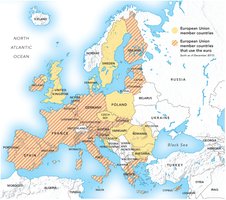
The euro is used by 19 European countries, replacing their national currencies.
Some developing countries peg their currencies to the dollar or another major currency.
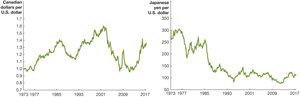
Example: Since 1973, the U.S. dollar has appreciated against the Canadian dollar but depreciated against the Japanese yen.
Determinants of Exchange Rates in the Long Run
Exchange rates are influenced by several factors, especially over the long term:
Relative Price Levels: Higher inflation in one country leads to depreciation of its currency.
Relative Productivity Growth: Countries with faster productivity growth see their currencies appreciate due to increased demand for their goods.
Preferences for Domestic vs. Foreign Goods: Increased demand for a country's exports strengthens its currency.
Tariffs and Quotas: Trade barriers can affect currency demand and exchange rates.
Theory of Purchasing Power Parity (PPP): In the long run, exchange rates should adjust so that identical goods cost the same in different countries, eliminating arbitrage opportunities.
Formula:
where is the exchange rate, is the foreign price level, and is the domestic price level.
Limitations: Not all goods are tradable, consumer preferences differ, and trade barriers exist.
Exchange Rates and Firms
Exchange rate movements impact businesses:
Appreciation: Makes imports cheaper and exports more expensive, benefiting importers but hurting exporters.
Depreciation: Makes exports cheaper and imports more expensive, benefiting exporters but hurting importers.
Risk: Floating rates introduce uncertainty, complicating long-term planning for firms engaged in international trade.
The Euro and the European Monetary Union
The euro was introduced to promote trade and economic stability among European nations. The European Central Bank (ECB) manages monetary policy for the eurozone.
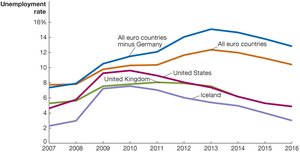
Example: During the 2007–2009 financial crisis, eurozone countries could not devalue their currencies to boost exports, leading to prolonged recessions in some nations.
Pegging and Currency Crises
Pegging can stabilize exchange rates but may lead to crises if the peg becomes unsustainable.
Advantages: Predictability for firms, credibility in fighting inflation.
Disadvantages: Vulnerability to speculative attacks, loss of independent monetary policy, and the need to maintain large reserves.
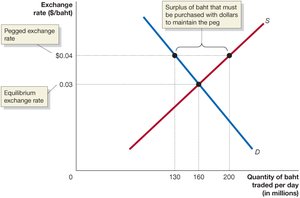
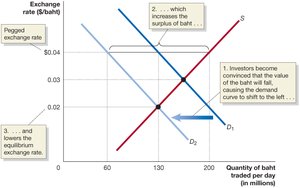
Example: The 1997 Asian financial crisis began when Thailand could no longer maintain its currency peg, leading to a sharp devaluation and economic recession.
The Chinese Yuan: Managed Float and Controversy
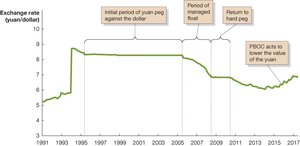
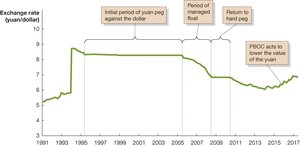
China has managed the yuan's exchange rate, at times pegging it to the dollar and at other times allowing it to float within a controlled range. This policy has been controversial, with critics arguing that an undervalued yuan gives Chinese exporters an unfair advantage.
International Capital Markets
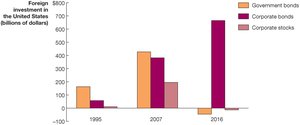
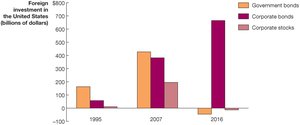
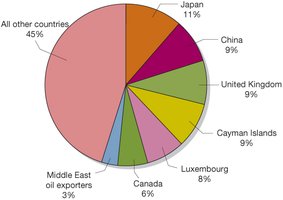
International capital markets have grown rapidly since the 1980s, allowing funds to move more freely across borders. This has increased investment opportunities but also made economies more interconnected and susceptible to global shocks.
Appendix: The Gold Standard and the Bretton Woods System
Historically, exchange rates were fixed under the gold standard and later the Bretton Woods system.
Gold Standard: Currencies were backed by gold, limiting monetary policy flexibility.
Bretton Woods System: Established fixed exchange rates tied to the U.S. dollar, which was convertible to gold. Created the International Monetary Fund (IMF) to oversee the system and provide financial assistance.
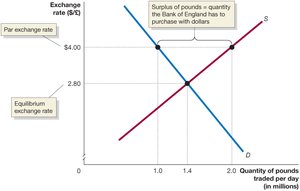
Devaluation: Lowering the fixed exchange rate when a currency is overvalued.
Revaluation: Raising the fixed exchange rate when a currency is undervalued.
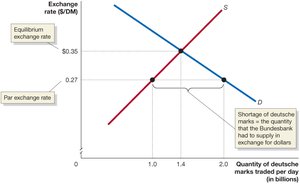
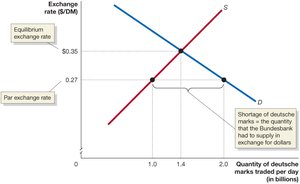
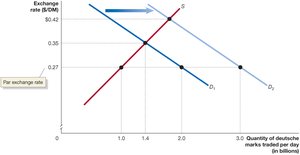
The Bretton Woods system collapsed in the early 1970s as countries moved to floating exchange rates.
Tariffs, GATT, and the WTO
High tariffs in the 1930s led to trade stagnation. The General Agreement on Tariffs and Trade (GATT) and later the World Trade Organization (WTO) reduced tariffs and promoted global trade.
Summary Table: Exchange Rate Systems
System | Description | Advantages | Disadvantages |
|---|---|---|---|
Floating | Market-determined exchange rates | Monetary policy flexibility | Exchange rate volatility |
Managed Float | Mostly floating, with occasional intervention | Balance between stability and flexibility | Potential for market uncertainty |
Fixed/Pegged | Currency value fixed to another currency or commodity | Stability, predictability | Vulnerability to crises, loss of policy autonomy |
Additional info: The notes above expand on the textbook outline by providing definitions, examples, and context for each system and historical event. The included images directly support the explanations of exchange rate movements, currency crises, and the evolution of international financial systems.
