 Back
BackTime Value of Money, Bond and Stock Valuation in Macroeconomics
Study Guide - Smart Notes
 Tailored notes based on your materials, expanded with key definitions, examples, and context.
Firms, the Stock Market, and Corporate Governance
Time Value of Money: Concepts and Importance
The time value of money is a foundational concept in finance and macroeconomics, reflecting the idea that a sum of money has different values at different points in time due to its potential earning capacity. This principle underlies the valuation of bonds, stocks, and other financial instruments.
Present Value (PV): The value today of a future sum of money or stream of cash flows, discounted at a specific interest rate.
Future Value (FV): The amount of money an investment made today will grow to at a specified future date, given a certain interest rate.
Interest Rate: The percentage rate at which money grows over time, also known as the discount rate when calculating present value.
Application: Comparing different financial instruments (e.g., bonds) requires understanding their cash flow timing and amounts.
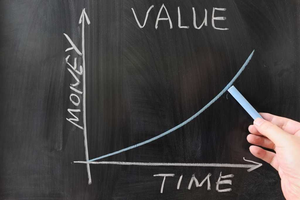
Future Value Calculations
Future value calculations determine how much an investment made today will be worth at a future date, given a specific interest rate and time period.
Formula: The future value of a present sum is calculated as: where PV is the present value, r is the interest rate per period, and n is the number of periods.
Example 1: FV = 100 \times (1 + 0.05)^1 = 105$
Example 2: FV = 500 \times (1 + 0.05)^2 = 500 \times 1.1025 = 551.25$
Example 3: FV = 1,000 \times (1 + 0.07)^3 = 1,000 \times 1.225043 = 1,225.04$
Present Value Calculations
Present value calculations are used to determine how much must be invested today to achieve a desired future sum, given a specific interest rate.
Formula: where FV is the future value, r is the interest rate per period, and n is the number of periods.
Application: Used to compare the value of different cash flow streams, such as contest winnings or investment returns.
Example: Choosing between two contest prizes:
Prize 1: $50,000 now + $50,000 each year for 4 years
Prize 2: $175,000 now
Assuming a 10% interest rate, calculate the present value of each prize to determine the better option.
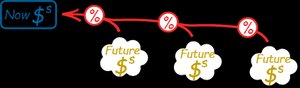
Using Present Value to Calculate Bond Prices
Bonds are debt instruments that pay periodic coupon payments and return the principal at maturity. The price of a bond is the present value of all future cash flows (coupons and principal) discounted at the market interest rate.
Bond Price Formula: where C is the annual coupon payment, F is the face value, r is the interest rate, and n is the number of periods remaining.
Example: A bond with P = \frac{80}{(1 + 0.10)^1} + \frac{80}{(1 + 0.10)^2} + \frac{1,000}{(1 + 0.10)^2}$
Active Learning: Calculate the present value of a bond that pays $50 in coupons for 4 years and $1,000 at the end, with a 6% interest rate.
Using Present Value to Calculate Stock Prices
Stock prices can be estimated using the present value of expected future dividends. For stocks with dividends growing at a constant rate, the Gordon Growth Model (Dividend Discount Model) is used.
Gordon Growth Model Formula: where P_0 is the current stock price, D_1 is the dividend next year, r is the required rate of return, and g is the dividend growth rate.
Example 1: A stock pays a P_0 = \frac{60}{0.07 - 0.04} = \frac{60}{0.03} = 2,000$
Example 2: A stock just paid a D_1 = 6 \times (1 + 0.04) = 6.24P_0 = \frac{6.24}{0.07 - 0.04} = \frac{6.24}{0.03} = 208$
Active Learning: If a company pays a P_0 = \frac{2}{0.04 - 0.03} = 200$
Summary Table: Key Formulas for Time Value of Money
Concept | Formula | Description |
|---|---|---|
Future Value (FV) | Value of present sum after n periods | |
Present Value (PV) | Current value of future sum | |
Bond Price | Present value of coupons and face value | |
Stock Price (Gordon Model) | Present value of growing dividends |
Practice Questions
Suppose you put $500 in your savings account and earn 4% interest per year. How much will you have in your account after two years?
If you borrowed $1,000 from a friend for 3 years at an interest rate of 7%, how much would you pay them back?
How much is a bond that pays $50 in coupon payments for 4 years and $1,000 at the end of the fourth year worth today if the interest rate is 6%?
If a company pays a dividend of $2 to be received one year from now, dividends are expected to grow at a rate of 3 percent per year for the indefinite future, and the interest rate is 4 percent, the price of the company's stock should be ________ per share.
