 Back
BackUnemployment and Inflation: Measurement and Types in Macroeconomics
Study Guide - Smart Notes
 Tailored notes based on your materials, expanded with key definitions, examples, and context.
Unemployment and Inflation
Introduction
Unemployment and inflation are two of the most important macroeconomic indicators used to assess the health of an economy. Understanding how these are measured and what they represent is essential for analyzing economic performance and policy.
Measuring Unemployment
Key Labor Market Indicators
The U.S. Department of Labor, through the Bureau of Labor Statistics (BLS), regularly reports on employment, unemployment, and other labor force statistics. The most watched indicator is the unemployment rate, which is the percentage of the labor force that is unemployed.
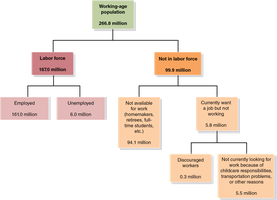
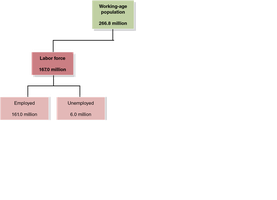
Labor force: The sum of employed and unemployed workers in the economy.
Unemployment rate: The percentage of the labor force that is unemployed.
Labor force participation rate: The percentage of the working-age population in the labor force.
Employment-population ratio: The percentage of the working-age population that is employed.
These statistics are estimated using surveys, primarily the Current Population Survey (household survey).
Classification of Individuals
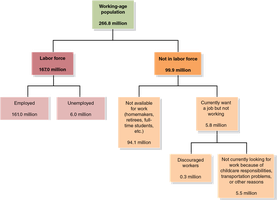
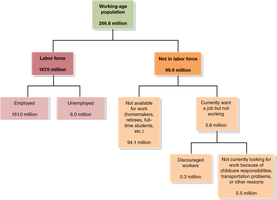
Employed: Individuals currently working or temporarily away from their job.
Unemployed: Individuals not currently at work but available for work and actively seeking employment.
Not in the labor force: Individuals neither employed nor unemployed, including discouraged workers and those not seeking work for other reasons.
Problems with Measuring Unemployment
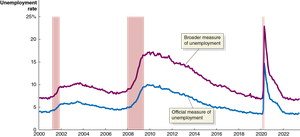
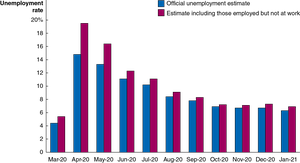
The official unemployment rate may understate or overstate true joblessness:
Understates: Does not count discouraged workers or underemployed individuals.
Overstates: Some may falsely claim to be seeking work or not working for other reasons.
The BLS also reports a broader measure (U-6) that includes discouraged and underemployed workers.
Unemployment Rate Variations
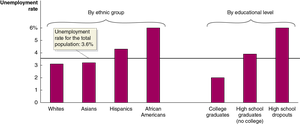
Unemployment rates differ by ethnic group and education level, reflecting structural differences in the labor market.
Duration of Unemployment
Long-term unemployment can have negative effects, such as skill decay and discouragement. The average duration of unemployment fluctuates with economic conditions, rising during recessions.
Labor Force Participation Trends
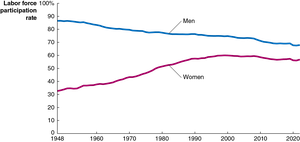
Labor force participation rates have changed over time, with a decline among men and an increase among women since 1948. Recently, participation among women has also declined.
Establishment Survey
The BLS also conducts the establishment (payroll) survey, which samples businesses about their employees. This survey excludes self-employed individuals and newly opened firms, but provides payroll-based data.
Job Creation and Destruction
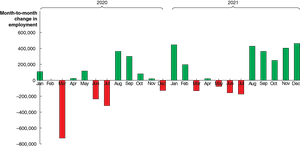
Jobs are constantly created and destroyed in the economy, reflecting its dynamic nature. Net changes in employment do not capture the full extent of job turnover.
Wage Measurement
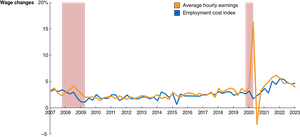
The BLS publishes data on average hourly earnings (AHE) and the employment cost index (ECI), which includes benefits and is adjusted for occupational mix.
Types of Unemployment
Overview
There are three main types of unemployment, each with distinct causes and implications:
Frictional unemployment: Short-term unemployment from the process of matching workers with jobs.
Structural unemployment: Unemployment from a persistent mismatch between worker skills and job requirements.
Cyclical unemployment: Unemployment caused by business cycle recessions.
Frictional Unemployment
Frictional unemployment arises from job search and transitions, including seasonal unemployment. It can increase economic efficiency by allowing better job matches.
Structural Unemployment
Structural unemployment is associated with longer unemployment spells and results from changes in technology or industry. Workers may need retraining to adapt to new job requirements.
Cyclical Unemployment and the Natural Rate
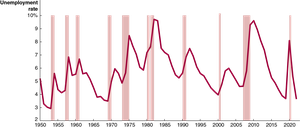
Cyclical unemployment occurs during recessions. When only frictional and structural unemployment exist, the economy is at full employment. The natural rate of unemployment is the sum of frictional and structural unemployment, typically between 4.0% and 5.0% in the U.S.
Technological Change and Structural Unemployment
Advances in technology, such as robotics and AI, can increase structural unemployment by making certain skills obsolete. The "technologically unemployed" may find it harder to secure comparable jobs.

Explaining Unemployment
Government Policies Affecting Unemployment
Governments can influence unemployment through various policies:
Trade Adjustment Assistance: Provides retraining for workers displaced by foreign competition, reducing structural unemployment.
Subsidies for new hires: Reduce frictional unemployment.
Unemployment insurance: May increase unemployment by allowing longer job searches.
Minimum wage laws: Can reduce employment among low-wage workers, especially teenagers, but overall effects are small.
Labor unions: Bargain for higher wages and better conditions, but have limited impact on overall unemployment in the U.S.
Efficiency wages: Firms pay above-market wages to increase productivity, which can lead to higher unemployment as more people seek these jobs than are available.
Key Formulas
Unemployment Rate:
Labor Force Participation Rate:
Employment-Population Ratio:
Summary Table: Types of Unemployment
Type | Cause | Duration | Example |
|---|---|---|---|
Frictional | Job search, transitions | Short-term | Recent graduate seeking first job |
Structural | Mismatch of skills | Long-term | Factory worker displaced by automation |
Cyclical | Business cycle recession | Variable | Worker laid off during economic downturn |
