 Back
BackUnemployment and Inflation: Measurement, Types, and Economic Impact
Study Guide - Smart Notes
 Tailored notes based on your materials, expanded with key definitions, examples, and context.
Unemployment and Inflation
Introduction
Unemployment and inflation are two of the most important macroeconomic indicators used to assess the health of an economy. This chapter explores how these variables are measured, the types of unemployment, the causes and consequences of inflation, and the impact of government policies on labor markets.
Measuring Unemployment and Labor Market Indicators
Key Definitions and Formulas
Unemployment Rate: The percentage of the labor force that is unemployed. Calculated as:
Labor Force Participation Rate: The percentage of the working-age population in the labor force.
Employment-Population Ratio: The percentage of the working-age population that is employed.
The U.S. Bureau of Labor Statistics (BLS) uses monthly household and establishment surveys to collect data for these indicators. The household survey includes both employment and unemployment, while the establishment survey focuses on payroll employment.
Problems with Measuring Unemployment
Discouraged Workers: Individuals who have stopped looking for work are not counted as unemployed.
Underemployment: Part-time workers who prefer full-time jobs are counted as employed.
Survey Limitations: Responses are not verified, and some may misreport their status.
Unemployment Rates for Different Groups
Unemployment rates vary by demographic group, education level, and region.
Minority groups and those without a high school diploma often experience higher unemployment rates.
Trends in Labor Force Participation
Labor force participation among men has declined since 1948, while participation among women has increased.
Overall participation rates fluctuate with economic cycles and demographic changes.
Job Creation and Destruction
Millions of jobs are created and destroyed annually due to technological change, consumer preferences, and entrepreneurial activity.
Employment-Population Ratio as a Labor Market Indicator
The employment-population ratio is often considered a more comprehensive measure of labor market health than the unemployment rate, as it accounts for discouraged workers and those not actively seeking employment.
Types of Unemployment
Frictional Unemployment
Short-term unemployment arising from the process of matching workers with jobs.
Includes job search and seasonal unemployment.
Structural Unemployment
Long-term unemployment caused by a mismatch between workers' skills and job requirements.
Often requires retraining or relocation.
Cyclical Unemployment
Unemployment caused by economic recessions and downturns in the business cycle.
Natural Rate of Unemployment
The sum of frictional and structural unemployment; also called the full-employment rate.
Explaining Unemployment
Government Policies
Policies that aid job search and retraining can reduce frictional and structural unemployment.
Unemployment insurance may increase the time spent searching for jobs but reduces hardship during unemployment.
Minimum wage laws, labor unions, and efficiency wages can increase unemployment if wages are set above market levels.
Measuring Inflation
Key Definitions
Price Level: The average prices of goods and services in the economy.
Inflation Rate: The percentage increase in the price level from one year to the next.
Consumer Price Index (CPI)
Measures the average prices paid by a typical urban family for a fixed market basket of goods and services.
Subject to biases: substitution, quality improvements, new products, and outlet bias.
Producer Price Index (PPI)
Measures average prices received by producers at all stages of production.
Can signal future changes in consumer prices.
Using Price Indexes to Adjust for Inflation
Nominal vs. Real Variables
Nominal variables: Measured in current-year prices.
Real variables: Adjusted for inflation using a price index.
Nominal Interest Rates vs. Real Interest Rates
Definitions and Calculation
Nominal Interest Rate: The stated rate on a loan.
Real Interest Rate: The nominal rate minus the inflation rate.
Implications of Inflation
Anticipated inflation can be incorporated into contracts and interest rates.
Unanticipated inflation causes redistribution of income between borrowers and lenders.
Menu costs arise from the need to frequently change prices.
Does Inflation Impose Costs on the Economy?
Distributional Effects
Inflation redistributes income: some people's incomes rise faster than inflation, others slower.
Unanticipated inflation is particularly problematic for long-term contracts and loans.
Labor Market Trends and Policy Implications
Employment-Population Ratio and Demographic Changes
The employment-population ratio is influenced by demographic shifts, such as the aging of the population and retirement trends. Policy interventions may be needed to increase labor force participation and support economic growth.
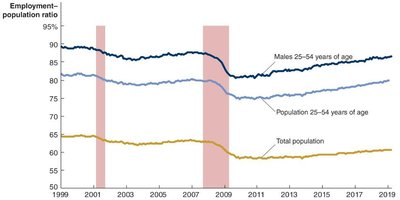
Table: Types of Unemployment
Type | Definition | Duration | Example |
|---|---|---|---|
Frictional | Short-term unemployment from job search | Short | Recent college graduate seeking first job |
Structural | Mismatch between skills and job requirements | Long | Factory worker displaced by automation |
Cyclical | Unemployment due to economic downturn | Variable | Worker laid off during recession |
Table: Calculation of CPI and Inflation Rate
Year | Value of Market Basket | CPI | Inflation Rate |
|---|---|---|---|
1 (Base Year) | $25.25 | 100.0 | — |
2 | $28.40 | 112.5 | 12.5% |
3 | $30.50 | 120.8 | 7.4% |
Table: Unemployment Reasons (2008-2014)
Year | Job Losers (%) | Job Leavers (%) | Reentrants & New Entrants (%) |
|---|---|---|---|
2008 | 53.7 | 10.0 | 36.3 |
2009 | 64.2 | 6.2 | 29.6 |
2010 | 62.4 | 6.0 | 31.6 |
2011 | 60.2 | 7.1 | 34.8 |
2012 | 55.0 | 7.7 | 37.3 |
2013 | 53.0 | 8.1 | 38.9 |
2014 | 50.7 | 8.6 | 40.7 |
Summary
Understanding unemployment and inflation is essential for analyzing macroeconomic conditions and designing effective policy responses. Accurate measurement, awareness of different types of unemployment, and the use of price indexes to adjust for inflation are critical for both economists and policymakers.
