 Back
BackUnemployment and Inflation: Measurement, Types, and Economic Implications
Study Guide - Smart Notes
 Tailored notes based on your materials, expanded with key definitions, examples, and context.
Unemployment and Inflation
Introduction
Unemployment and inflation are two of the most important macroeconomic indicators used to assess the health of an economy. This chapter explores how these variables are measured, the different types of unemployment, the causes and consequences of inflation, and the policy implications for governments and central banks.
Measuring Unemployment
Key Labor Market Indicators
Unemployment Rate: The percentage of the labor force that is unemployed and actively seeking work.
Labor Force Participation Rate: The percentage of the working-age population that is either employed or actively seeking employment.
Employment-Population Ratio: The percentage of the working-age population that is employed.
These indicators are primarily measured using the Current Population Survey (household survey) and the Establishment Survey (payroll survey) conducted by the U.S. Bureau of Labor Statistics (BLS).
Formulas
Unemployment Rate:
Labor Force Participation Rate:
Employment-Population Ratio:
Problems with Measuring Unemployment
Discouraged Workers: Individuals who have stopped looking for work are not counted as unemployed, which can understate the true unemployment rate.
Part-Time Workers: People working part-time for economic reasons are counted as employed, even if they desire full-time work.
Survey Limitations: Self-reported data may be inaccurate due to misreporting or unverified claims.
Trends and Group Differences
Unemployment rates vary by demographic group (e.g., higher for minorities and those without a high school diploma).
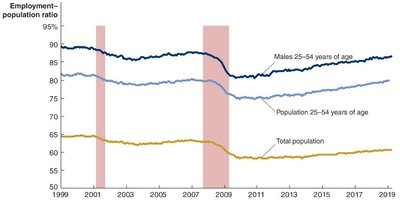
Labor force participation among men has declined since 1948, while participation among women increased sharply until 1999 and then declined slightly.
Job Creation and Destruction
The U.S. economy continuously creates and destroys jobs due to technological change, consumer preferences, and entrepreneurial activity. Net changes in employment reflect the balance of these processes.
Employment-Population Ratio as a Labor Market Indicator
The employment-population ratio is often considered a more comprehensive measure of labor market health than the unemployment rate, as it is less affected by labor force dropouts.
Types of Unemployment
Frictional Unemployment
Frictional unemployment is short-term and arises from the process of matching workers with jobs. It includes people transitioning between jobs or entering the labor force for the first time. Seasonal unemployment is a subset, caused by predictable fluctuations in demand or weather.
Structural Unemployment
Structural unemployment results from a persistent mismatch between workers' skills and job requirements. It often requires retraining or relocation and can last longer than frictional unemployment.
Cyclical Unemployment
Cyclical unemployment is caused by downturns in the business cycle (recessions). It reflects insufficient demand for goods and services in the economy.
Natural Rate of Unemployment
The natural rate of unemployment is the sum of frictional and structural unemployment. It is also called the full-employment rate of unemployment and represents the baseline level of unemployment in a healthy economy.
Explaining Unemployment
Government Policies
Unemployment Insurance: Provides income support but may increase the duration of unemployment by reducing the urgency to find new work.
Minimum Wage Laws: If set above the market equilibrium, can increase unemployment among low-skilled workers.
Labor Unions: Negotiate higher wages for members, but have a limited effect on overall unemployment due to low unionization rates in the private sector.
Efficiency Wages: Firms may pay above-market wages to boost productivity, which can also increase unemployment if not all workers can find such jobs.
Measuring Inflation
Price Level and Inflation Rate
Price Level: A measure of the average prices of goods and services in the economy.
Inflation Rate: The percentage increase in the price level from one year to the next.
Price Indexes
Consumer Price Index (CPI): Measures the average price paid by urban consumers for a fixed basket of goods and services.
Producer Price Index (PPI): Measures average prices received by producers at all stages of production.
GDP Deflator: Measures the price level of all final goods and services included in GDP.
Calculating the CPI
CPI in Year X =
Inflation Rate =
Biases in the CPI
Substitution Bias: Consumers may substitute cheaper goods, but the CPI assumes a fixed basket.
Quality Change Bias: Improvements in product quality may be misinterpreted as price increases.
New Product Bias: New goods are not immediately included in the basket.
Outlet Bias: The rise of discount stores and online shopping may not be fully captured.
Adjusting for Inflation
Nominal vs. Real Variables
Nominal Variable: Measured in current-year dollars (not adjusted for inflation).
Real Variable: Adjusted for inflation, measured in base-year dollars.
To convert a nominal variable to a real variable:
Real Value =
Interest Rates and Inflation
Nominal vs. Real Interest Rates
Nominal Interest Rate: The stated rate on a loan or investment.
Real Interest Rate: The nominal interest rate minus the inflation rate.
Real Interest Rate = Nominal Interest Rate Inflation Rate
A negative real interest rate means that the purchasing power of money lent is declining over time.
Costs of Inflation
Anticipated vs. Unanticipated Inflation
Anticipated Inflation: Can be planned for, but still imposes costs such as menu costs (the cost of changing prices) and shoe-leather costs (the cost of reducing money holdings).
Unanticipated Inflation: Causes arbitrary redistributions of income and wealth, especially between borrowers and lenders, and can distort long-term contracts.
Distributional Effects
Inflation does not reduce the average consumer's purchasing power if incomes rise at the same rate as prices, but it can hurt those on fixed incomes or with contracts not indexed to inflation.
Deflation (falling prices) can increase the real burden of debt and discourage spending.
Labor Market Trends and Policy Implications
Long-Term Trends
Labor force participation and employment-population ratios are influenced by demographic changes, policy, and economic cycles. For example, the aging of the population and increased disability claims have contributed to a lower employment-population ratio in recent years.
Policy Considerations
Policies to increase labor force participation and employment-population ratios can boost GDP and living standards.
Understanding the sources and types of unemployment helps policymakers design effective interventions, such as retraining programs or adjustments to unemployment insurance.
Appendix: Business Cycles and Labor Market Indicators
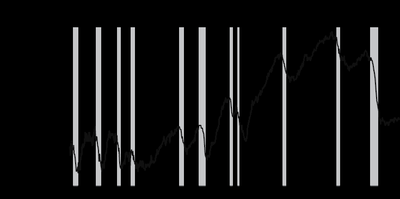
Business cycles—periods of expansion and recession—affect unemployment and employment-population ratios. During recessions, unemployment rises and the employment-population ratio falls. The recovery of these indicators can be slow, as seen after the 2007–2009 recession.
Summary Table: Types of Unemployment
Type | Definition | Duration | Main Cause |
|---|---|---|---|
Frictional | Short-term, matching workers with jobs | Short | Job search, transitions |
Structural | Mismatch between skills and jobs | Long | Technological change, industry shifts |
Cyclical | Due to business cycle downturns | Variable | Recessions |
Key Terms
Consumer Price Index (CPI): Measures average prices paid by urban consumers.
Producer Price Index (PPI): Measures average prices received by producers.
Efficiency Wage: Above-market wage to boost productivity.
Discouraged Workers: Not actively seeking work, not counted as unemployed.
Natural Rate of Unemployment: Frictional plus structural unemployment.
Menu Costs: Costs to firms of changing prices.
Deflation: Decline in the price level.
