 Back
BackUnemployment and Inflation: Measuring and Understanding Inflation
Study Guide - Smart Notes
 Tailored notes based on your materials, expanded with key definitions, examples, and context.
Unemployment and Inflation
Measuring Inflation
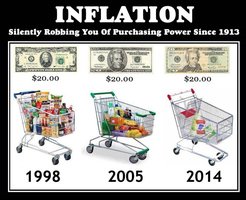
Inflation is a persistent rise in the general price level of goods and services in an economy over time. As prices increase, the purchasing power of money declines, meaning each dollar buys fewer goods and services. The price level is a measure of the average prices in the economy, and the inflation rate is the percentage change in the price level from one year to the next.
Stable prices are crucial for making sound economic decisions about spending and saving.
Inflation erodes the value of money, reducing what can be purchased with a fixed amount of currency.
The Consumer Price Index (CPI)
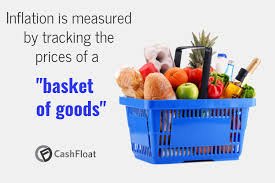
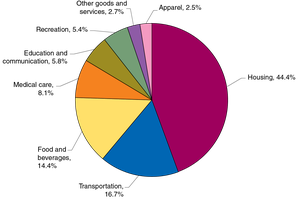
The Consumer Price Index (CPI) is a key measure of inflation, tracking the average price changes paid by urban consumers for a fixed basket of goods and services. The Bureau of Labor Statistics (BLS) surveys 14,000 households to determine the composition of this basket, which includes 211 types of goods and services typically purchased by a family of four.
The CPI is used to monitor changes in the cost of living and to adjust wages and government benefits for inflation.
The CPI basket is periodically updated to reflect changing consumer habits.
Steps to Calculate the CPI
Determine a fixed basket of goods (e.g., 4 hot dogs, 2 hamburgers).
Find the price of each good in each year (e.g., hot dogs and hamburgers in 2001, 2002, 2003).
Calculate the cost of the basket in the base year and the current year.
Compute the CPI:
Calculate the inflation rate:
Is the CPI an Accurate Measure of Inflation?
While the CPI is widely used, it has several limitations that may cause it to overstate true inflation by 0.5 to 1 percentage point per year:
New Product Bias: The basket is updated infrequently, so new products may not be included promptly, and their prices often fall after introduction.
Outlet Bias: The CPI may not fully account for purchases at discount stores or online retailers, though point-of-purchase surveys help reduce this bias.
Increase in Quality Bias: Improvements in product quality can raise prices, but not all of the increase reflects inflation. For example, a computer with better features may cost more, but the higher price is partly due to quality improvements.
Substitution Bias: The CPI assumes consumers buy the same basket each period, ignoring the fact that consumers substitute cheaper goods when prices change.
Example: If the cost of the basket rises from $200 to $300, the CPI is 1.50. If consumers substitute cheaper goods and spend only $250, the true CPI is 1.25, showing the CPI overstates inflation.
Producer Price Index (PPI)
The Producer Price Index (PPI) measures the average prices received by producers for their goods and services at all stages of production. It uses a basket of goods relevant to producers and is an early indicator of future consumer price changes.
Using Price Indexes to Adjust for the Effects of Inflation
Price indexes like the CPI are used to compare the value of money across different time periods. This allows us to adjust salaries, prices, or other monetary values for inflation, making meaningful comparisons over time.
Formula for Adjusting for Inflation:
Example: Comparing the earnings of athletes in different eras or adjusting a 1984 salary to its 2015 equivalent using the CPI.


Nominal Interest Rates versus Real Interest Rates
The nominal interest rate is the stated rate on a loan or investment, while the real interest rate adjusts for inflation, reflecting the true increase in purchasing power.
Formula:
Example: If you lend $1,000 at 4% interest and inflation is 2%, your real interest rate is 2%.
Does Inflation Impose Costs on the Economy?
Inflation can have various effects on the economy, depending on whether it is anticipated or unanticipated:
Anticipated Inflation: Allows consumers, workers, and firms to prepare, but still causes costs such as:
Redistribution of income (some incomes lag behind inflation)
Loss of value for cash holdings
Menu costs (the cost to firms of changing prices)
Tax distortions (taxes are levied on nominal, not real, returns)
Unanticipated Inflation: Creates uncertainty, making borrowing and lending riskier. Lenders may receive lower real returns if inflation is higher than expected.
People on fixed incomes (e.g., retirees) are especially vulnerable, as their purchasing power declines with inflation.
Additional info: Menu costs can include expenses such as printing new menus, updating price lists, or re-tagging merchandise. Tax distortions occur because capital gains and interest income are taxed on nominal, not inflation-adjusted, amounts.
