 Back
BackArthritis: Medical Terminology, Pathology, and Clinical Management
Study Guide - Smart Notes
 Tailored notes based on your materials, expanded with key definitions, examples, and context.
Arthritis
Overview of Arthritis
Arthritis is a general term for inflammation of the joints, resulting in pain, stiffness, and reduced mobility. There are two main types: Osteoarthritis and Rheumatoid Arthritis. Understanding the differences between these types is essential for medical terminology and clinical practice.
Osteoarthritis: Degenerative joint disease characterized by the breakdown of cartilage.
Rheumatoid Arthritis: Autoimmune disorder causing chronic inflammation of joints.
Comparison of Osteoarthritis and Rheumatoid Arthritis
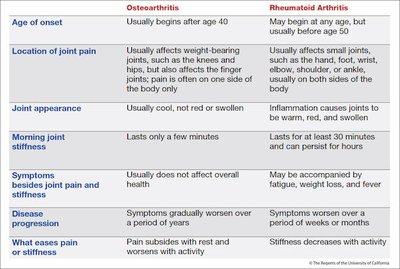
The following table summarizes key differences between osteoarthritis and rheumatoid arthritis:
Feature | Osteoarthritis | Rheumatoid Arthritis |
|---|---|---|
Age of onset | Usually begins after age 40 | May begin at any age, but usually before age 50 |
Location of joint pain | Weight-bearing joints (knees, hips), also fingers; often one side | Small joints (hands, feet), also shoulders, ankles; usually both sides |
Joint appearance | Usually cool, not red or swollen | Inflammation causes joints to be warm, red, and swollen |
Morning joint stiffness | Lasts only a few minutes | Lasts at least 30 minutes and can persist for hours |
Symptoms besides joint pain and stiffness | Usually does not affect overall health | May be accompanied by fatigue, weight loss, and fever |
Disease progression | Symptoms gradually worsen over years | Symptoms worsen over a period of weeks or months |
What eases pain or stiffness | Pain subsides with rest and worsens with activity | Stiffness decreases with activity |
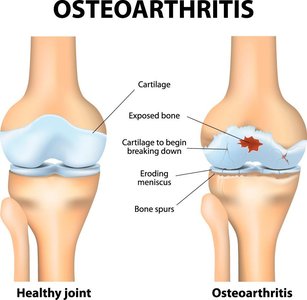
Osteoarthritis
Pathophysiology of Osteoarthritis
Osteoarthritis is characterized by the erosion of the smooth cartilage at the ends of bones, leading to direct bone-on-bone contact. This results in pain, restricted movement, and often affects the hands, spine, knees, and hips.
Cartilage breakdown: The protective cartilage deteriorates, exposing bone surfaces.
Bone contact: Bones rub against each other, causing pain and stiffness.
Joint changes: Extra bone growths (bone spurs) may develop, increasing friction and inflammation.
Movement impact: Symptoms worsen with activity and improve with rest.
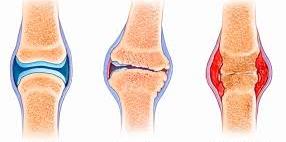
Joint Changes in Arthritis
In arthritis, several pathological changes occur at the joint:
Synovial fluid dries up: Reducing lubrication and increasing friction.
Erosion of cartilage: Loss of protective tissue leads to pain.
Stiffness: Reduced mobility due to joint changes.
Bone ends rub: Direct contact causes further damage.
Extra bone growths: Bone spurs develop, worsening symptoms.
Inflammation: Swelling and redness may occur.
Risk Factors for Developing Arthritis
Several factors increase the risk of developing arthritis, particularly osteoarthritis:
Joint injury: Overuse or insufficient healing after injury or surgery.
Secondary arthritis: Occurs in joints damaged by other conditions (e.g., rheumatoid arthritis, gout).
Age: Risk increases with age.
Family history: Genetic predisposition, though no single gene identified.
Obesity: Excess weight strains weight-bearing joints.
Excessive exercise: Overuse can damage joints.
Gender: Women are at higher risk, possibly due to oestrogen.
Treating Arthritis
Management of arthritis involves a combination of lifestyle changes, medication, supportive treatments, and assistive devices.
Lifestyle changes: Regular exercise, weight loss, suitable footwear, and devices to reduce joint strain.
Medication: Painkillers, anti-inflammatory drugs, opioids (e.g., codeine), capsaicin creams, and joint replacement surgery.
Supportive treatment: Hot/cold packs, physiotherapy, occupational therapy.
Assistive devices: Nutritional supplements, podiatry, appropriate footwear.
Impact of Arthritis on Life
Arthritis can significantly affect daily life and independence:
Pain: Limits activity, may lead to weight gain and further joint strain.
Sleep: Pain can reduce sleep quality and affect emotional well-being.
Mobility: Difficulty moving, lifting, and participating in hobbies or recreational activities.
Dexterity: Loss of fine motor skills affects activities like sewing or model making.
Independence: Challenges with washing, cooking, shopping, and employment.
Rheumatoid Arthritis
Pathophysiology of Rheumatoid Arthritis
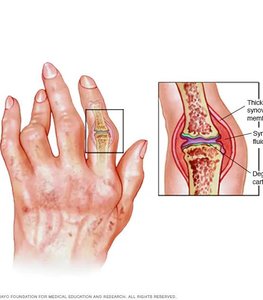
Rheumatoid arthritis is an autoimmune disease where the immune system attacks the synovial membrane, causing chronic inflammation, pain, and joint destruction.
Immune response: The body mistakenly targets joint tissues.
Inflammation: Joints become warm, red, and swollen.
Systemic symptoms: May include fatigue, fever, and weight loss.
Progression: Symptoms worsen over weeks or months and can affect multiple joints symmetrically.
Treatments for Rheumatoid Arthritis
Treatment aims to reduce inflammation, manage pain, and preserve joint function:
Anti-rheumatic drugs: Slow disease progression.
Biological treatments: Injections that block immune system chemicals.
Painkillers and anti-inflammatory drugs: Manage symptoms.
Joint replacement: For severe cases.
Physiotherapy and occupational therapy: Improve mobility and function.
Podiatry and nutritional supplements: Support overall health.
Summary Table: Joint Changes in Arthritis
Healthy Joint | Osteoarthritis Joint |
|---|---|
Cartilage intact, smooth movement | Cartilage eroded, exposed bone, bone spurs |
Synovial fluid present | Synovial fluid reduced, increased friction |
No inflammation | Inflammation and pain |
Key Medical Terminology
Cartilage: Flexible connective tissue at the ends of bones.
Synovial fluid: Lubricating fluid within the joint capsule.
Bone spurs: Extra bone growths at the joint margins.
Meniscus: Cartilage pad in the knee joint.
Autoimmune: Immune system attacks the body's own tissues.
Relevant Equations and Concepts
Joint Force and Weight-Bearing
The force exerted on a joint can be estimated by: where F is force, m is mass, and g is acceleration due to gravity. Additional info: Increased body weight (obesity) raises the force on weight-bearing joints, contributing to osteoarthritis risk.
