 Back
BackBlood and the Lymphatic and Immune Systems: Medical Terminology Study Guide
Study Guide - Smart Notes
 Tailored notes based on your materials, expanded with key definitions, examples, and context.
Blood: Functions and Overview
Functions of Blood
Blood is a vital fluid that performs several essential functions in the human body, including transportation, protection, and clotting. It circulates through the vascular system, delivering nutrients and oxygen, removing waste, and defending against pathogens.
Transport: Blood carries substances such as oxygen, carbon dioxide, nutrients, and waste products throughout the body. These substances are either attached to red blood cells or dissolved in plasma.
Protection: White blood cells (leukocytes) fight infection and disease.
Clotting: Platelets initiate the blood clotting process to prevent excessive bleeding.
Components of Blood
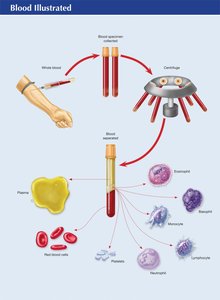
Blood consists of formed elements (cells) and plasma, each with distinct roles.
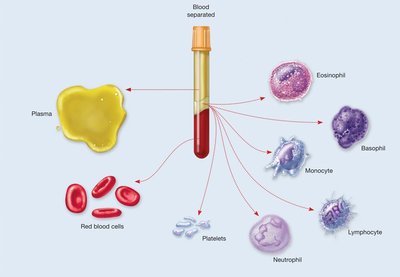
Formed Elements: Erythrocytes (red blood cells), platelets (thrombocytes), and leukocytes (white blood cells).
Plasma: The liquid portion of blood, making up about 55% of its volume.
Anatomy and Physiology of Blood
Blood Volume and Circulation
The average adult has approximately five liters of blood, which circulates continuously through the body within blood vessels.
Production: Blood cells are produced in the red bone marrow through a process called hematopoiesis.
Mixture: Blood is a mixture of cells floating in plasma.

Plasma
Plasma is the fluid portion of blood, comprising about 55% of whole blood. It is primarily water, with dissolved proteins and other substances.
Water Content: Plasma is 90–92% water.
Dissolved Substances: Includes plasma proteins (albumin, globulin, fibrinogen), electrolytes (calcium, potassium, sodium), glucose, amino acids, fats, urea, and creatinine.
Plasma Proteins:
Albumin: Transports fatty substances.
Globulin: Gamma globulins act as antibodies.
Fibrinogen: Essential for blood clotting.
Blood Cells (Formed Elements)
Red Blood Cells (Erythrocytes)
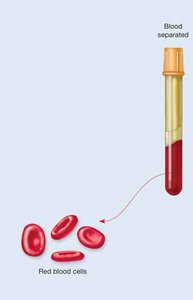
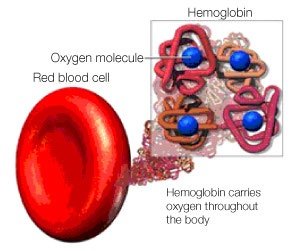
Red blood cells are specialized for oxygen transport and are the most numerous blood cells.
Structure: Enucleated (no nucleus), biconcave disk shape.
Count: Approximately 5 million per cubic millimeter; adults have about 35 trillion, with more in males.
Hemoglobin: The protein responsible for oxygen transport and the red color of blood.
Life Span: 120 days; old cells are removed by the spleen, and bilirubin is produced as a waste product.
White Blood Cells (Leukocytes)
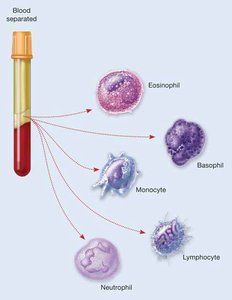
Leukocytes are responsible for immune defense and are subdivided based on the presence of granules in their cytoplasm.
Structure: Spherical shape with a large nucleus.
Count: About 8,000 per cubic millimeter.
Categories:
Granulocytes: Contain granules in cytoplasm.
Basophils: Release histamine and heparin to damaged tissue.
Eosinophils: Destroy parasites and increase during allergic reactions.
Neutrophils: Important for phagocytosis.
Agranulocytes: No granules in cytoplasm.
Monocytes: Important for phagocytosis.
Lymphocytes: Provide protection through immunity.
Platelets (Thrombocytes)
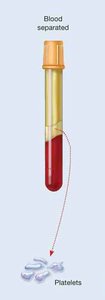
Platelets are small fragments of cells essential for blood clotting.
Structure: Plate-like fragments of larger cells.
Count: 200,000–300,000 per cubic millimeter.
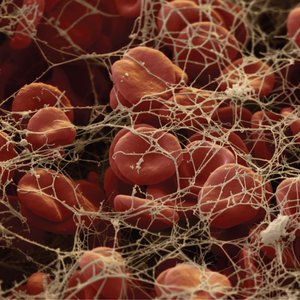
Function: Critical in blood clotting (hemostasis); agglutinate into clusters when blood vessel is damaged, leading to formation of thrombin, which converts fibrinogen to fibrin, resulting in a mesh-like blood clot.
Blood Typing and Compatibility
Blood Typing
Blood typing is essential before transfusions to ensure compatibility. It is based on the presence of marker proteins (antigens) on the surface of erythrocytes.
ABO System: Two possible markers, A and B.
Type A: Has A marker, produces anti-B antibodies.
Type B: Has B marker, produces anti-A antibodies.
Type AB: Has both markers, produces no antibodies (universal recipient).
Type O: Has no markers, produces both anti-A and anti-B antibodies (universal donor).
Rh Factor:
Rh-positive (Rh+): Has Rh factor, will not make anti-Rh antibodies.
Rh-negative (Rh–): Lacks Rh factor, will produce anti-Rh antibodies.
Transfusion Rules: Rh+ can receive Rh+ or Rh– blood; Rh– can receive only Rh– blood.
Medical Terminology: Blood Combining Forms
Key Combining Forms and Definitions
agglutin/o: Clumping (e.g., agglutination)
bas/o: Base (e.g., basophil)
coagul/o: Clotting (e.g., coagulation)
cyt/o: Cell (e.g., cytoplasm)
erythr/o: Red (e.g., erythrocyte)
fibrin/o: Fibers, fibrous (e.g., fibrinolytics)
granul/o: Granules (e.g., granuloma)
hem/o, hemat/o: Blood (e.g., hemodynamics, hematocrit)
leuk/o: White (e.g., leukopenia)
lymph/o: Lymph (e.g., lymphoma)
neutr/o: Neutral (e.g., neutrophil)
phag/o: Eat, swallow (e.g., dysphagia)
septic/o: Infection (e.g., septicemia)
thromb/o: Clot (e.g., thrombolytic)
Blood Pathology and Disorders
General Blood Pathology
hematoma: Collection of blood under skin due to damaged blood vessels.
hemorrhage: Rapid flow of blood.
hemophilia: Genetic disorder; blood fails to clot due to lack of one clotting factor.
hyperlipidemia: Excessive level of lipids in the bloodstream; risk factor for atherosclerosis.
pancytopenia: Too few of all blood cells.
septicemia: Bacteria or toxins in the bloodstream; also called blood poisoning.
Erythrocyte Pathology
anemia: Reduction in number of RBCs or hemoglobin; results in less oxygen reaching tissues.
aplastic anemia: Severe anemia; red bone marrow stops making sufficient blood cells; may require bone marrow transplant.
erythrocytosis: Too many RBCs.
erythropenia: Too few RBCs.
Anatomical Terms Related to Blood
Key Terms and Definitions
agranulocyte: White blood cell without granules.
basophil: WBC that attracts a basic pH stain.
eosinophil: WBC that attracts a rosy red stain.
erythrocyte: Red blood cell.
fibrinous: Pertaining to having fibers.
granulocyte: White blood cell with granules.
hematic: Pertaining to blood.
leukocyte: White blood cell.
lymphocyte: WBC formed in lymphatic tissue.
monocyte: WBC with single large nucleus.
neutrophil: WBC that attracts neutral pH stain.
thrombocyte: Clotting cell, platelets.
sanguinous: Pertaining to blood.
Summary Table: Blood Components and Functions
Component | Main Function | Key Features |
|---|---|---|
Plasma | Transport, clotting, immunity | 90–92% water, proteins, electrolytes |
Erythrocytes | Oxygen transport | Biconcave, no nucleus, hemoglobin |
Leukocytes | Immune defense | Granulocytes & agranulocytes |
Platelets | Clotting | Cell fragments, hemostasis |
Summary Table: Blood Typing Compatibility
Blood Type | Antigens | Antibodies | Can Receive From | Can Donate To |
|---|---|---|---|---|
A | A | Anti-B | A, O | A, AB |
B | B | Anti-A | B, O | B, AB |
AB | A, B | None | A, B, AB, O | AB |
O | None | Anti-A, Anti-B | O | A, B, AB, O |
Key Equations and Formulas
Hematocrit Calculation
The hematocrit is the ratio of the volume of red blood cells to the total volume of blood.
Blood Volume Estimation
Blood volume can be estimated based on body weight.
Example: Sickle Cell Anemia
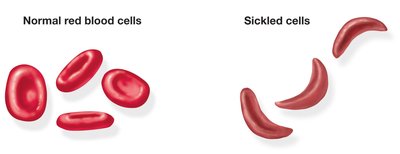
Sickle cell anemia is a genetic disorder characterized by abnormal, sickle-shaped erythrocytes, which can lead to blockages in blood vessels and reduced oxygen delivery.
