 Back
BackBody Organization and Medical Care: Medical Terminology Chapter 2 Study Notes
Study Guide - Smart Notes
 Tailored notes based on your materials, expanded with key definitions, examples, and context.
Body Organization
Overview of Body Organization
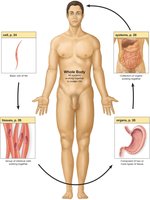
The human body is organized into hierarchical levels, each building upon the previous. Understanding these levels is fundamental to medical terminology and the study of anatomy and physiology.
Cell: The basic unit of life, capable of performing all vital functions.
Tissue: Groups of similar cells working together to perform a specific function.
Organ: Structures composed of multiple tissue types working together for a common purpose.
System: Groups of organs that perform complex functions for the body.
Body: The complete living organism.
Combining Forms in Body Organization
Medical terms often use combining forms to describe body structures and functions. Mastery of these forms is essential for building and interpreting medical vocabulary.
Cyt/o: Cell (e.g., cytology – study of cells)
Hist/o: Tissue (e.g., histology – study of tissues)
Organ/o: Organ
System/o: System
Levels of Body Organization
Cells
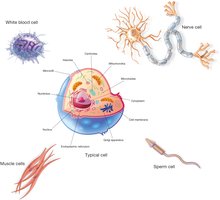
Cells are the fundamental units of life, responsible for all vital processes. They contain three main structures: the cell membrane, nucleus, and cytoplasm.
Cell Membrane: Encloses the cell, controlling entry and exit of substances.
Nucleus: Contains genetic material (chromosomes made of DNA).
Cytoplasm: Gel-like substance where cellular activities occur.
Somatic Cells: Body cells with 46 chromosomes.
Gametes: Reproductive cells (sperm and ova) with 23 chromosomes.
Stem Cells: Undifferentiated cells capable of becoming any cell type.
Tissues
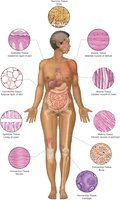
Tissues are groups of similar cells performing a common function. There are four primary tissue types:
Muscle Tissue: Produces movement by contracting. Types: skeletal (attached to bone), smooth (in organs), cardiac (in heart).
Epithelial Tissue: Covers body surfaces and lines organs. Functions: protection, absorption, secretion, excretion.
Connective Tissue: Supports and protects the body. Types include adipose (fat), bone, cartilage, tendons.
Nervous Tissue: Composed of neurons; transmits electrical impulses throughout the body.
Organs and Systems
Organs are structures made of multiple tissue types working together. Organ systems are groups of organs performing related functions. Each system has specialized organs and medical specialties associated with it.
Integumentary System: Skin, hair, nails; dermatology.
Musculoskeletal System: Bones, joints, muscles; orthopedics.
Cardiovascular System: Heart, arteries, veins; cardiology.
Blood (Hematic) System: Plasma, erythrocytes, leukocytes, platelets; hematology.
Lymphatic System: Lymph nodes, vessels, spleen, thymus, tonsils; immunology.
Respiratory System: Nasal cavity, pharynx, larynx, trachea, bronchial tubes, lungs; pulmonology, otorhinolaryngology.
Gastrointestinal System: Oral cavity, pharynx, esophagus, stomach, intestines, liver, gallbladder, pancreas, salivary glands; gastroenterology, proctology.
Urinary System: Kidneys, ureters, bladder, urethra; nephrology, urology.
Female Reproductive System: Ovaries, fallopian tubes, uterus, vagina, vulva, breasts; gynecology, obstetrics.
Male Reproductive System: Testes, epididymis, vas deferens, penis, seminal vesicles, prostate, bulbourethral gland; urology.
Endocrine System: Pituitary, pineal, thyroid, parathyroid, thymus, adrenal, pancreas, ovaries, testes; endocrinology.
Nervous System: Brain, spinal cord, nerves; neurology, neurosurgery.
Special Senses: Eyes (ophthalmology), ears (otorhinolaryngology).
Anatomical Position and Body Planes
Anatomical Position
The anatomical position is the standard reference for describing body locations and directions. The person stands erect, faces forward, arms at sides with palms forward, and feet parallel.
Body Planes
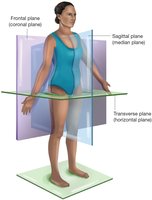
Body planes are imaginary lines used to divide the body for anatomical study and medical reference.
Sagittal (Median) Plane: Divides the body into left and right portions.
Frontal (Coronal) Plane: Divides the body into anterior (front) and posterior (back) portions.
Transverse (Horizontal) Plane: Divides the body into superior (upper) and inferior (lower) portions.
Body Sections
Cross-section: Perpendicular slice to the long axis of a structure.
Longitudinal section: Lengthwise slice along the long axis of a structure.
Body Regions and Cavities
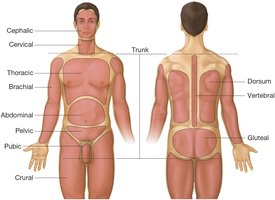
Body Regions
The body is divided into regions for easier identification and reference in medical contexts.
Cephalic: Head
Cervical: Neck
Thoracic: Chest
Brachial: Arms
Abdominal: Abdomen
Pelvic: Pelvis
Pubic: Genital region
Crural: Legs
Dorsum: Back
Gluteal: Buttocks
Vertebral: Spinal column
Trunk: Torso (excluding head, neck, extremities)
Body Cavities
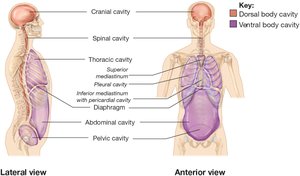
The body contains open spaces called cavities, which house and protect internal organs.
Dorsal Cavities: Cranial (brain) and spinal (spinal cord)
Ventral Cavities: Thoracic (lungs, mediastinum) and abdominopelvic (digestive, excretory, reproductive organs)
Thoracic Cavity: Contains pleural (lungs) and pericardial (heart) cavities
Abdominopelvic Cavity: Divided into abdominal (upper) and pelvic (lower) cavities
Viscera: Organs within the ventral cavities, surrounded by double-layered sacs (pleura in thoracic, peritoneum in abdominopelvic)
Anatomical and Clinical Divisions of the Abdomen
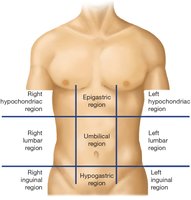
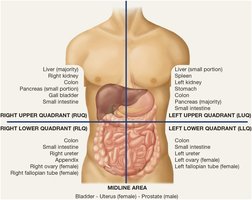
The abdomen is divided for descriptive and diagnostic purposes:
Anatomical Divisions: Nine regions (e.g., right hypochondriac, epigastric, umbilical, left lumbar, etc.)
Clinical Divisions: Four quadrants (RUQ, LUQ, RLQ, LLQ), each containing specific organs.
Directional Terms
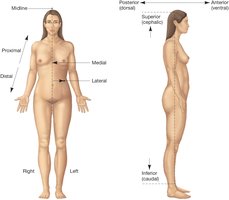
Standard Directional Terms
Directional terms are used to describe the location of structures or the position of the body relative to other parts.
Superior (Cephalic): Toward the head or above another structure
Inferior (Caudal): Toward the feet or below another structure
Anterior (Ventral): Toward the front or belly side
Posterior (Dorsal): Toward the back or spinal side
Medial: Toward the midline
Lateral: Toward the side
Proximal: Nearer to the point of attachment
Distal: Farther from the point of attachment
Apex: Tip or summit of an organ
Base: Bottom or lower part of an organ
Superficial: Toward the surface
Deep: Further from the surface
Body Positions
Supine: Lying horizontally facing upward
Prone: Lying horizontally facing downward


Medical Care Terminology
Pathology and Disease
Medical care terminology includes terms for disease processes and their study.
Pathology (Path): Study of disease
Etiology: Cause of a disease
Pathogenesis: How a disease develops
Disease, Disorder, and Syndrome
Disease: Abnormal and harmful functioning of body systems
Disorder: Irregularity in normal functioning, often used interchangeably with disease
Syndrome: Group of signs and symptoms occurring together
Signs: Objective evidence of abnormalities
Symptoms: Subjective experiences felt only by the patient
Diagnosis, Prognosis, and Treatment
Diagnosis: Identification of a disease, often using laboratory tests or imaging
Prognosis: Expected course and outcome of a disease
Therapeutic Procedures: Treatments to manage or cure disease
Summary Table: Major Organ Systems and Specialties
System | Main Organs | Medical Specialty |
|---|---|---|
Integumentary | Skin, hair, nails | Dermatology |
Musculoskeletal | Bones, joints, muscles | Orthopedics |
Cardiovascular | Heart, arteries, veins | Cardiology |
Blood (Hematic) | Plasma, erythrocytes, leukocytes, platelets | Hematology |
Lymphatic | Lymph nodes, vessels, spleen, thymus, tonsils | Immunology |
Respiratory | Nasal cavity, pharynx, larynx, trachea, bronchial tubes, lungs | Pulmonology, Otorhinolaryngology |
Gastrointestinal | Oral cavity, pharynx, esophagus, stomach, intestines, liver, gallbladder, pancreas, salivary glands | Gastroenterology, Proctology |
Urinary | Kidneys, ureters, bladder, urethra | Nephrology, Urology |
Female Reproductive | Ovaries, fallopian tubes, uterus, vagina, vulva, breasts | Gynecology, Obstetrics |
Male Reproductive | Testes, epididymis, vas deferens, penis, seminal vesicles, prostate, bulbourethral gland | Urology |
Endocrine | Pituitary, pineal, thyroid, parathyroid, thymus, adrenal, pancreas, ovaries, testes | Endocrinology |
Nervous | Brain, spinal cord, nerves | Neurology, Neurosurgery |
Special Senses | Eyes, ears | Ophthalmology, Otorhinolaryngology |
